Can Changing Transmission Fluid Cause Problems?
Yes. Changing transmission fluid can cause problems if the transmission already has worn clutches, blocked passages, the wrong fluid was used, or the service is done incorrectly. In many cases, though, fresh fluid is the lower-risk choice. A bad service can trigger slip, shudder, or a no-move condition, while stale fluid keeps heat and debris working against the parts. This guide explains when a fluid change can expose existing wear, when the service itself causes trouble, and when skipping it is the bigger risk.
Transmission fluid decision table
| mileage band | service history | symptoms | fluid appearance | transmission type | recommended action | risk level |
|---|---|---|---|---|---|---|
| under 60,000 miles | documented service, correct fluid known | no slip, no shudder, normal engagement | clear to light amber | standard automatic | Follow the owner’s manual and maintenance schedule; service on interval if due. | low |
| 60,000-120,000 miles | some records, interval not fully clear | minor delay, light rough shift, no slipping | slightly dark but not burnt | standard automatic | Start with a drain-and-fill and inspect the filter if the vehicle calls for pan service. | moderate |
| 120,000-150,000 miles | mixed or partial history | rough shifts, occasional flare, no severe slip | dark fluid, no strong burnt smell | standard automatic | Get a pre-service inspection first; if service is still appropriate, choose a partial service before a flush. | moderate to high |
| 150,000+ miles | unknown or never changed | already slipping, harsh engagement, delayed drive or reverse | dark-brown or black, possibly burnt | high-mileage neglected unit | Do not assume a fluid change will help; diagnose wear first, then decide whether any service is safe. | high |
| any mileage | unknown fluid spec | normal or abnormal | any | CVT | Use only the exact specified CVT fluid; avoid a power flush unless the manufacturer allows it. | high if wrong fluid is used |
| any mileage after heavy towing | severe-duty use | heat, shudder, delayed shifts | darkening or burnt odor | automatic or CVT | Shorten the interval and inspect for heat damage before service. | moderate to high |
| any mileage | first service after long neglect | already slipping | burnt or black | standard automatic | Avoid assuming the fluid caused the fault; worn clutches may already be near failure. | high |
Can changing transmission fluid cause problems?
Yes, but the cause matters. A fluid change can create trouble if the transmission already has worn clutches, the wrong fluid goes in, or the service disturbs debris that was masking an existing problem. It can also reveal wear that was already there and likely to show up soon anyway.
What a fluid change can expose
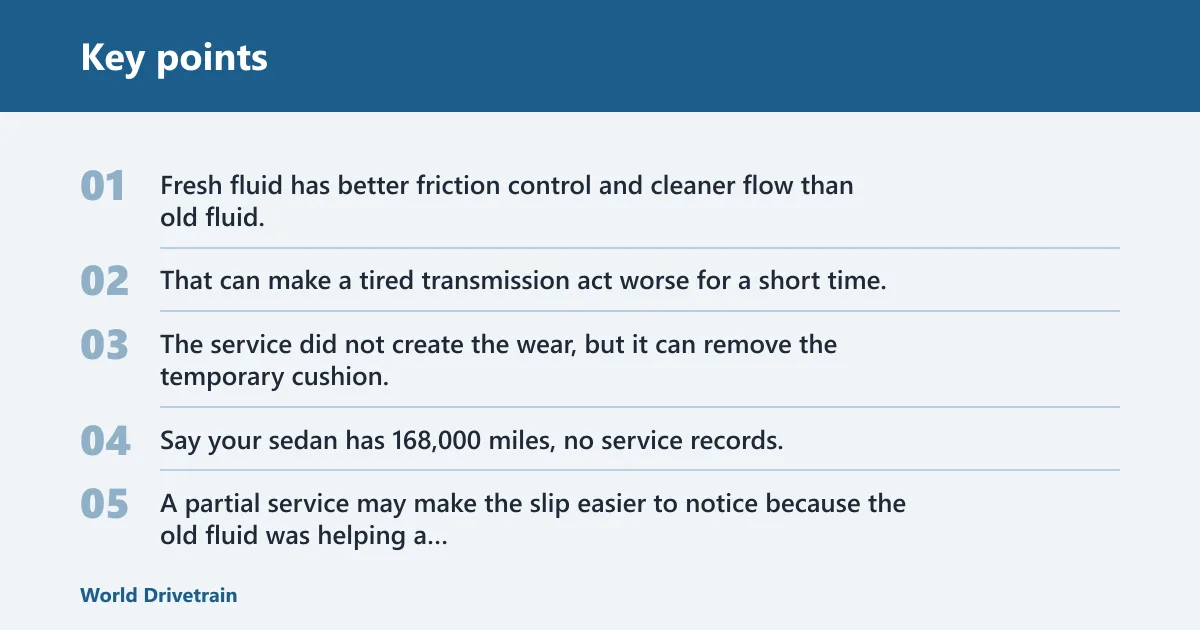
Fresh fluid has better friction control and cleaner flow than old fluid. That can make a tired transmission act worse for a short time, especially if the old fluid had thickened enough to help worn parts hold pressure. The service did not create the wear, but it can remove the temporary cushion.
Say your sedan has 168,000 miles, no service records, and a delay when shifting into Drive. A partial service may make the slip easier to notice because the old fluid was helping a worn clutch hang on. That is exposure, not proof that the fresh fluid damaged the unit.
When the service itself is the issue
The service is the problem when the wrong fluid is used, the level is wrong, the filter is left clogged when the vehicle calls for replacement, or a flush is done where a partial service would have been the safer first step. CVTs deserve special caution because they require specialized fluid, and a power flush can damage internal components.
Transmission fluid does three jobs: it lubricates moving parts, carries heat away from internal parts, and builds hydraulic pressure for shifting. Heat and friction break it down over time, so old fluid cannot protect the unit as well. That is why service mistakes matter more on a transmission that is already stressed.
When skipping service is the bigger risk
Delaying service can lead to slipping, overheating, and eventually transmission failure. That risk rises with towing, stop-and-go traffic, hot climates, and mountain driving, because severe duty shortens the service interval. On many vehicles, the owner’s manual and maintenance schedule should be the first source for interval and fluid-spec guidance.
A common first-timer mistake is to treat “never changed” as a reason to avoid service forever. If the unit is still shifting normally and the fluid spec is confirmed, a cautious service often beats continued heat and contamination. The question is not whether fresh fluid is magic; it is whether the transmission can still accept service without hidden failure.
Can old transmission fluid make problems worse?
Old fluid can make problems worse because it has less ability to lubricate, cool, and carry hydraulic pressure. When the fluid turns dark, smells burnt, or contains debris, it may already be part of the problem. That said, the fluid often shares blame with wear that started long before the service question came up.
Burnt, dark, or contaminated fluid
Dark-brown or black fluid with a burnt smell is a warning sign. It does not prove the transmission is finished, but it does point toward overheating, friction, or material wear. Those are the same conditions that can make a service riskier, especially if the unit has no service history.
Suppose a minivan with 142,000 miles has dark fluid and a faint burnt odor, but no hard slip yet. That is a better candidate for a careful inspection and a partial service than for a machine flush. The fluid condition is a clue, not a diagnosis.
Why old fluid and worn parts often travel together
Old fluid and worn parts usually show up together because both come from heat and load. A transmission that has been run hard for years may have clutch wear, varnish, or valve-body issues before anyone opens the pan. Fresh fluid does not create those faults; it can simply stop hiding them.
That is why a high-mileage neglected transmission often needs triage, not a blanket answer. At 150,000+ miles with unknown history, worn clutches may already be present, and some units react differently to fresh fluid because the old fluid was supporting marginal operation.
Drain-and-fill versus flush
A drain-and-fill is a partial service that usually replaces about 40-50% of the fluid. A full flush can exchange nearly 100% of old fluid. On neglected units, that difference matters because a partial service is often the safer starting point, while a flush can be a poor fit if the transmission is already tired.
Why a partial service is often safer
A drain-and-fill changes some of the fluid without shocking the system all at once. It also gives you a chance to inspect the pan and, on some vehicles, replace the transmission filter during the same service. That inspection step can show clutch debris, metal, or sludge before anyone commits to a more aggressive service.
When a flush is a poor fit
A machine-based flush can push out almost all of the old fluid. That can be useful on the right vehicle, at the right interval, with the right fluid, but it is not the default answer for an unknown-history transmission. On a very neglected unit, moving a lot of fluid at once may disturb debris or reveal a problem that was already there.
Flushes are also a poor fit when the fluid spec is uncertain. That is especially true for CVTs, which require specialized fluid and should not be treated like standard automatics. If the owner’s manual or transmission service data does not clearly allow a flush, do not guess.
Should you change it or leave it alone?
Use the manual first, then match the service to mileage, records, symptoms, and fluid condition. If the transmission is healthy and the interval is due, service is usually the lower-risk choice. If the unit is already slipping or the fluid is burnt and black, inspect first so you do not mistake a failing transmission for a fluid problem.
- Confirm the exact fluid spec in the owner’s manual or maintenance schedule.
- Check mileage and whether severe-duty use applies.
- Look for slip, shudder, delayed engagement, or harsh shifting.
- Check fluid color and smell, if the vehicle allows it.
- Choose a drain-and-fill first unless the manufacturer clearly calls for a different service.
- Have the pan and filter inspected when the vehicle design allows it.
When should you leave it alone?
Leave it alone only when the fluid spec is unknown, the transmission already shows warning signs that need diagnosis, or a technician cannot verify that service is appropriate for that unit. In other words, do not service blind. A wrong-fluid or wrong-procedure mistake can be worse than waiting one more day for correct information.
No symptoms and documented service history
If the transmission shifts normally and the service history is documented, follow the schedule. Many manufacturers list some automatics with “lifetime” fluid, but technicians often still recommend service around 60,000-80,000 miles. Severe-duty use can shorten that interval further, especially with towing or frequent stop-and-go driving.
Fluid spec uncertainty
If it is unclear whether the vehicle needs standard ATF or a specialized CVT fluid, stop before any service is started. Wrong fluid can cause failure. That is not a scare tactic; it is a parts compatibility issue, and it matters more than the mileage alone.
Vehicles needing a manual check before service
Some vehicles need a pan drop, a level check at a specific temperature, or a scan-tool procedure before any fluid decision makes sense. Those details belong to the service data, not a guess at the driveway. If the shop cannot explain the exact procedure, look for one that can.
Can a fluid change fix problems?
It can improve shifting quality if the problem is old, degraded fluid or a service interval that was overdue. A fluid change cannot repair worn clutches, a failing pump, blocked passages, or a damaged torque converter. If the transmission is already slipping hard, diagnosis comes first.
What it can improve
Clean fluid can restore pressure consistency, reduce heat buildup, and improve shifting when wear is still limited. That is why a vehicle that is overdue but not yet failing may respond well to service. The improvement comes from restoring the fluid’s job, not from repairing metal or friction material.
What it cannot repair
Changing fluid will not fix a transmission that is already failing. If reverse is delayed, gears flare, or the unit slips after warm-up, those are signs of deeper trouble. Fresh fluid may change how the failure feels, but it does not rebuild clutch material or restore damaged valve bodies.
Signs you need diagnosis first
Get a diagnosis before service if the transmission bangs into gear, will not move, goes into limp mode, or has metal in the pan. Those symptoms point past routine maintenance. A service decision should follow the fault, not replace it.
Frequently asked questions
Can transmission fluid flush cause problems?
Yes. A flush can be a poor fit for very neglected transmissions, and it is often cautioned against for some CVTs. A machine-based flush replaces nearly 100% of old fluid, which can be more aggressive than a drain-and-fill on a unit with unknown history or visible wear.
Is it bad to not change transmission fluid?
Often, yes. Old fluid breaks down from heat and friction, and delaying service can lead to slipping, overheating, and eventually transmission failure. The risk is higher under towing, stop-and-go driving, hot weather, and mountain use, where the service interval should be shorter.
Should I change my transmission fluid if it’s never been changed?
Maybe, but only after a careful check. If the transmission shifts normally and the fluid spec is known, a drain-and-fill is often the safer first step. If it is a high-mileage neglected unit with burnt fluid or slipping, diagnose first so you do not confuse service timing with existing wear.
What happens if I don’t change my transmission fluid?
The fluid keeps aging, heat keeps building, and wear particles keep circulating. That can lead to rough shifts, slipping, and more internal damage over time. The transmission may keep working for a while, but the risk of failure rises as the fluid loses its ability to protect the parts.
Does changing automatic transmission fluid cause problems?
It can, but usually only when the transmission is already worn, the wrong fluid is used, or the service choice is wrong for the unit. For many healthy automatics, a correct service at the right interval lowers risk rather than raising it. The key is matching the service to the transmission’s condition.