Differential Fluid vs Transmission Fluid: What’s the Difference?
Differential fluid and transmission fluid are usually different, but some transaxles and transaxle-style drivetrains share one lubricant, so match the unit design and the owner’s manual. Using the wrong fluid can lead to noisy gears, harsh shifting, seal damage, or costly wear. This guide explains how to tell separate-fluid setups from shared-lube designs and how to identify the correct fluid for your vehicle or axle unit.
| Decision factor | Differential fluid | transmission fluid | Winner |
|---|---|---|---|
| Primary job | Handles ring-and-pinion load in axles and other gear sets | Acts as a hydraulic medium, lubricant, and cooler in automatics | tie |
| Typical viscosity | Thicker; common examples include 75W-90 and 80W-90 | Thin, low-viscosity fluid | Differential fluid |
| Where it belongs | Differentials, some manual transmissions, and some transfer cases | Automatic transmissions and some automated manual transmissions | tie |
| Spec sensitivity | Needs viscosity, API class, and OEM approval matched to the unit | Needs exact ATF family and OEM approval matched to the unit | tie |
| Wrong-fluid risk | Noise, wear, shudder in limited-slip units, and lubrication mismatch | Slip, heat, shift complaints, and reduced cooling | tie |
| Shared-lube edge cases | Some transaxles and certain manual gearboxes do not use axle-style gear oil | Some units that look like transmissions still need gear oil, not ATF | tie |
What each fluid does
Differential fluid
Differential fluid, often called gear oil, is built for meshing gears under high load. It is thicker than ATF and often uses SAE grades such as 75W-90 or 85W-140, with EP additives and anti-foam agents for axle gears, transfer cases, and some manual transmissions.
Transmission fluid
Transmission fluid is the working fluid for automatic transmissions and some automated manual transmissions. It supports hydraulic pressure for shifting, carries heat away, and lubricates internal parts. Typical transmission fluid colors are red or amber, but color alone does not identify the correct spec.
Why viscosity is not the whole story
Thickness matters, but it is not the final answer. A fluid can match the viscosity and still miss the maker’s approval, friction package, or additive chemistry that the unit needs.
That is why “gear oil” and “ATF” are labels, not automatic instructions. The bottle has to match the drivetrain design and the service spec.
Where each fluid belongs by drivetrain type
Some vehicles separate the transmission, differential, and transfer case into different housings. Others combine functions in a transaxle or a shared-lube gearbox, which is why the physical layout matters before the label on the bottle does.
Automatic transmission
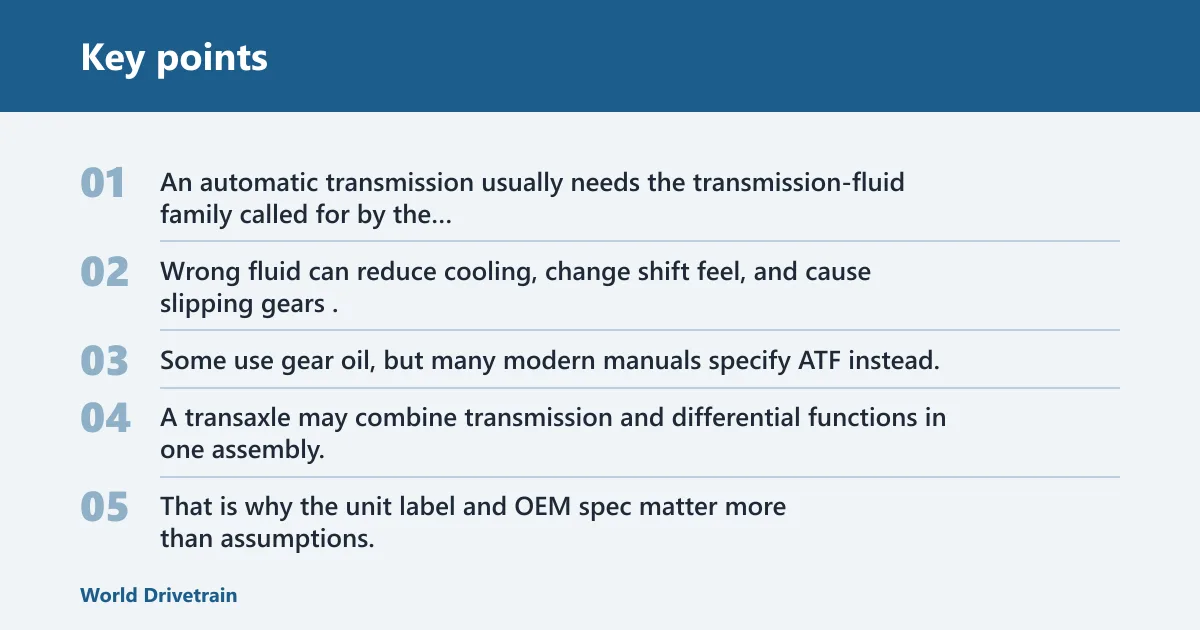
An automatic transmission usually needs the transmission-fluid family called for by the maker. Wrong fluid can reduce cooling, change shift feel, and cause slipping gears.
Manual transmission
Manual transmissions are mixed. Some use gear oil, but many modern manuals specify ATF instead, so the owner’s manual is the deciding source, not the word “manual” on the gearbox.
Transaxle
A transaxle may combine transmission and differential functions in one assembly, and some designs are reported to use one shared lubricant. Others do not. That is why the unit label and OEM spec matter more than assumptions.
Transfer case
Transfer cases can use gear oil in many applications, but not all. The fluid choice depends on the transfer case design, the presence of clutch packs, and the manufacturer’s approval.
Open differential
An open differential usually wants standard gear oil that matches the axle’s viscosity and API class requirements. It does not need the friction characteristics required by many limited-slip units.
Limited-slip differential
A limited-slip differential may require friction-modified gear oil or a separate additive, depending on axle design. Common performance and rear-wheel-drive applications are more likely to need that extra friction control to prevent chatter and shudder.
Differential fluid decision matrix
| Drivetrain type | Fluid type | What to check on the bottle | Top-up caution |
|---|---|---|---|
| Automatic transmission | transmission fluid | Exact ATF family, OEM approval, and any required viscosity or service spec such as Dexron VI, Mercon V, ATF+4, or Allison TES-295 | Do not mix with gear oil or generic ATF that lacks the listed approval |
| Manual transmission | Either gear oil or transmission fluid, depending on OEM spec | Approved viscosity, API class if gear oil is specified, and the vehicle maker’s manual | Do not assume all manuals want 75W-90; some call for ATF |
| Transaxle | Either shared-lube ATF or gear oil, depending on design | OEM spec first, then viscosity and fluid family | Do not top off with the wrong family just because the housing has one fill plug |
| Transfer case | Usually gear oil, but design-specific | Viscosity, API class, and the transfer case service spec | Do not mix ATF and gear oil unless the manual explicitly allows it |
| Open differential | Gear oil | SAE grade such as 75W-90 or 80W-90, API class, and OEM approval | Do not substitute ATF; it is too thin for axle gear loading |
| Limited-slip differential | Friction-modified gear oil or gear oil plus approved additive | LS designation, viscosity, API class, and axle-specific approval | Do not add friction modifier unless the axle design calls for it |
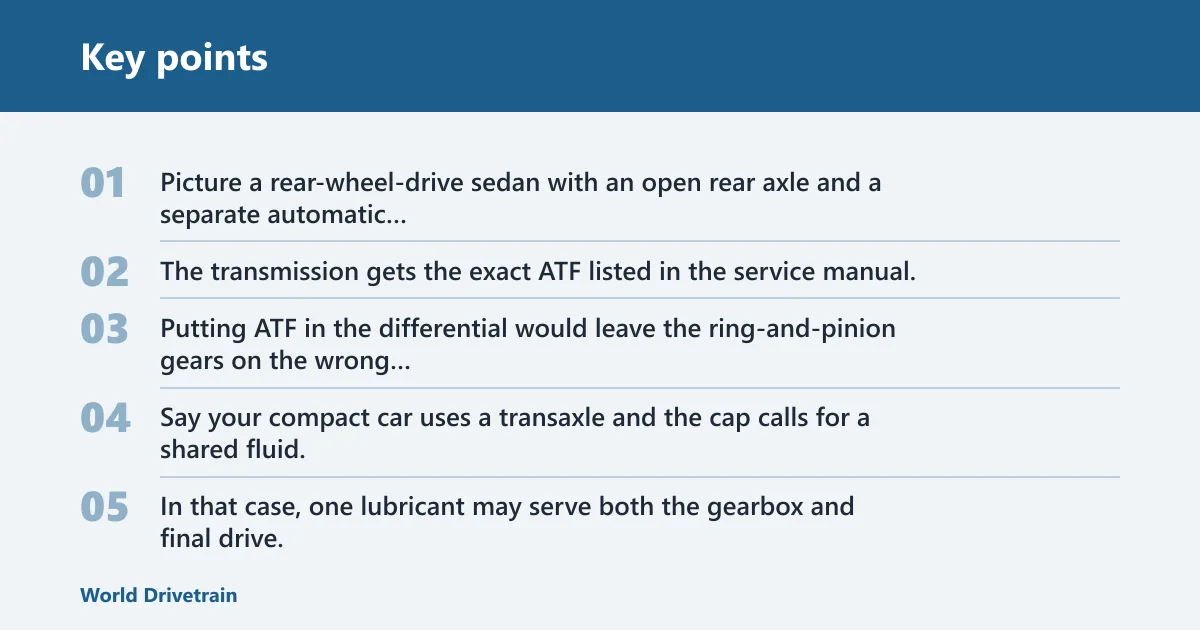
Picture a rear-wheel-drive sedan with an open rear axle and a separate automatic transmission. The transmission gets the exact ATF listed in the service manual, while the axle gets gear oil. Putting ATF in the differential would leave the ring-and-pinion gears on the wrong lubricant film.
Say your compact car uses a transaxle and the cap calls for a shared fluid. In that case, one lubricant may serve both the gearbox and final drive. The bottle still has to match the OEM spec, because a shared housing does not mean a shared chemistry works everywhere.
Can you use transmission fluid in a differential?
Usually no. A differential needs gear oil viscosity and additive chemistry, while transmission fluid is built for hydraulic control in automatic units. The main exception is a design that specifically calls for ATF or another shared lubricant, which the owner’s manual must confirm.
When a manual gearbox is the exception
Some manual gearboxes and a few transaxles specify transmission fluid instead of gear oil. That does not make ATF a universal substitute; it means the manufacturer designed the unit around ATF flow and friction behavior.
Why ATF is usually the wrong choice for axle gears
Axle gears need higher film strength than typical ATF provides. If the fluid is too thin, the gear mesh can run hotter and noisier, and the unit may wear faster under load.
What limited-slip units change
Limited-slip differentials add another variable. They may need a friction modifier in the gear oil so the clutch pack engages without chatter. Straight ATF does not solve that requirement unless the axle maker specifically approves it.
Can gear oil be used as transmission fluid?
Usually no for automatics. Automatic transmissions need ATF chemistry, hydraulic behavior, and cooling performance that gear oil does not provide. Some manual transmissions are different and may specify gear oil, but the manual decides that, not the transmission housing shape.
Why automatics need ATF chemistry and hydraulic behavior
Automatic transmissions depend on fluid pressure to apply clutches and operate valves. Using thick gear oil can restrict flow and reduce cooling, which can lead to overheating, poor shifts, and slipping gears.
When some manuals specify gear oil
Many manuals do use gear oil, often in grades such as 75W-90 or 85W-140. That is normal for certain gearboxes, but it does not mean any thick oil belongs in any manual transmission.
Why OEM approval beats general labels
A bottle that says “gear oil” or “ATF” is only a starting point. The correct choice has to meet the vehicle maker’s service specification, because viscosity alone does not cover friction control, seal compatibility, or shift quality.
How do you read the bottle before you buy?
Start with the service manual, then match the bottle to the unit. The three checks that matter are viscosity, API class, and OEM approval. If any one of those is missing, the bottle is not a safe guess.
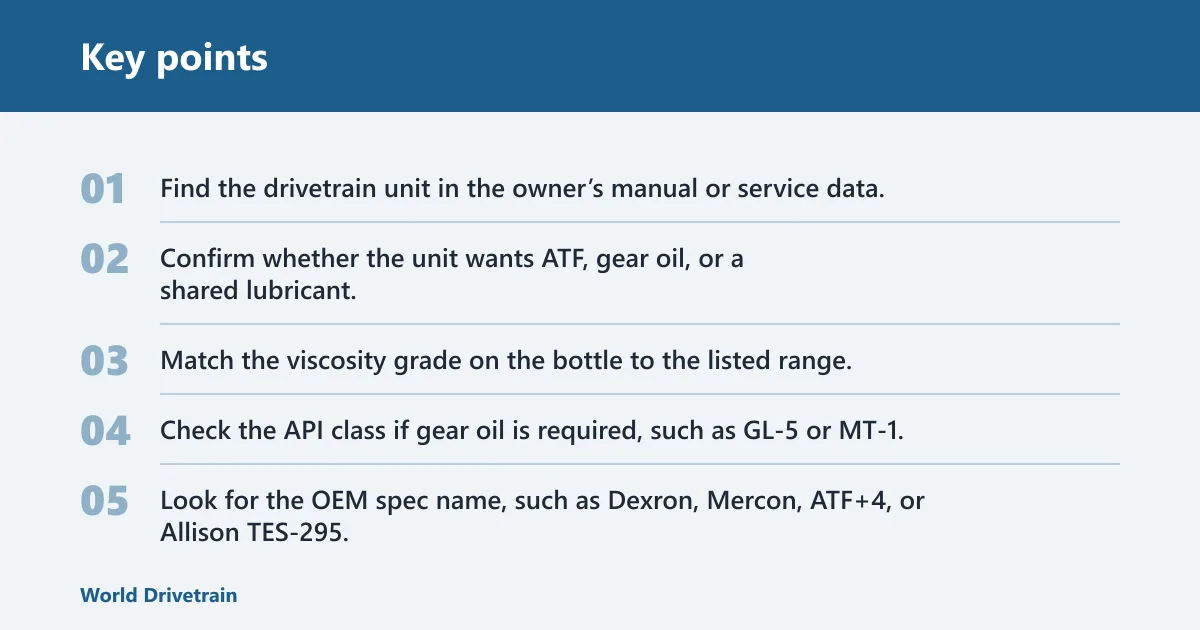
- Find the drivetrain unit in the owner’s manual or service data.
- Confirm whether the unit wants ATF, gear oil, or a shared lubricant.
- Match the viscosity grade on the bottle to the listed range.
- Check the API class if gear oil is required, such as GL-5 or MT-1.
- Look for the OEM spec name, such as Dexron, Mercon, ATF+4, or Allison TES-295.
- Do not top off with a fluid that only “seems close.”
Viscosity grades
Common gear oil grades include 75W-90, 80W-90, and 85W-140. Transmission fluid is typically much thinner. That difference matters because axle gears and automatic valve bodies need very different flow behavior.
API classes
Gear oil bottles often show API GL-5 or MT-1. Many quality 75W-90 gear oils meet those standards. Those labels tell you more about gear protection and additive package than a color or brand name ever will.
OEM specs
Dexron III, Dexron-VI, Mercon V, ATF+4, and Allison TES-295 are examples of automatic transmission fluid specifications. A bottle must match the exact approval called for by the vehicle maker, not just the general ATF category.
Choose Differential fluid if… / Choose transmission fluid if…
Choose Differential fluid if the unit is an axle, final drive, transfer case that calls for gear oil, or a manual gearbox that explicitly specifies gear oil. Choose transmission fluid if the unit is an automatic transmission, an automated manual transmission, or a shared-lube transaxle that the manufacturer designed around ATF.
Choose neither until you confirm the service manual if the vehicle has a transaxle, a limited-slip axle, or an unusual drivetrain layout with shared fluid paths. The correct answer depends on the exact unit, not the broad label on the housing.
Why the right choice is different by use case
Differential fluid wins where gear loading is the main issue. Transmission fluid wins where hydraulic control, cooling, and clutch behavior are the main issue. Shared-lube designs are the exception, and they only work when the OEM spec says they do.
For example, a rear axle with a limited-slip carrier may need friction-modified gear oil, while a separate six-speed automatic in the same vehicle needs a very different ATF. Those are not interchangeable fills.
How often should you change each one?
Service intervals vary by component, duty cycle, and manufacturer. There is no universal mileage that fits every differential or transmission, so the owner’s manual controls the schedule. Severe use, towing, heat, and stop-and-go operation usually shorten intervals.
Severe-duty conditions
Frequent towing, high ambient heat, short trips, and repeated low-speed operation can load the fluid faster. Some transmission services are much more frequent than others, and a DSG oil change is a distinct service rather than a generic fluid drain.
Why the owner’s manual controls the schedule
FixMyCar reports transmission fluid changes are often less frequent than engine oil changes, roughly every 30,000 to 60,000 miles, but that is not a universal rule for every unit. The better approach is to follow the maker’s interval and the fluid spec for the exact drivetrain.
Frequently asked questions
What is the difference between differential fluid and transmission fluid?
Differential fluid is usually gear oil for axle gears, manual gearboxes, and some transfer cases. Transmission fluid is the fluid for automatics and some automated manual transmissions, where it also acts as a hydraulic medium and cooler. The correct choice depends on drivetrain design, not just on the word “fluid.”
What happens if I put the wrong fluid in the differential?
The differential may become noisy, run hotter, or wear faster. In limited-slip units, the wrong fluid can also cause chatter or shudder. If the fluid is too thin or lacks the correct additives, the gears may not get the film strength the axle was designed to use.
Is differential fluid the same as gear oil?
In common automotive use, yes. Differential fluid is often called gear oil, and many applications use the same family of lubricants. The important detail is the exact viscosity, API class, and OEM approval for the unit you are servicing.
Do manual transmissions use the same fluid as differentials?
Sometimes, but not always. Some manual transmissions use gear oil, while others call for ATF. A differential almost never shares a universal rule with a manual gearbox, so the transmission code and owner’s manual matter more than the word “manual.”
What is the correct fluid for a limited-slip differential?
The correct fluid is usually a friction-modified gear oil or a gear oil plus an approved additive, but the axle design decides that. Open differentials do not always need the same friction package. Check the service manual before adding modifier, because the wrong friction level can cause shudder.
How often should differential fluid be changed compared with transmission fluid?
There is no single interval that applies to every vehicle. Some transmissions have shorter or more specialized service schedules than differentials, and duty cycle changes both. Use the owner’s manual for each unit separately, because the two fluids do not share one maintenance schedule.