How Long Will a Noisy Differential Last?
A noisy differential can last days or years, but a growl, howl, or clunk that changes with speed or load means you should plan repair soon. A loud whine with heat, metal flakes, or vibration can fail with little warning. Ignoring it can destroy gears, bearings, and axle parts, turning a repair into a tow and a much larger bill. This guide explains what each noise usually means, how urgent it is, and what remaining-life scenarios are realistic.
What a differential noise can mean
A differential lets the outside wheel turn faster than the inside wheel in a turn, so some noise can first appear where turning loads change. Light whine often points to fluid condition or gear wear. Noise on turns can point to side gears or spider gears. Noise with vibration raises the risk level fast.
Light whine at steady speed
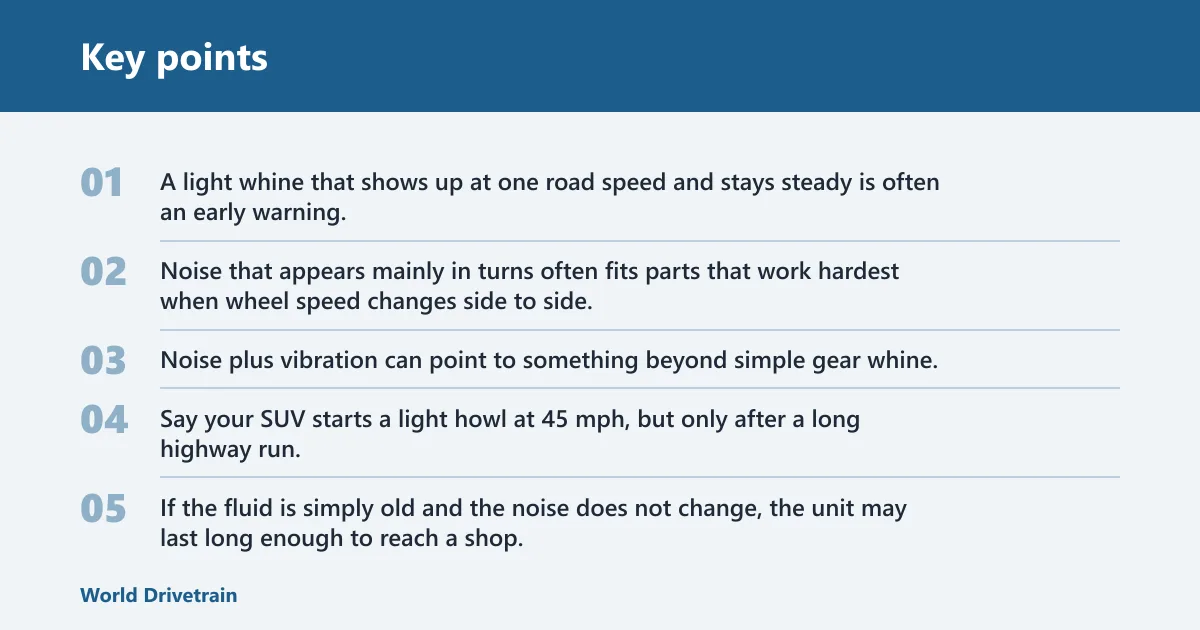
A light whine that shows up at one road speed and stays steady is often an early warning. It may be a fluid issue, a bearing beginning to wear, or gear pattern wear. That kind of noise can linger for a while, but it should not be treated as harmless.
Noise only on turns
Noise that appears mainly in turns often fits parts that work hardest when wheel speed changes side to side. That includes limited-slip components, spider gears, or worn bearings that shift under load. If the sound is mild and the fluid is clean, the car may be drivable for a short time, but inspection should still be scheduled soon.
Noise with vibration
Noise plus vibration can point to something beyond simple gear whine. That pattern can mean a worn bearing, damaged gear teeth, or excessive backlash that is already affecting the rotating parts. The remaining life can drop from “weeks” to “days” fairly quickly if the source is metal damage rather than only low fluid.
Differential noise decision table
| Noise scenario | Likely cause | Risk level | How long it may last in practical terms | What to do |
|---|---|---|---|---|
| Light whine at steady speed | Old fluid, slight gear wear, or early bearing wear | Lower, but not zero | Could continue for weeks or longer if the cause is mild, though it can gradually worsen. | Inspect soon |
| Noise only on turns | Side gears, spider gears, or limited-slip wear | Moderate | May stay manageable for a short period, then become more frequent as wear grows | Inspect soon |
| Noise with vibration | Bearing damage, gear damage, or excessive backlash | High | Could fail without much notice after a brief window of continued use | Inspect soon, reduce driving |
| Noise plus metal in fluid | Active gear or bearing wear inside the housing | Very high | May last only a short time before failure risk rises sharply | Stop driving |
| Loud grinding or roaring | Severe gear, bearing, or axle damage | Immediate failure risk | Could fail at any time | Stop driving |
Say your SUV starts a light howl at 45 mph, but only after a long highway run. If the fluid is simply old and the noise does not change, the unit may last long enough to reach a shop. If the howl gets louder each day, the remaining life is shrinking.
How do you tell low fluid from wear?
Low or old differential fluid often creates a lighter whine and may show up after heat builds. Wear damage tends to be louder, harsher, and more likely to come with vibration, clunking, or metal in the oil. The fluid condition tells a lot, but it does not rule out internal damage.
Old or low fluid clues
Low fluid is often tied to leaking seals, a missing fill plug seal, or fluid that has not been changed on schedule. Old fluid can lose its protective film and let heat rise. If the noise is mild and the housing is not full of debris, the problem may still be at the maintenance stage rather than the failure stage.
Bearing or gear damage clues
Damaged bearings and gears usually make harsher sounds than fluid alone. A roar that changes with vehicle speed, a growl that changes with load, or clunks on throttle changes often points to wear. Metal flakes in the drained fluid are a strong warning that the problem is no longer only about service timing.
When the fluid condition points to repair now
If the drained fluid smells burnt, looks glittery, or contains chips, the differential needs more than a top-off. That usually means the inside parts have already started to break down. Continued driving can push a repair into a failure that also affects the axle shafts or the ring and pinion.
-
Check the fluid level. If the housing has a fill plug and the level is low, that alone can explain new noise. Low fluid should be corrected right away, because poor lubrication speeds heat and wear.
-
Inspect the drained fluid. Look for metal flakes, a burnt smell, or a dark, thin texture. Clean fluid with no debris suggests a less severe issue; visible metal points to internal damage.
-
Match the noise pattern. Note whether the sound changes on turns, acceleration, deceleration, or steady speed. That pattern helps separate a simple fluid problem from a worn bearing or gear set.
Picture a rear axle that is quiet in a parking lot but howls on the highway and leaves silver specks in the oil. That combination is not a maintenance reminder. It is a sign that the remaining life may be short and the unit should be treated as a repair case now.
How long do differentials last?
Most differentials need a fluid change at about 50,000 miles, and consistent service habits often decide whether the unit reaches normal life or starts making noise early. A healthy differential can last a long time. Missed fluid service can shorten that life quickly.
Rear vs front differentials
Rear, front, and limited-slip differentials can all make noise, but the symptom pattern matters more than the location alone. Rear differentials are common in trucks and rear-wheel-drive vehicles and often run under steady load. Front differentials may share space with the transaxle on some vehicles, so a noise there can be harder to isolate without inspection.
Limited-slip units
Limited-slip differentials can make additional noise if the clutch packs or friction modifiers are wrong for the unit. Some clicking or chatter in tight turns can be normal for certain designs, but loud whine, grinding, or vibration is not. Limited-slip noise should still be checked if it changes with speed or gets worse.
Service interval and lifespan
The common service interval around 50,000 miles is preventative maintenance, not a wear limit. It helps keep fluid from breaking down and keeps a leak from going unnoticed long enough to cause damage. A differential can last well beyond that with proper service, but noise means the clock may already be running on damaged parts.
Can you keep driving on a noisy differential?
Yes, sometimes for a short time, but only if the sound is mild and stable. Noisy differentials do not all fail at once, yet the risk rises fast when the noise gets louder, the housing runs hot, or metal shows up in the fluid. The safe answer changes with the symptom pattern.
When it is a short-term nuisance
A light whine that stays about the same, with no vibration and no metal in the fluid, can sometimes be driven briefly while you arrange service. Keep trips short and avoid hard throttle. That does not mean the part is healthy; it only means the failure risk is not yet at the stop-driving stage.
When you should inspect soon
If the noise changes with turns, gets louder under acceleration, or appears after a recent fluid loss, schedule inspection soon. A good rule is to stop treating it as background noise once it becomes repeatable. The goal is to catch a repair before the gears or bearings are damaged enough to spread debris through the housing.
When you should stop driving
Loud grinding, roaring, clunking, heavy vibration, or metal in the fluid means the car needs repair now. Ignored differential problems can eventually lead to failure, and failure can lock up the axle or leave the vehicle stranded. At that point, continued driving is a risk to the differential and the rest of the driveline.
-
Reduce driving load. Avoid towing, hard launches, and long highway runs until the problem is inspected. Lower load can slow damage when the issue is still mild.
-
Schedule inspection promptly. Do this as soon as the noise changes from occasional to repeatable. Early inspection can turn a repair into a fluid service instead of a full rebuild.
-
Stop if symptoms worsen. If the sound becomes grinding, the vehicle shakes, or the axle housing gets very hot, do not keep driving. Tow it instead.
How to quieten a noisy differential
The right fix depends on whether the noise comes from fluid condition or from worn parts. Fresh fluid can quiet a mild whine if the unit is otherwise healthy. Once gears, bearings, or limited-slip parts are damaged, silence usually requires repair, not an additive or a top-off.
-
Confirm the correct fluid. Use the fluid type specified for that axle or transaxle. Wrong fluid can increase chatter or leave limited-slip parts noisy.
-
Change worn fluid. If the fluid is old, dark, or low, replace it and fix the leak if one exists. Fluid change is preventative maintenance, but it can also reduce noise when the problem is still early.
-
Inspect seals and bearings. A leak will return if the seal is damaged, and a worn bearing will keep howling even with fresh fluid. Repair the underlying fault so the noise does not come back.
A common first-timer mistake is to add fluid after hearing a whine and then assume the problem is solved. If the drained oil contains metal or the noise changes after a short drive, the unit likely needs more than service. That is the point where quieting it means repair, not a quick refill.
Frequently asked questions
How long can I drive with a noisy differential?
If the noise is a mild whine with no vibration or metal in the fluid, you may have enough time to arrange a short-term repair visit. If it grows louder, changes with load, or adds vibration, the remaining life can shrink fast. Grinding or metal means do not keep driving.
How long should a rear differential last?
A rear differential can last many miles if the fluid stays clean and full and the seals do not leak. There is no single mileage cutoff. Once a rear axle starts howling, especially with heat or metal in the oil, the remaining life depends on how quickly it is inspected.
Is a noisy differential safe to keep driving on?
Only in the mildest cases, and only for a short time while you arrange service. A steady light whine is less urgent than grinding, roaring, or vibration. If the sound gets louder, changes with turns, or comes with metal in the fluid, stop driving.
How do I tell if the noise means low fluid or failing parts?
Low or old fluid usually causes a lighter whine and may appear before other symptoms. Failing parts more often bring growl, clunk, vibration, or metal in the drained fluid. If the sound is harsh or changing quickly, assume internal wear until inspection proves otherwise.
Common vs differential mode noise
Common axle noise usually means a problem that is present most of the time, such as a bearing or gear wear pattern. Differential mode noise tends to show up mainly in turns, where the part is working hardest to let the outside wheel turn faster than the inside wheel. The pattern helps narrow the fault.