Is It Worth Replacing a Transmission?
Replacing a transmission is usually worth considering only when the repair cost sits well below the car’s value and the car can stay reliable for roughly 2–3 more years; if the quote runs above about half of market value, replacement often loses. Skip that math and you can sink thousands into a car that still fails. This guide shows how to compare repair, replacement, and selling using total ownership cost.
Should you replace the transmission?
Start with current market value, not what you paid for the car. If the estimate is a small share of value, the engine is healthy, and the rest of the car has years left, replacement can make sense. If the bill is near half the car’s value, or the car needs other major work soon, selling is often the cleaner move.
Use value, remaining life, and exit cost
A transmission replacement can be worthwhile if the car is otherwise sound and the repair cost is reasonable compared with its value. That comparison should include what you would spend to replace the car, not just the repair quote. A newer used car can trigger taxes, title fees, higher insurance, and finance charges.
Common warning signs include slipping, delayed engagement, whining or grinding noises, burning smell, leaks, and a check engine light. Those signs point to diagnosis, not automatic replacement. A bad solenoid, valve body issue, low fluid, or external leak may change the repair path.
- Get a written diagnosis, not just a code scan.
- Ask for the estimate on repair, rebuild, remanufactured, and used replacement units.
- Compare repair, replacement, and selling using total ownership cost.
- Estimate at least 2–3 more years of use after the repair.
- Check whether selling or buying another car costs less over that same period.
Transmission decision matrix
Use this as a practical filter, not a rule carved in stone. The goal is to decide whether the repair buys enough dependable years per dollar to beat selling or replacing the car. Score each item honestly, because one weak category can erase the value of a new transmission.
| Factor | Favors replacement | Favors selling or another path |
|---|---|---|
| Vehicle value | Repair is well below current market value | Repair is near or above half of value |
| Mileage | Moderate mileage with clear service history | Over 150,000 miles and other wear is visible |
| Engine health | No compression, oil consumption, or overheating issues | Engine has major faults or likely future repair |
| Rust/body condition | Solid frame, floors, mounts, and body panels | Rust, collision damage, or structural corrosion |
| Transmission type | Manual or a rebuildable automatic | CVT or a unit with limited parts support |
| Labor estimate | Reasonable book time and straightforward removal | High labor time or complex drivetrain disassembly |
| Warranty terms | Parts and labor coverage with clear limits | Parts-only or short coverage from the provider |
| Expected years of use | At least 2–3 more years, often more | Little useful life left after the repair |
Worth replacing transmission table
| Repair cost as share of current value | Decision guide |
|---|---|
| Under 30% | Usually yes, if the rest of the car is strong |
| 30% to 40% | Maybe, if body, engine, and warranty support the repair |
| 40% to 50% | Borderline; older or high-mileage cars need a stronger case |
| Over 50% | Usually no; selling is often the better financial choice |
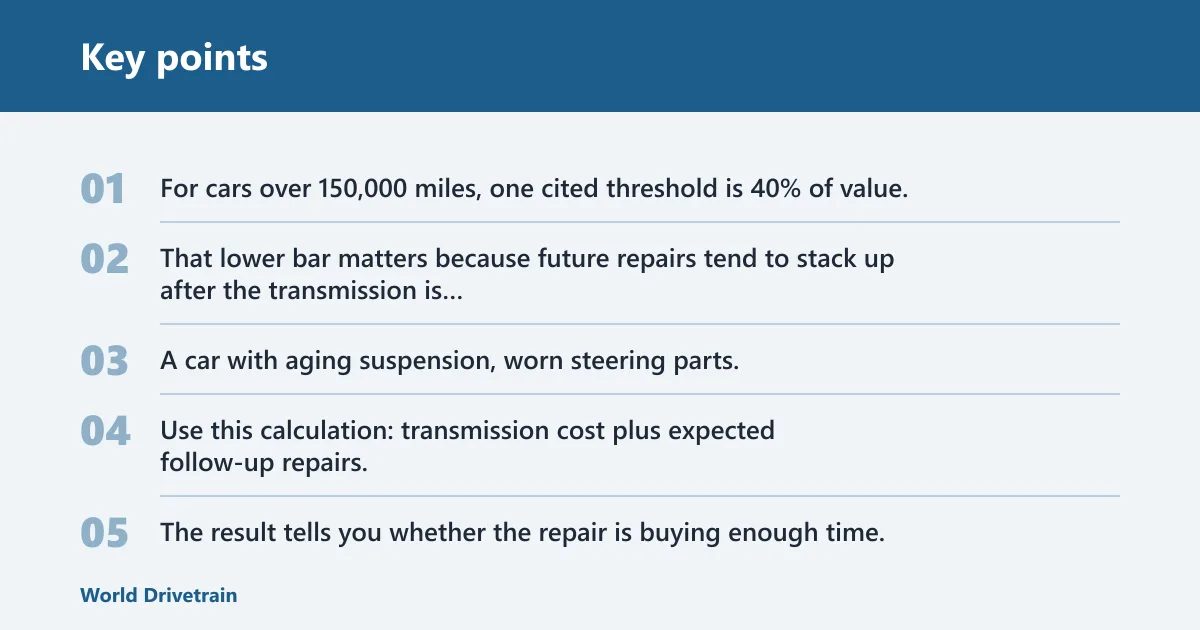
For cars over 150,000 miles, one cited threshold is 40% of value. That lower bar matters because future repairs tend to stack up after the transmission is fixed. A car with aging suspension, worn steering parts, or electrical issues can eat the savings fast.
Cost per year of extra ownership
Use this calculation: transmission cost plus expected follow-up repairs, divided by the years you expect to keep the car. The result tells you whether the repair is buying enough time. If a about $4,800 job only buys about two more years, that works out to about $2,400 per year before fuel, insurance, and maintenance.
Say your sedan is worth about $6,000 and the transmission quote is about $2,100. If you expect three more years of use and another $900 in likely wear items, the extra ownership cost is $1,000 per year. That is easier to justify than spending $4,500 on a car worth $5,000.
What drives transmission replacement cost
Transmission work is expensive because it is mechanically complex, and the labor bill often matters as much as the parts. Book time is commonly 8 to 15 hours, and actual cost changes with shop rate, layout, rust, and whether nearby parts must come off with the gearbox.
Labor time and layout
Labor can add another $500 to $1,600 depending on complexity, but that is only part of the story. Front-wheel-drive cars with transverse engines often need tighter packaging work, axle removal, subframe support, or extra disassembly. Four-wheel-drive vehicles can add transfer case and driveshaft steps.
A shop charging about $140 per hour and billing about 10 hours will add about $1,400 before parts. If the job turns into about 14 hours because rusted fasteners or stuck drivetrain hardware slow removal, the labor alone rises to about $1,960. That spread is why two quotes for the same model can differ sharply.
Parts price by transmission type
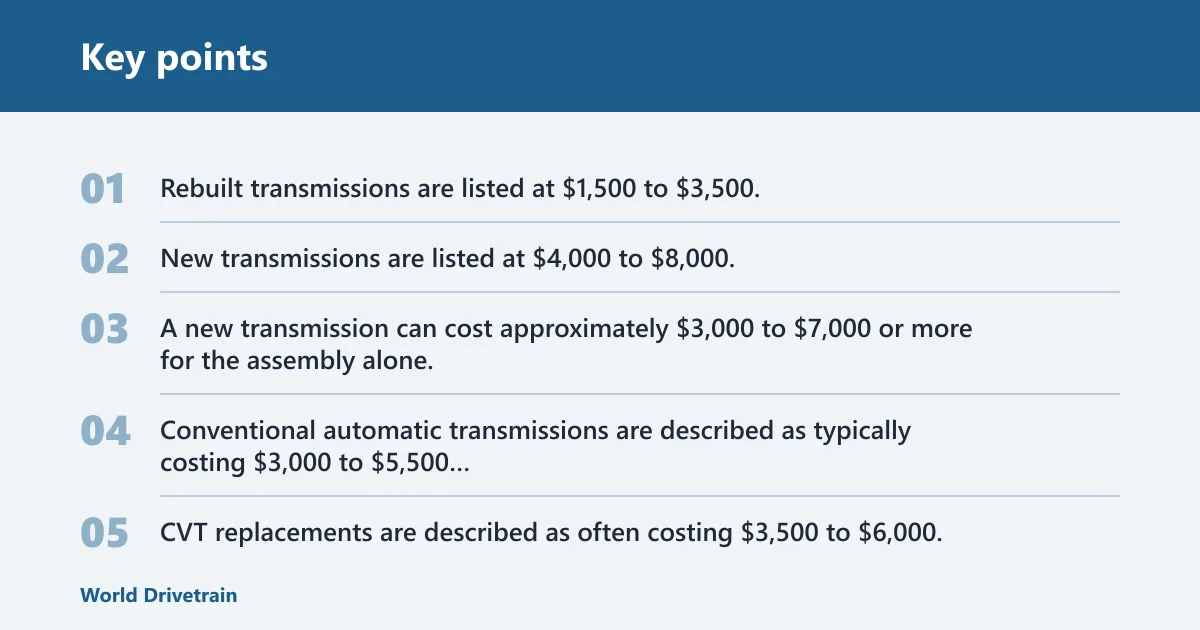
- Rebuilt transmissions are listed at $1,500 to $3,500.
- New transmissions are listed at $4,000 to $8,000.
- A new transmission can cost approximately $3,000 to $7,000 or more for the assembly alone.
- Conventional automatic transmissions are described as typically costing $3,000 to $5,500 at independent shops.
- CVT replacements are described as often costing $3,500 to $6,000.
- Dual-clutch transmissions are described as around $4,000 to $7,500 depending on brand and unit type.
Automatic transmissions are described as more expensive because they have more moving parts. Automatic and CVT transmissions can be expensive to replace because of complex internal components and electronic control systems. Manual transmissions are generally the cheapest type to replace.
Diagnosis changes the final invoice
Some failures are not full transmission failures. A bad cooler line, low fluid, failed solenoid, or worn mount can mimic major damage. A proper diagnosis can also uncover related parts such as the torque converter, clutch hydraulics, axles, seals, or software calibration that should be handled during the same repair.
Which transmission type matters most?
Transmission type changes the decision because rebuildability, parts cost, and long-term tolerance for wear are not the same. Manual gearboxes are usually simpler and cheaper. CVTs and many dual-clutch units demand a stricter value test because the replacement cost can be high and the expected payoff shorter.
Automatic transmission replacement logic
Conventional automatics often make sense to replace when the rest of the vehicle is still strong and the unit is common enough for parts and rebuild support. They usually cost more than manuals, but many shops can rebuild them, which can lower cost versus a new assembly.
Manual transmission rebuildability and lower parts cost
Manual units are often the easiest to justify because they are mechanically simpler and usually cheaper to repair. If the clutch, flywheel, or hydraulics are the real problem, the total bill may be far lower than a full gearbox replacement. That changes the decision completely.
CVT replacement risk and shorter tolerance for wear
Is it worth replacing a CVT transmission? Sometimes, but the bar should be higher. CVTs can be expensive to replace, and a failed unit in an older high-mileage car often points to broader wear elsewhere. If the vehicle has other weak systems, the replacement may buy too little time.
DCT/DSG complexity and calibration concerns
Dual-clutch units can be rewarding to repair on the right car, but they are less forgiving about age, software issues, and heat-related wear. Calibration matters after installation, so the final cost can include programming or adaptation work. That makes a weak vehicle body or engine case even less attractive.
How do replacement options compare?
The replacement choice is not simply new versus used. New, rebuilt, remanufactured, and used units carry different risk, warranty, and service-life profiles. The cheapest unit can be the most expensive if it fails early or carries little coverage.
New transmission
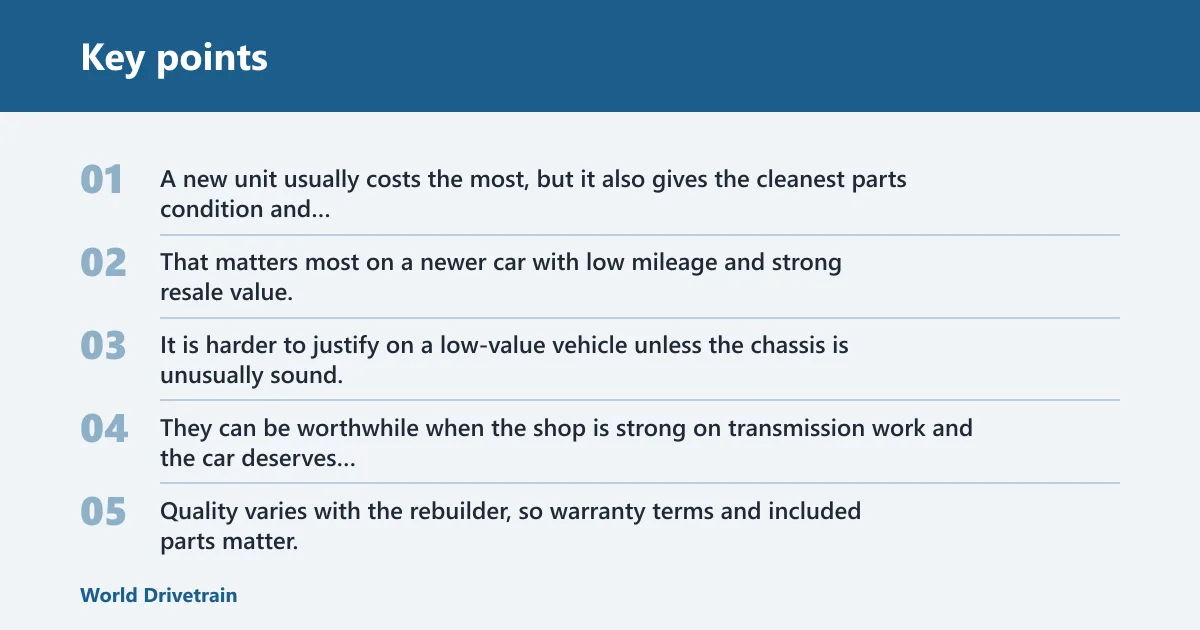
A new unit usually costs the most, but it also gives the cleanest parts condition and the strongest expected service life. That matters most on a newer car with low mileage and strong resale value. It is harder to justify on a low-value vehicle unless the chassis is unusually sound.
Rebuilt transmission
Rebuilt units are often the middle ground. They can be worthwhile when the shop is strong on transmission work and the car deserves more years of service. Quality varies with the rebuilder, so warranty terms and included parts matter.
Remanufactured transmission
Remanufactured units are rebuilt to a specified standard and often come with clearer parts coverage than a local one-off rebuild. That does not make them perfect, but it can reduce risk on a car that still has value and should be kept for several years.
Used transmission
Used transmissions are the riskiest choice because the remaining life is unknown. They can make sense on a low-value car when the goal is to keep it moving for the least cash outlay, but the lower upfront price should not be mistaken for lower total cost.
Warranty coverage by option
Warranty terms change the math. Parts-only coverage leaves labor exposure on you if the unit fails again. Parts and labor coverage is more valuable, especially when removal is expensive. Always check time limits, mileage limits, who pays diagnostic time, and whether the shop requires fluid changes or specific service intervals.
| Option | Typical risk profile | Warranty value |
|---|---|---|
| New | Lowest parts uncertainty | Often strongest, but verify labor coverage |
| Remanufactured | Balanced cost and service life | Often better than used, varies by provider |
| Rebuilt | Depends heavily on rebuilder quality | Can be solid if labor is covered |
| Used | Highest uncertainty | Usually limited and shortest coverage |
When does it make financial sense?
It makes financial sense when the car has enough useful life left to repay the repair through years of dependable use. A strong body, healthy engine, clean maintenance history, and reasonable mileage all support the decision. The transmission should not be the only good part left on the car.
Newer car with strong body and engine
If the vehicle has solid compression, no overheating history, minimal rust, and decent service records, the repair can preserve real value. That is especially true when the transmission quote lands below 30% to 40% of current value and the car is otherwise desirable.
Reasonable mileage and a long enough use window
The repair needs time to pay back. A car with 90,000 miles and a healthy engine can often justify a transmission if the owner wants several more years. A 200,000-mile car with the same quote usually needs a much stronger justification.
Picture a 2018 compact SUV with a $14,000 private-party value and a $4,200 replacement quote. If the body is clean, the engine is healthy, and the shop provides parts and labor warranty, the repair may be worth it. The same quote on a rusted, poorly maintained 2009 sedan is a different answer.
Low risk of follow-on repairs
Future repair burden matters. Suspension wear, steering looseness, electrical faults, or cooling system problems can quickly consume the value of the transmission job. A repair that only buys another year is much weaker than one that buys three or four.
When is replacement a bad bet?
Replacement is a poor bet when the car has high mileage, visible rust, or several weak systems that will demand money next. The transmission may be repairable, but that does not mean the vehicle is worth restoring. The rest of the car must still have meaningful life left.
High mileage with multiple weak systems
Over 150,000 miles, the case for replacement gets stricter. If the suspension clunks, the steering is loose, the air conditioning is weak, and the engine uses oil, the transmission bill is only one piece of a larger cost stack. The odds of more spending rise fast.
Rust, body damage, or structural wear
Rust around suspension points, subframes, floors, or body mounts can make an otherwise sound drivetrain irrelevant. A clean transmission cannot rescue a car that is becoming unsafe or too costly to keep on the road. That is a hard stop for many owners.
Engine problems that make the car a poor bet
If the engine has low compression, chronic overheating, timing issues, or serious oil consumption, the transmission decision should change. Replacing the gearbox on a weak engine can trap you in a second major repair soon after the first one is done.
CVT or older vehicle cases with limited payoff
Is it worth replacing a transmission in an old car? Often no, unless the car is exceptionally clean and the repair is still far below value. CVT cases are especially sensitive because the replacement bill can be high and the future repair burden may be larger than owners expect.
A common first-timer mistake is approving the job because the car is paid off. That ignores market value, labor cost, and the chance that the engine, rust, or electronics will need money next. Paid off does not mean cheap to keep.
Frequently asked questions
Is it worth replacing a transmission on a car?
Yes, if the car’s current market value is clearly higher than the repair quote and the rest of the vehicle is in good shape. If the estimate is near or above 50% of value, replacement usually stops making sense. The car also needs enough likely service life to justify the spend.
Is it worth fixing a transmission?
Sometimes, but only when the fault is limited and the total bill still fits the value of the car. A smaller repair can be better than full replacement if the problem is external, electrical, or isolated to a valve body or sensor. Diagnosis decides the path.
How much does transmission cost to fix?
The answer depends on the fault, the vehicle, and labor rate. Some jobs land lower if the issue is minor and caught early.
How long will a replaced transmission last?
That depends on the unit type, installation quality, driving conditions, and whether the rest of the car is healthy. A replaced transmission should be judged by the years of useful ownership it buys, not by the part alone. A strong warranty helps, but it does not guarantee the vehicle’s other systems.
Is it worth replacing a CVT transmission?
Only on the right car. CVTs are often costly to replace, and the decision should be stricter than for a manual or a common automatic. If the car is older, high-mileage, or already needs other major work, a CVT replacement often fails the cost-per-year test.
Is replacing a transmission expensive?
Yes. It is expensive because the job is mechanically complex, often requires 8 to 15 hours of labor, and can involve expensive parts. Automatic and CVT units usually cost more than manuals, and labor rises further when drivetrain layout makes removal harder.