Why Is My Transmission Noisy in Park but Quiet in Gear?
If your transmission is noisy in Park but quiet in Drive or Reverse at idle, the most likely cause is idle-related resonance, often from a flexplate, torque converter, mount, exhaust shield, or an accessory, not a hard internal gear failure. Ignoring it can turn a small vibration or rattle into a cracked flexplate, broken mount, or costly teardown. This guide explains which parts match that symptom pattern, how load and fluid pressure change the sound, and what checks to do next.
Why does it sound different in Park?
Park and Neutral remove drivetrain load, so the engine and transmission sit at a different balance point. That can expose a whine, hum, or rattle that gets masked once Drive or Reverse adds load, changes idle speed, and shifts the way the engine, torque converter, and mounts move together.
What changes when the transmission is unloaded
In Park, the automatic transmission still spins internal parts at idle, including the pump on many units, but the output side is not driving the wheels. That lower load can make pump whine, converter issues, mount vibration, or an exhaust rattle easier to hear because the engine is not being pulled down by vehicle load.
Why Drive or Reverse can mask the noise
When you shift into Drive or Reverse, idle speed usually drops slightly and the powertrain twists on its mounts. That change can move a heat shield away from contact, alter belt resonance, or load the torque converter and pump in a way that quiets a narrow noise band. If the sound disappears only under load, that clue matters.
How idle speed and engine load affect what you hear
A noise that tracks engine RPM rather than road speed is usually being driven by something spinning at idle, not by gears under motion. If the tone changes as idle drops in gear, or gets louder when the engine is lightly revved in Park, that points more toward pump, converter, accessory, or exhaust behavior than a gearset failure.
Transmission noise diagnostic matrix
Use the pattern first. Then decide whether the problem is likely fluid-related, load-related, or outside the transmission. A noise that changes with temperature, idle speed, or gear selection is often more useful than the exact sound type.
| Symptom pattern | Most likely cause | Quick at-home check | Urgency level |
|---|---|---|---|
| Cold-only noise | ATF viscosity, pump cavitation, accessory belt or pulley noise | Listen at cold start, then again after full warm-up; note whether the sound fades as ATF warms | Moderate if it fades; high if it gets louder or adds slip |
| Hot-only noise | Low fluid, aeration, worn pump, torque converter wear | Check ATF at operating temperature and look for foam, a burned smell, or level drop when hot | High |
| Noise that stops in gear | Idle resonance, mount, exhaust shield, flexplate, or a pump sound masked by load | Shift from Park to Drive with your foot on the brake and note whether the sound changes immediately | Moderate; higher if vibration is severe |
| Noise that worsens with RPM | Pump whine, belt and pulley issue, torque converter, or bearing noise | Lightly raise RPM in Park; if the pitch rises with engine speed, follow the accessory and pump path | Moderate to high |
| Noise with fluid leaks or shifting problems | Low ATF, wrong fluid, internal wear, pressure loss | Check under the car for fresh ATF at the pan, cooler lines, axle seals, and case seams, then look for delayed engagement, flare, or harsh shifts | High; stop if slipping is present |
What fluid checks tell you
ATF level and condition matter because the transmission needs fluid to lubricate parts and build hydraulic pressure. Check level at operating temperature, not cold, unless your owner’s manual says otherwise. Low fluid may aerate and foam, which can make a pump sound louder in Park or Neutral.
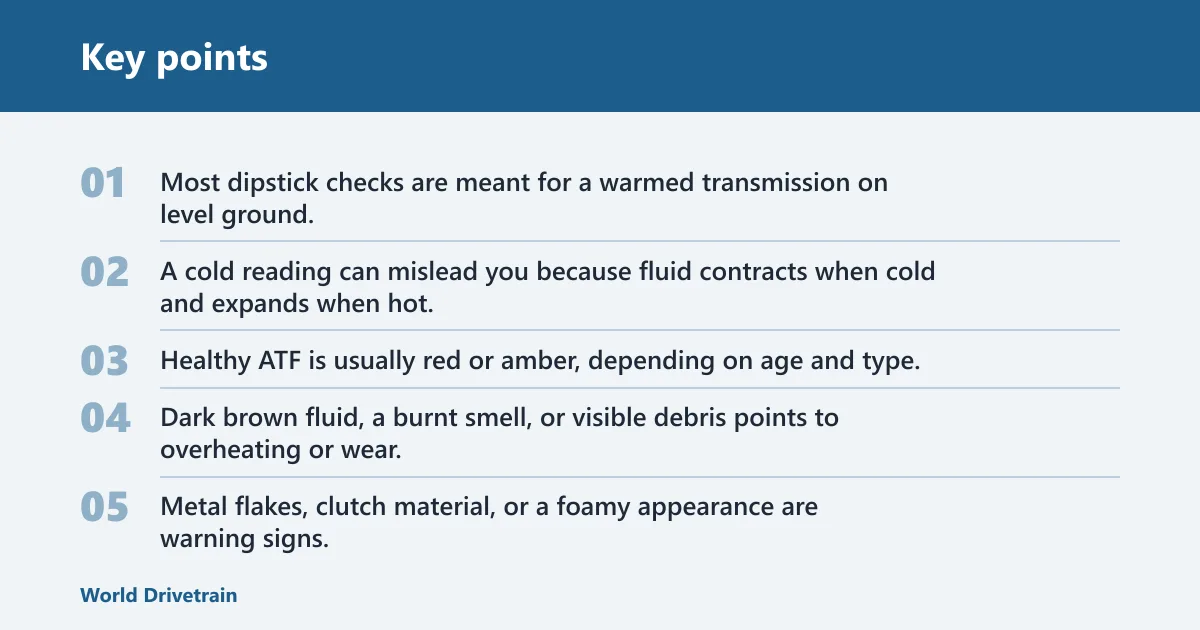
Check ATF level at operating temperature
Most dipstick checks are meant for a warmed transmission on level ground, with the engine running and the shifter held through the range if the manufacturer calls for that. A cold reading can mislead you because fluid contracts when cold and expands when hot. Follow the vehicle-specific procedure.
Read fluid color, smell, and contamination
Healthy ATF is usually red or amber, depending on age and type. Dark brown fluid, a burnt smell, or visible debris points to overheating or wear. Metal flakes, clutch material, or a foamy appearance are warning signs, especially if the noise is louder hot than cold.
Why the correct OEM-spec ATF matters
Many transmissions need a specific fluid type to control friction, pressure, and converter operation. Wrong fluid can change shift feel and pump behavior, and some units become noisy or harsh with the wrong specification. Use the exact OEM-spec fluid listed for the transmission family, not a generic match.
How low fluid can cause aeration and whine
When the pump draws air along with fluid, pressure drops and the pump can cavitate. That often sounds like a whine or buzz most clearly in Park or Neutral, where the engine is unloaded and the noise is easier to hear. If the fluid is low enough to foam, the sound may worsen hot.
Say your sedan idles quietly in Drive, but in Park it starts a high, steady whine after a 20-minute drive. If the dipstick shows low ATF at the correct hot check and the fluid looks foamy, low fluid and aeration move near the top of the list.
Could the pump or torque converter be noisy?
Yes. A transmission oil pump can whine or cavitate, and the sound is often most noticeable in Park or Neutral because the engine is not under the same load as it is in gear. The torque converter can also make noise that changes with load, especially if internal wear, bearing damage, or clutch faults are present.
Pump whine and cavitation patterns
The pump creates hydraulic pressure for the transmission, so a pressure problem can show up as a pitch that rises with engine speed. If the noise is strongest at idle in Park and fades in gear, the pump may be exposed because fluid supply is marginal, the pickup is drawing air, or the pump itself is worn.
Torque converter faults that change with load
The torque converter couples engine output to the transmission and behaves differently in Park than in Drive or Reverse. Converter clutch wear, bearing issues, or internal turbulence can make a sound at idle that changes when line pressure and load change. A converter-related noise may also come with shudder or a faint rumble.
When normal fluid level still points to internal wear
Normal fluid level does not rule out pump wear, a worn converter, or internal bearing damage. If the noise persists with the correct ATF level, the proper fluid type, and no obvious leak, the next step is not to assume it is harmless. Worn internal parts can make noise before a MIL appears.
Could something outside the transmission sound the same?
Absolutely. A collapsed mount, a serpentine belt issue, a bad pulley, or a loose heat shield can sound like transmission whine at idle. The key clue is what happens when you shift. If the noise changes with engine movement more than with drivetrain function, look outside the transmission first.
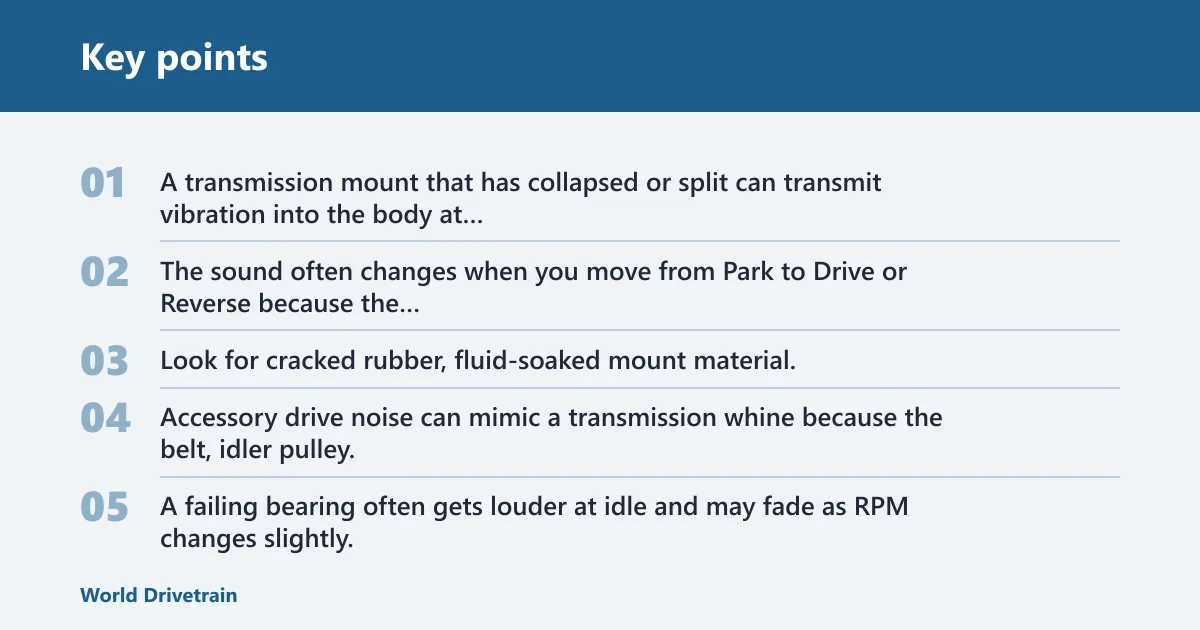
Transmission mount vibration at idle
A transmission mount that has collapsed or split can transmit vibration into the body at idle. The sound often changes when you move from Park to Drive or Reverse because the powertrain twists under load. Look for cracked rubber, fluid-soaked mount material, or excessive engine movement when shifting.
Serpentine belt, pulley, and tensioner noise
Accessory drive noise can mimic a transmission whine because the belt, idler pulley, alternator, and tensioner all spin at engine speed. A failing bearing often gets louder at idle and may fade as RPM changes slightly. If the pitch follows engine speed exactly, do not assume the transmission is at fault.
Exhaust shield or contact-point rattle
Exhaust heat shields, hangers, or pipes can rattle in Park when the engine sits at a certain vibration frequency. Shift into gear, and the engine load changes enough to move the exhaust or change resonance. That can make the rattle stop even though the transmission itself is fine.
Picture a minivan that rattles only in Park with the A/C on, then goes quiet in Reverse. A loose heat shield above the transmission tunnel can do that because the idle vibration in Park lines up with the loose panel, while the load change in gear moves it off that frequency.
What to check before you drive again
Start with simple checks, then decide whether the car is safe to keep driving. A loud grind, slipping, delayed engagement, or a growing noise is not a wait-and-see situation. Use the symptom pattern, fluid condition, and scan data together, because not every transmission fault turns on the MIL.
- Use an OBD-II scan tool and check stored and pending codes.
- Review live data for idle speed and transmission temperature if the tool supports it.
- Look under the car for fresh ATF leaks at the pan, cooler lines, axle seals, and case seams.
- Shift from Park to Drive and Reverse with the brake held, and note whether the sound changes immediately.
- Watch for slipping, hard shifts, flare, delayed engagement, or any burning smell.
- Stop driving if the noise becomes grinding, the trans slips, or the vehicle will not engage normally.
Use an OBD-II scan tool
Stored and pending codes can point to pressure, speed sensor, or control issues even when the dash is clear. Some faults do not trigger the MIL right away. Live idle speed and transmission temperature help separate a cold-only issue from one that appears after the fluid warms up.
Decide when to stop driving
If the noise is only present in Park and the vehicle shifts normally, a short diagnostic drive to a repair shop may be reasonable. Stop driving if the transmission slips, bangs into gear, leaks heavily, or the noise turns into grinding. Those signs suggest active damage or a low-pressure condition.
Frequently asked questions
Why is my transmission noisy in park but quiet in gear?
That pattern usually means the noise is tied to idle load, not a gearset under road load. Common causes include pump whine, torque converter noise, a loose mount, an exhaust shield, or an accessory pulley. The sound can fade in gear because load changes alter vibration and mask the source.
Is a transmission noise in Park normal?
Not always. Some light idle noise can be normal, but a clear whine, rattle, or grinding sound is not something to ignore. A sound that changes with temperature, RPM, or gear selection deserves a closer look because it can point to fluid, pump, converter, or mount problems.
Can low transmission fluid make noise only in Park?
Yes. Low ATF can cause aeration, and pump cavitation is often easiest to hear when the transmission is unloaded in Park or Neutral. The sound may get worse hot if the level drops further or the fluid foams more. Check level at operating temperature and confirm the correct fluid type.
Could the torque converter or pump be making this noise?
Yes. The pump is a common source of whine that tracks engine speed, and the torque converter can make noise if it has internal wear or clutch issues. If the sound is strongest at idle in Park and changes when you shift into gear, those parts move higher on the list.
Can an exhaust or engine mount sound like transmission noise?
Yes. A loose heat shield or pipe can rattle at idle, and a worn mount can send vibration into the cabin that sounds like a transmission problem. If the sound changes with engine movement more than with actual driving load, inspect the mount and exhaust before assuming the transmission is failing.
Is it safe to drive if the transmission only noises in Park?
It may be safe for a short trip if the transmission shifts normally and the noise stays limited to Park at idle. Do not keep driving if there is slipping, grinding, delayed engagement, or a strong leak. A quiet shift into gear does not rule out a pump or fluid problem.
When should I stop driving and get it checked?
Stop driving if the noise gets louder, the car starts slipping, shifts become harsh or delayed, or the fluid level is low enough to foam. Also stop if the sound becomes a grind or the vehicle hesitates to move in Drive or Reverse. Those signs call for prompt diagnosis.