Can Low Differential Fluid Cause Whining or Grinding?
Yes. Low differential fluid can cause whining, and if the level drops far enough, it can also lead to grinding as gears run hotter and lose lubrication. Ignore it, and a cheap top-off can turn into bearing, gear, or axle damage. This article shows how noise timing helps separate low fluid from wheel bearing, pinion, and axle problems.
Differential noise by driving condition
Sound timing matters more than the sound itself. A whine on acceleration points to a different issue than a grind in a parking-lot turn, and a clunk during throttle changes can also point away from fluid level alone. Differential fluid lubricates gears and bearings, and it can be low, contaminated, or incorrect in front, rear, center, or transaxle applications.
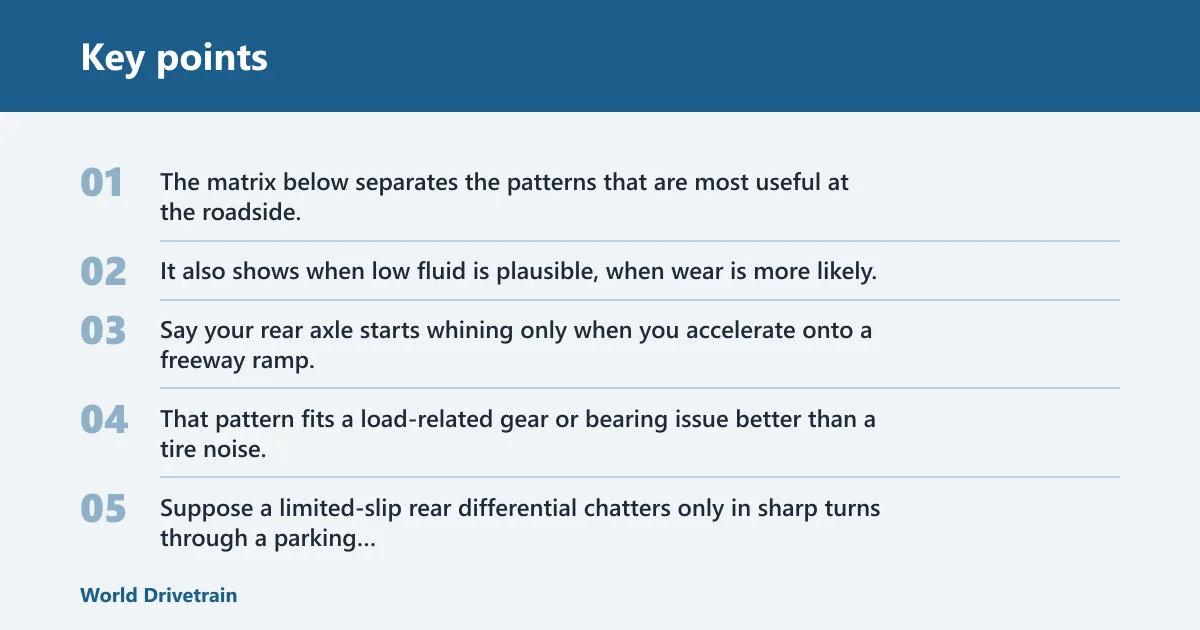
The matrix below separates the patterns that are most useful at the roadside. It also shows when low fluid is plausible, when wear is more likely, and when the safest move is to stop driving.
| Sound | When it happens | Likely cause | Is low fluid plausible? | Stop-driving urgency |
|---|---|---|---|---|
| Whine on acceleration | Throttle applied, noise rises with speed under load | Ring-and-pinion wear, pinion bearing wear, low lubrication | Yes | Medium if mild; high if loud or worsening |
| Whine on deceleration | Lift off the throttle, especially at steady speed | Ring-and-pinion gear pattern issue, bearing wear, setup wear | Sometimes | Medium; schedule inspection soon |
| Grind on turns | While cornering, especially under load | Severe wear, damaged gears, low lubrication, limited-slip distress | Yes, but damage is more likely | High; stop driving if it is loud or repeatable |
| Chatter in tight turns | Low-speed parking lot turns, often with limited-slip units | Limited-slip friction modifier depleted, wrong fluid, clutch chatter | Possible | Low to medium; correct fluid/spec may fix it |
| Clunk on load change | On throttle tip-in, lift-off, or gear changes | Driveshaft, universal joints, backlash, mount or axle play | Less likely | Medium; inspect soon |
Say your rear axle starts whining only when you accelerate onto a freeway ramp, then quiets on steady cruise. That pattern fits a load-related gear or bearing issue better than a tire noise, and low fluid stays on the list because lubrication and cooling drop as the oil level falls.
Suppose a limited-slip rear differential chatters only in sharp turns through a parking lot, but drives quietly in a straight line. That points more toward depleted friction modifier or the wrong fluid than toward a damaged ring-and-pinion set.
Can low differential fluid cause whining?
Yes. Low differential fluid can cause whining or humming because the gears and bearings lose oil film, lubrication drops, and heat builds faster. When the oil film thins, the pinion bearings, carrier bearings, and ring-and-pinion gears can run noisier under load. Low fluid is plausible, but it is not the only explanation.
When whining is more likely from fluid level
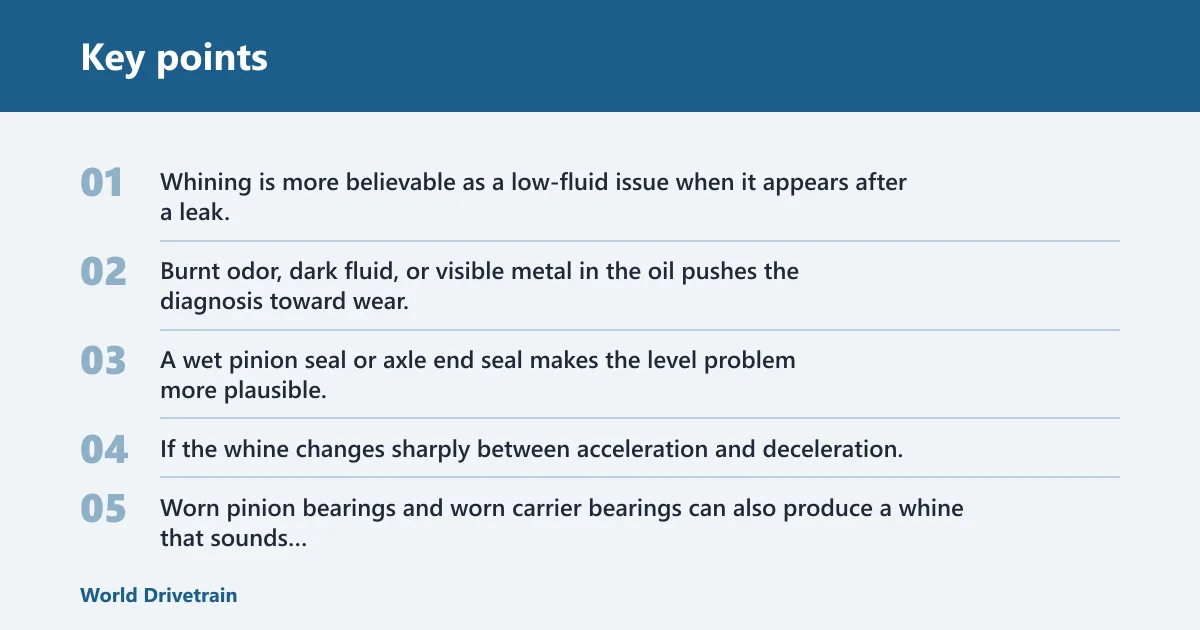
Whining is more believable as a low-fluid issue when it appears after a leak, grows with speed, or gets louder under acceleration. Burnt odor, dark fluid, or visible metal in the oil pushes the diagnosis toward wear, not just level. A wet pinion seal or axle end seal makes the level problem more plausible.
When whining points to wear instead
If the whine changes sharply between acceleration and deceleration, ring-and-pinion gear wear or setup error becomes more likely. Worn pinion bearings and worn carrier bearings can also produce a whine that sounds fluid-related. Low fluid can make the damage worse, but it may not be the original cause.
Can low differential fluid cause grinding?
Yes, but grinding is a more serious warning than a simple whine. Once the oil is low enough for metal contact, gears and bearings can score, overheat, and shed debris. That makes grinding more consistent with internal damage or severe lubrication loss than with a minor top-off issue.
Why grinding changes the diagnosis
Grinding often suggests the differential has moved beyond a simple fluid-level problem. Metallic fluid, a burnt smell, or visible shavings means parts are already wearing. At that point, adding fluid alone may quiet the noise briefly, but it does not fix damaged gears or bearings.
Grinding on turns is a red flag
If the noise appears while cornering, the loading on the side gears, clutch packs, and bearings changes. That is why a turn-only grind is more concerning than a straight-line hum. Limited-slip units can chatter in turns, but true grinding should not be treated as normal chatter.
What does differential whine sound like?
Differential whine is usually a high-pitch tone that rises and falls with vehicle speed. It may sound like a faint airplane note, a steady howl, or a thin mechanical whistle. A low hum can be the same fault in a different stage, especially if bearing wear is involved.
High-pitch whine versus low hum
Whine tends to be sharper and more noticeable at highway speed. Humming is lower and can overlap with tire noise, which is why timing matters. If the sound tracks road speed in a straight line but changes little with engine rpm, the differential, wheel bearings, and tires all remain possible.
Acceleration versus deceleration helps separate causes
Ring-and-pinion gear wear often changes character depending on load. A whine that appears on throttle but softens on coast points one way; the opposite pattern points another. That load sensitivity is more useful than sound quality alone, because bearing and gear faults can overlap.
Is it the differential or a wheel bearing?
It may be either. Wheel bearings can sound very similar to differential noise, and noise can come from wheel bearings instead of the differential. Tire-related noise can also mislead diagnosis. Speed alone does not prove the differential is at fault.
Simple clues from straight-line driving and turns
A wheel bearing often changes when the vehicle’s weight shifts in a turn. If the noise gets louder on a left turn, the right-side bearing may be loaded more heavily, and the reverse can also happen. Differential noise often changes more with throttle, coast, or axle load than with steering angle alone.
Why a straight road test matters
On a smooth straight road, a bearing or differential fault may both sound like a steady hum. That is why you should note whether the noise changes with speed, with acceleration, or with lane changes. A quick road test can narrow the source, but it cannot confirm it without inspection.
Leak points and fluid condition
Leaks matter because they lower fluid level and can point to the failing part. Axle seals, pinion seals, and cover gaskets are common leak points, and wetness near the housing or at the wheels is useful evidence. Differential fluid can be contaminated, burnt, milky, or metallic, and those clues change the diagnosis.
Where leaks often show up
Fluid near the pinion yoke suggests a pinion seal issue. Wetness on the axle ends or inside the brake area points more toward axle seals. A damp cover seam can mean the cover gasket or sealant has failed. Any of those leaks can lead to a low level if ignored.
How fluid condition changes the meaning of the noise
Burnt fluid often means overheating. Metallic fluid suggests wear already inside the housing. Milky fluid usually points to water contamination, which can attack bearings and gears quickly. Incorrect fluid can also matter, especially in limited-slip differentials that need a specific viscosity and friction-modifier specification.
Limited-slip chatter is not the same as gear grind
Limited-slip differentials can chatter or bind in tight turns when the additive package is depleted or the wrong fluid is used. That sound is usually a grabby chatter, not a harsh grinding noise. If the complaint is limited to slow parking lot turns, the fluid specification deserves attention.
Can you keep driving with a noisy differential?
Sometimes, but only when the noise pattern points to a mild issue and the fluid level is still likely recoverable. A light whine with no grinding, no metal in the oil, and no rapid worsening may allow careful driving to a repair. Loud growling, grinding, or sudden change means stop driving.
When a top-off issue is still possible
If the noise is new, the housing is wet, and the fluid is low but not burnt or metallic, a leak and top-off problem is plausible. That still requires the correct fluid type and fill procedure for that vehicle. Guessing at the fluid can create a second problem, especially on AWD or limited-slip systems.
When to stop driving now
Stop driving if the differential grinds, growls loudly, or changes rapidly over a short distance. Those signs can mean bearing or gear damage is already underway. Low fluid increases the risk of internal gear and bearing damage, so continuing to drive can turn a repairable problem into a housing or axle failure.
What rapid change usually means
If the noise suddenly becomes louder after a highway run, or if it changes from whine to grind, the lubrication margin may be gone. A temperature rise and accelerated wear can follow quickly. That is the point where towing is safer than gambling on another few miles.
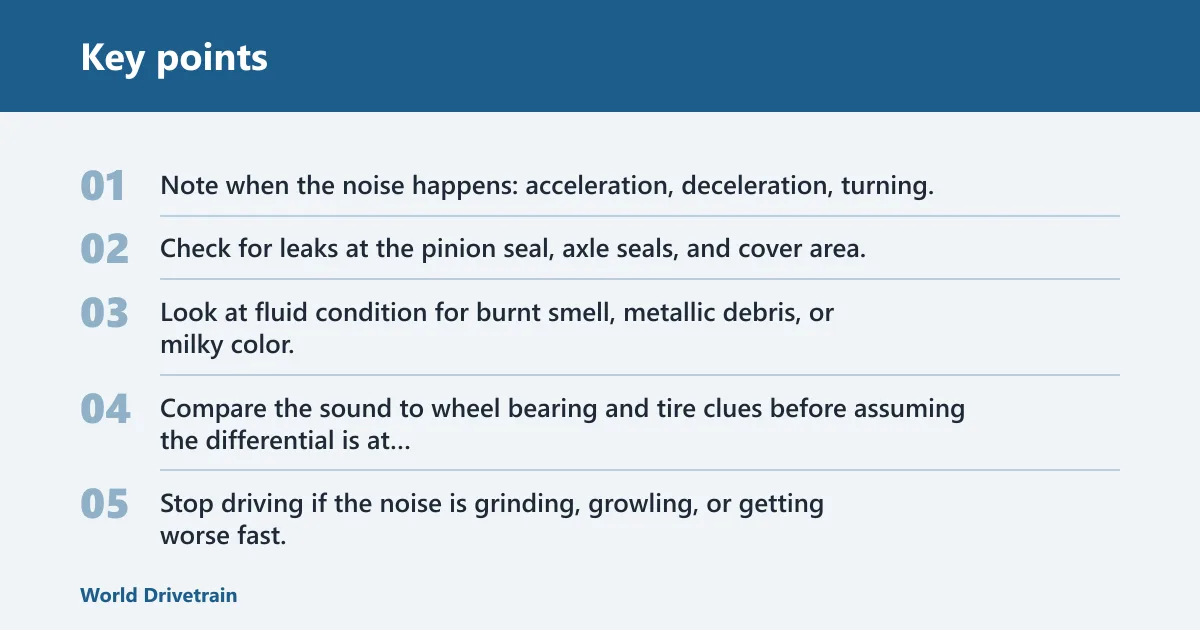
- Note when the noise happens: acceleration, deceleration, turning, or straight-line cruising.
- Check for leaks at the pinion seal, axle seals, and cover area.
- Look at fluid condition for burnt smell, metallic debris, or milky color.
- Compare the sound to wheel bearing and tire clues before assuming the differential is at fault.
- Stop driving if the noise is grinding, growling, or getting worse fast.
What else can sound like differential trouble?
Driveshaft and universal joints can create clunks or vibration that sound like axle trouble. Tire noise and rough pavement can mimic a hum. Limited-slip chatter in parking lots can be mistaken for gear damage. The source matters, because the repair path changes completely depending on which part is making the noise.
Driveshaft and universal joint noise
A clunk on throttle tip-in or lift-off can come from play in the driveshaft or universal joints, not the differential. That noise often shows up during load change rather than at a steady speed. If the sound feels like a bump or lash, inspection should include the shaft and joints.
Tire noise and road texture
Tires can hum or drone in a way that sounds mechanical. Uneven wear, aggressive tread, or certain pavement surfaces can make that noise worse. If the sound changes mainly with road surface and not with throttle or turn direction, the differential becomes less likely.
Limited-slip chatter in tight turns
In a tight parking lot turn, a limited-slip unit can chatter if the friction modifier is depleted or the wrong fluid is installed. That is a low-speed cornering symptom, not the same as a steady whine on the highway. The fix may be fluid-spec related, but only if the rest of the differential is not damaged.
Frequently asked questions
How can I tell if the noise is the differential and not a wheel bearing?
Watch for how the noise changes. Differential noise often changes with acceleration or deceleration, while wheel bearing noise often tracks road speed and may shift with steering load. Because the two can sound alike, speed alone does not prove the differential is the source.
Can I keep driving if the differential is noisy but not leaking?
Maybe, but only if the noise is mild, stable, and not grinding. A whine or hum can still mean bearing or gear wear, even without a visible leak. If the sound changes quickly, becomes louder, or turns into a grind, stop driving and get it inspected.
Does low differential fluid cause noise when turning?
It can, especially if the fluid is low enough to stress the side gears, bearings, or limited-slip clutches. Still, turn-only noise is not automatically a low-fluid problem. Chatter in tight turns often points to a limited-slip fluid or additive issue, while a harsh grind points to damage.
Is differential noise always a sign of internal damage?
No. Some noise comes from low fluid, contaminated fluid, wrong fluid, or a limited-slip additive problem. But whine that changes with load, metallic fluid, or any grinding raises the chance of actual wear inside the housing. The safer move is to inspect before more driving creates more damage.