How Much Does Axle Seal Leak Repair Cost?
An axle seal leak repair usually costs roughly $250 to $1,200, depending on the vehicle and how much related work is needed. Most front- or rear-wheel-drive cars land near $300 to $600, while AWD or 4WD jobs often cost more because labor and fluid work go up. Leaving it alone can drain gear oil or differential fluid, damage bearings or gears, and turn a seal job into a much larger repair. This guide breaks down the seal, labor, fluid, and common add-ons so you can judge whether a quote is fair. For related pricing, see Differential Fluid Change Cost and CV Axle Replacement Guide.
Axle seal cost table
The bill depends on whether you need a seal only, a seal plus fluid service, or a seal plus hardware because the axle shaft or bearing surface is worn. Access matters too. A simple seal on an easy-to-reach rear axle costs far less than a front seal buried near suspension parts or an AWD unit with extra disassembly. If the diagnosis overlaps with a transmission-side leak, a Transmission Leak Repair Cost guide can help you compare scopes.
| Repair scope | Typical total | What usually drives the price |
|---|---|---|
| Seal only | $250 to $450 | One seal, limited labor, light cleanup, no major fluid loss |
| Seal plus fluid service | $350 to $700 | Seal replacement plus gear oil or transmission fluid top-off or full change |
| Seal plus axle or bearing add-on | $650 to $1,200 | Worn shaft, bearing, or hub parts add labor and parts cost |
What changes the total
Parts are only part of the bill. Labor often sets the final price because the technician may need to remove brakes, hubs, axle shafts, or suspension parts to reach the seal.
Shop estimates also change with the exact leak location. Front axle seal work on a front-wheel-drive car can be tighter than rear axle seal work on a rear-wheel-drive truck. On AWD vehicles, the differential or transfer case area may add steps and fluid handling. If a worn joint or boot is part of the issue, compare the scope with a CV Axle Replacement Guide before approving the repair.
What does axle seal repair cost?
For a typical axle seal job, parts are usually modest and labor is the main expense. A basic seal may cost only a small amount, but the total rises fast if access is poor or if the repair needs fresh fluid afterward. Dealership quotes are often higher than independent shop pricing for the same work.
Typical parts cost
An aftermarket axle seal is usually cheaper than an OEM part. OEM seals generally cost more, but they may be specified for certain drivetrains or designs. If the quote includes an axle shaft, bearing, or hub assembly, the parts total can climb sharply.
Fluid is another part cost to watch. A rear axle seal may need gear oil, while a front transaxle application may need transmission fluid or a specified differential fluid. If the fluid was lost for any length of time, a full service may be better than a simple top-off. For vehicles due for maintenance soon after the repair, a Differential Fluid Change Cost estimate can help separate preventive service from repair costs.
Typical labor cost
Labor is the biggest swing factor. A straightforward rear seal on an accessible axle may take about an hour or two. A front seal on a tightly packaged drivetrain can take longer because the technician has to clear more components to reach the housing.
Shop labor rates usually come in below dealer rates. Dealerships may charge more because of higher overhead and brand-specific procedures. Independent drivetrain or general repair shops often price the same seal job lower when the access and parts list are simple. ASE technician labor-rate surveys and published dealer labor guides show wide regional variation, which is why quotes can land near $350 to $700 for seal-plus-fluid repairs and $650 to $1,200 when axle, hub, or bearing work is added. OEM service information from manufacturers such as Toyota, Ford, and GM also shows how drivetrain layout and added disassembly increase billed labor time.
Shop versus dealership pricing
A shop quote should separate parts, labor, and fluid. If it does not, ask for the breakdown before approving the repair. That lets you compare a dealership estimate against an independent shop on the same scope.
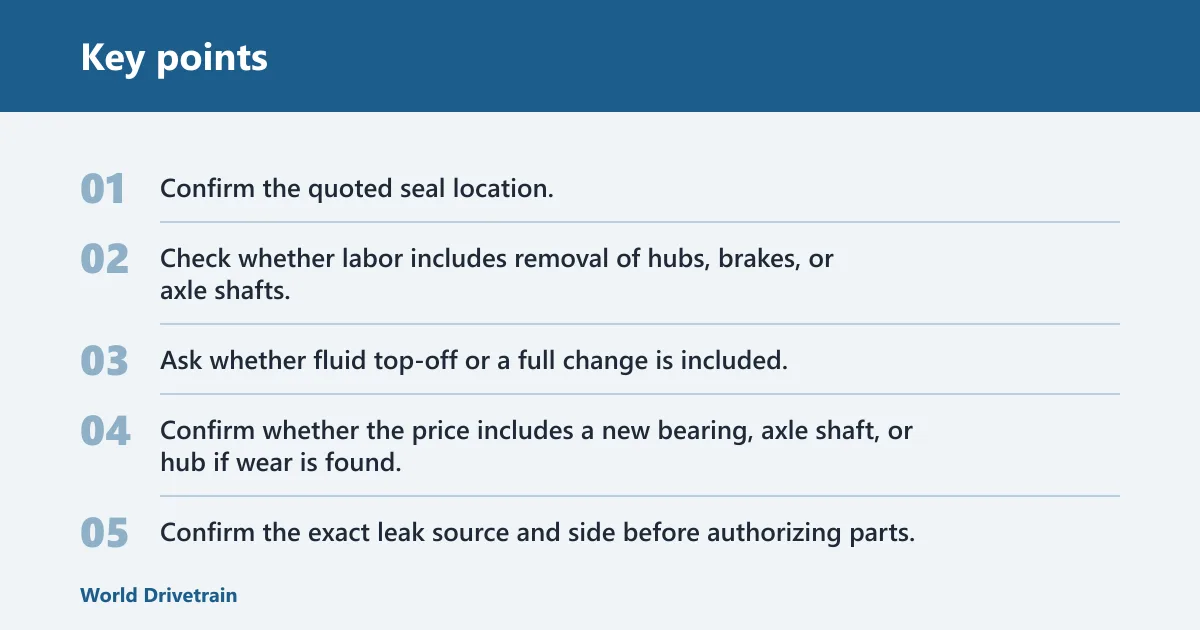
- Confirm the quoted seal location.
- Check whether labor includes removal of hubs, brakes, or axle shafts.
- Ask whether fluid top-off or a full change is included.
- Confirm whether the price includes a new bearing, axle shaft, or hub if wear is found.
How to verify the estimate
- Confirm the exact leak source and side before authorizing parts.
- Match the quote to the drivetrain: FWD, RWD, AWD, or 4WD.
- Check whether the estimate includes seal, labor, cleanup, and fluid.
- Ask whether brakes, hubs, or axle shafts must be removed.
- Verify whether any bearing, hub, or shaft wear is a separate line item.
- Confirm the fluid type and whether the repair needs a top-off or full change.
What is leaking, exactly?
An axle seal is a fluid-retaining seal at the point where the axle shaft passes through the housing. On front-wheel-drive cars, that area is often near the transaxle. On rear-wheel-drive vehicles, it is usually at the differential. On some AWD setups, you may also be dealing with a transfer case or a second differential.
Seal function and common failure causes
The seal keeps gear oil or transmission fluid inside the housing and dirt out. It can leak when the sealing lip wears, the shaft surface grooves, the housing is damaged, or the bearing develops play and lets the shaft move off-center.
Heat, age, contamination, and incorrect installation can also cause trouble. A bad breather or overfilled housing can add pressure and push fluid past the seal.
Seal leak versus CV boot grease
Do not assume every wet axle area is a seal leak. A torn CV boot can throw grease around the wheel well and mimic an axle seal problem. A real seal leak usually leaves fluid at the housing or backing plate, while CV grease is thicker and often splattered outward.
A common first-timer mistake is to spot oily residue near the wheel and skip the source check. The fix is different if the leak is coming from the seal, the boot, or another nearby part.
Why does the price change by drivetrain?
Drivetrain layout changes access, and access changes labor. Front-wheel-drive cars often require more disassembly around the transaxle and suspension. Rear-wheel-drive vehicles can be easier if the seal is at the axle housing and the shaft pulls out cleanly. AWD often adds extra components and fluid circuits.
Front-wheel drive access differences
On FWD vehicles, the seal may sit in or near the transmission case. That can mean tighter work space and more careful fluid handling. If the CV axle must be removed to reach the seal, labor rises.
Front axle seal jobs also need a careful source check because a transmission leak and an axle seal leak can appear close together. The quote should name the exact side and housing.
Rear-wheel drive and axle housing access
Rear axle seal work on RWD cars and trucks is often more direct, but it can still require hub or brake removal. Some vehicles need axle shaft pullers, and some need bearing service if the shaft rides on a worn surface.
Rear axle seal repair can be cheaper than a front or AWD job when the housing is easy to access. It can be more expensive when the axle bearing or shaft surface is damaged.
All-wheel drive and differential or transfer case proximity
AWD units can stack the labor because the seal may sit near a differential, transfer case, or intermediate shaft. More parts have to come off, and the correct fluid type matters. That is why AWD quotes often run higher than a simple two-wheel-drive seal repair.
How serious is a leaking axle seal?
A small seep is usually less urgent than an active drip, but both deserve attention. If fluid level drops enough, the housing can run low on lubrication, and that can damage bearings, gears, or the transmission components tied to the axle seal location. Contaminated or aerated fluid also loses effectiveness.
Minor seep versus active drip
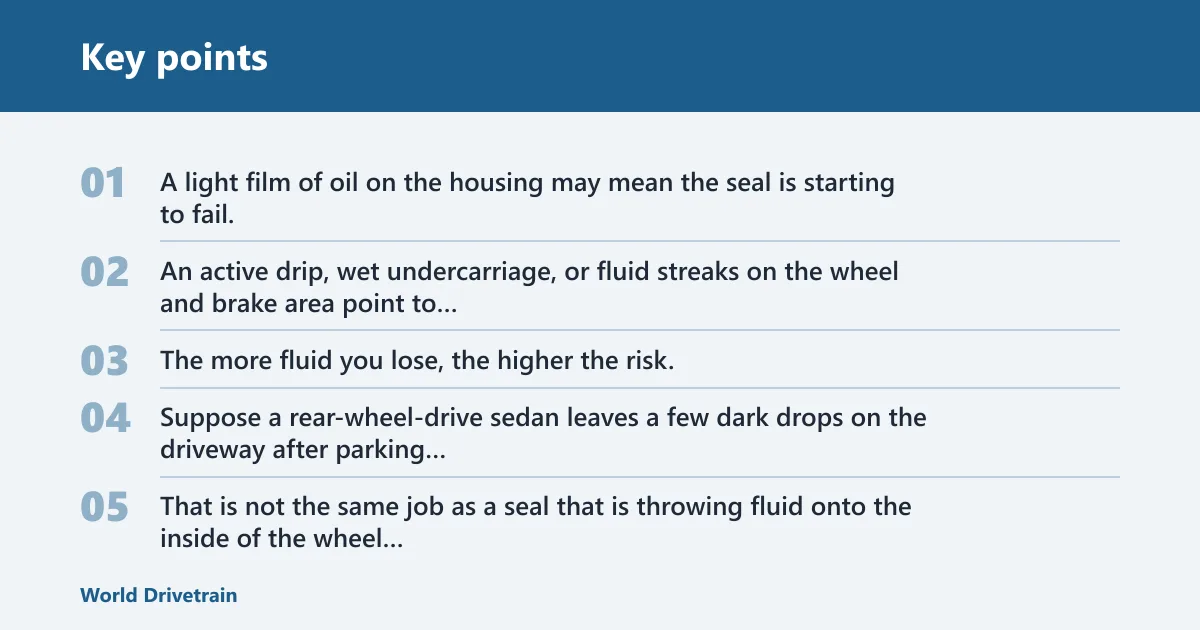
A light film of oil on the housing may mean the seal is starting to fail. An active drip, wet undercarriage, or fluid streaks on the wheel and brake area point to a more serious leak. The more fluid you lose, the higher the risk.
Suppose a rear-wheel-drive sedan leaves a few dark drops on the driveway after parking overnight. That is not the same job as a seal that is throwing fluid onto the inside of the wheel and making the differential run low. The second case needs faster action.
Low-fluid and contamination risks
Low gear oil can shorten bearing life and raise heat. If the seal leak allows water or road grit in, the fluid can contaminate and the wear rate climbs. Aeration can also happen if the level drops enough for the gears to whip air into the fluid.
Noise is another warning. A worn bearing or shaft surface may produce growl, hum, or rumble along with the leak.
When to stop driving
Stop driving if the leak is active, the fluid is visibly low, or you hear bearing noise. If the fluid is reaching the brakes or tire, the risk rises further because braking performance and tire grip can be affected.
What should a shop quote include?
A fair quote should list the leak source check, the seal, labor, cleanup, and any fluid service tied to the repair. If the technician finds shaft wear or bearing play, the estimate should show those add-ons separately instead of burying them in one line.
Leak source inspection
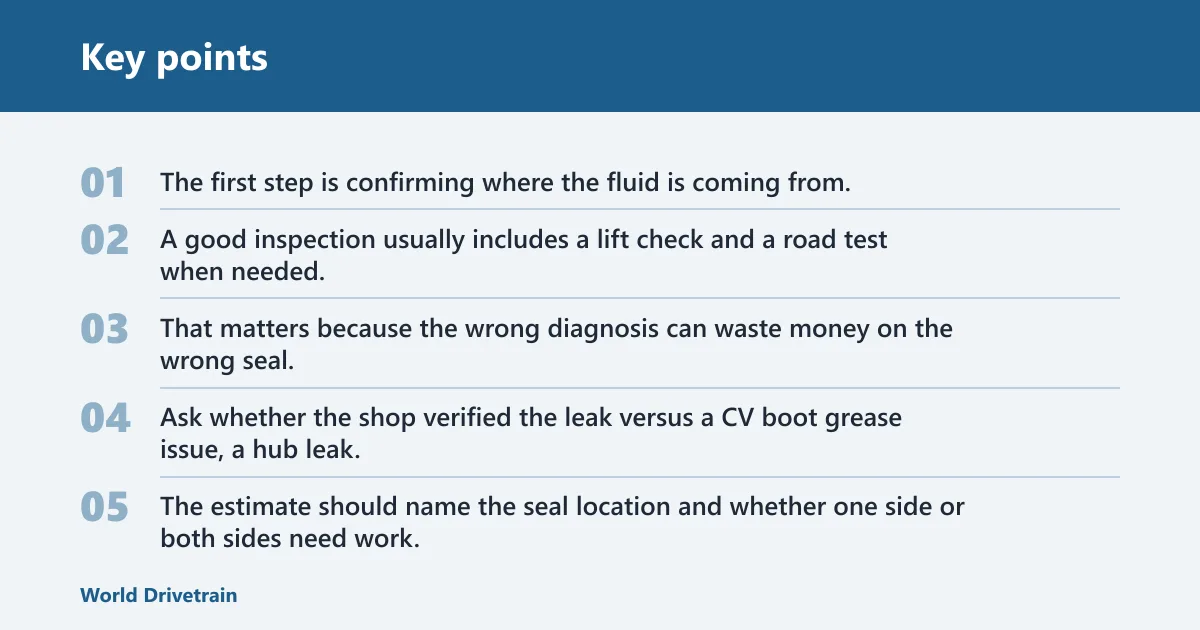
The first step is confirming where the fluid is coming from. A good inspection usually includes a lift check and a road test when needed. That matters because the wrong diagnosis can waste money on the wrong seal.
Ask whether the shop verified the leak versus a CV boot grease issue, a hub leak, or another nearby source. That one step can prevent a repeat visit.
Seal, labor, and cleanup
The estimate should name the seal location and whether one side or both sides need work. It should also include cleanup of leaked fluid so the area can be inspected after repair.
Fluid top-off or full fluid change
Do not assume fresh fluid comes with the seal. Some jobs need only a top-off after the leak is fixed. Others need a full change because the fluid level dropped too far or the fluid was contaminated.
Did the estimate mention the fluid type? It should. Differential fluid and transmission fluid are not interchangeable, and the wrong fluid can create another repair. If the vehicle also needs a maintenance service, compare it with Differential Fluid Change Cost to separate repair from routine service.
Shaft or bearing add-on notes
If the shaft surface is grooved or the bearing is loose, a seal alone may not solve the problem. The estimate should state whether the axle shaft, bearing, or hub is being replaced and why. That is where many surprise costs show up.
Can you drive with an axle seal leak?
You can sometimes drive a short distance with a minor seep, but it is not a fix-it-later problem. If the leak is small, the fluid level is stable, and there is no noise, a short trip to a shop may be reasonable. Active leakage, noise, or low-fluid signs mean do not keep driving.
Short-term exceptions
Short-term driving can be reasonable when the leak is light and the vehicle is not showing other symptoms. Even then, you should check the fluid level and plan the repair soon. A seal leak rarely gets better on its own.
Warning signs that mean do not drive
Do not drive if you see rapid dripping, smell hot oil, hear growling from the axle area, or notice fluid on the brake components. Those signs point to a repair that is already beyond simple monitoring.
When DIY is reasonable
DIY can make sense for a minor, accessible seal on a familiar platform if you have the right tools, a service manual, and a way to measure the correct fluid level afterward. It is a poor DIY candidate if the axle shaft must be pressed, the bearing is worn, or the leak source is uncertain.
Picture a front-wheel-drive compact with a slow seep from one transaxle seal and no bearing noise. That may be a reasonable do-it-yourself project for an experienced home mechanic. Picture the same car with a noisy hub and fluid on the brake rotor. That repair belongs on a lift.
Frequently asked questions
How much does axle seal replacement cost?
Axle seal replacement usually costs $250 to $1,200. The price depends on access, fluid needs, and whether the repair stays at the seal or expands into axle or bearing work. Simple seal-only jobs sit near the low end, while AWD or added hardware pushes the bill higher.
How much does it cost to fix an axle leak?
Fixing an axle leak can cost a few hundred dollars or more than $1,000. The exact price depends on whether the issue is only a seal, or whether the shaft surface, bearing, or fluid service also needs attention.
How much does it cost to replace an axle shaft seal?
Replacing an axle shaft seal usually falls in the same range as other axle seal work. The price changes if the axle shaft must come out or if the bearing surface is worn and needs replacement too.
Why do axle seals leak?
Axle seals leak when the seal wears out, the shaft surface grooves, or the bearing allows movement. Heat, contamination, poor installation, overfilled fluid, and a blocked breather can also trigger seepage or a larger leak.
Does axle seal leak repair include fluid replacement?
Not always. Some repairs only need a top-off, while others require a full fluid change because the level dropped too low or the fluid was contaminated.