What Does a Bad Transmission Sound Like?
A bad transmission can often sound like whining, humming, clunking, grinding, or a shudder that changes with gear selection; if it slips, loses drive, or grinds hard, stop driving. Keep going, and a fixable fault can turn into burned clutches, metal in the unit, and a much higher rebuild bill. This guide helps you match specific noises to transmission, wheel bearing, differential, mount, or engine causes.
Common transmission noises and what they mean
A bad transmission usually makes noise that tracks a change in gear, load, fluid pressure, or vehicle speed. The key is not the noise alone. It is the pattern: when it starts, whether it changes with RPM or road speed, and whether the vehicle still engages gears cleanly.
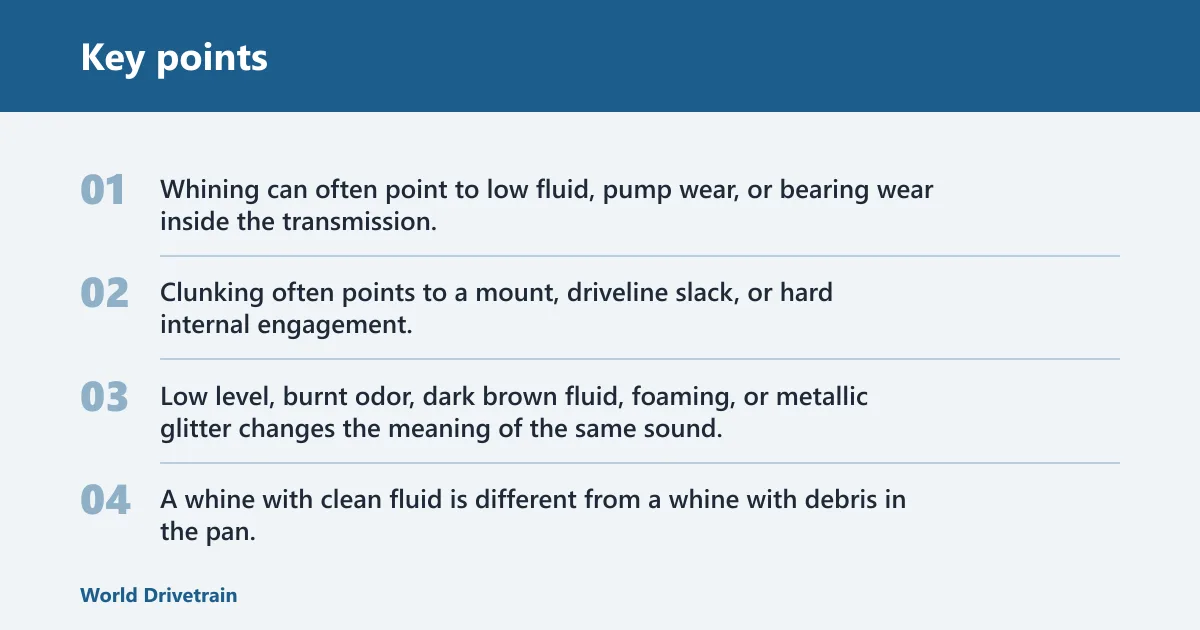
Whining can often point to low fluid, pump wear, or bearing wear inside the transmission. Clunking often points to a mount, driveline slack, or hard internal engagement. Grinding is often more serious and may mean worn gears, failed synchronizers in a manual, or damaged clutches in an automatic.
Transmission noise diagnosis matrix
| Noise | Most likely cause | Trigger condition | Severity | Action |
|---|---|---|---|---|
| High-pitched whine | Low fluid, pump wear, or bearing wear | Changes with engine RPM; often stronger in Drive than Park | Medium to high | Inspect soon; tow if it gets louder fast |
| Humming | Bearing wear, fluid aeration, or differential misdiagnosis | Tracks vehicle speed more than gear selection | Medium | Monitor, then inspect if it grows |
| Buzzing | Valve body, solenoid, or fluid pressure issue | Happens during shifts or at a steady throttle | Medium | Inspect soon |
| Clunking | Transmission mount, driveline lash, or hard gear engagement | Load changes, reverse engagement, or tip-in and tip-out | Medium to high | Inspect soon; tow if the drivetrain bangs hard |
| Grinding | Damaged gears, failed bearings, or clutch/synchronizer wear | During shifting or under load | High | Stop driving and tow |
| Rattling | Loose heat shield, mount movement, or internal looseness | Idle, takeoff, or light throttle | Medium | Inspect soon |
| Shudder | Torque converter, low fluid, clutch slip, or CVT belt/chain issue | Light acceleration or lockup engagement | Medium to high | Inspect soon; tow if slip is present |
| Metallic scrape or chatter | Internal hard-part damage or debris in the unit | Can appear at idle, shift, or movement | High | Stop driving and tow |
Fluid condition matters. Low level, burnt odor, dark brown fluid, foaming, or metallic glitter changes the meaning of the same sound. A whine with clean fluid is different from a whine with debris in the pan.
What does a bad transmission sound like when accelerating?
Under acceleration, a bad transmission often gets louder as torque demand rises. Whine, shudder, or a clunk on tip-in can point to low pressure, worn clutches, a failing pump, or a loose mount. If the sound grows with throttle and the vehicle slips or hesitates, treat it as urgent.
Acceleration clues
A noise that rises with engine RPM often points to a pump, torque converter, or internal bearing. A noise that rises with vehicle speed instead of RPM can point to gear train wear, differential noise, or a wheel bearing.
Say your automatic transmission whines lightly in Park, then the same whine becomes sharper when you pull onto a steep ramp. That pattern fits a pump or fluid-pressure problem better than a wheel bearing, because the load changes the noise more than road speed does.
Suppose the vehicle shudders at 25 to 40 mph during gentle throttle, then smooths out when you lift off. In an automatic transmission, that often points to torque converter shudder, low fluid, or a lockup control issue. A hard clunk at the same time can also point to a failed transmission mount.
What does a bad transmission sound like at idle or in reverse?
At idle, a transmission noise that appears in Drive but not Park often points to fluid pressure, pump load, or torque converter issues. In reverse, a clunk, grind, or delayed engagement usually means hard engagement, internal wear, or low pressure. Reverse should not create a heavy bang.
Idle and reverse clues
A high-pitched whine at idle that gets louder in Drive can point to a transmission pump. If the noise changes when you shift from Park to Reverse, the unit may be loading up a worn pump, valve body, or torque converter.
Reverse is a good separator because it loads the unit differently. A brief thump as the gear engages can happen, but a repeated bang, flare, or grinding sound suggests wear inside the transmission or a mount that lets the drivetrain shift too far.
Automatic transmission noise patterns
Automatic transmission noise often changes with gear engagement behavior, fluid condition, and engine load. The same unit can sound fine at cruise and noisy at idle or during a shift. That is why sound timing matters as much as sound type.
Torque converter signs
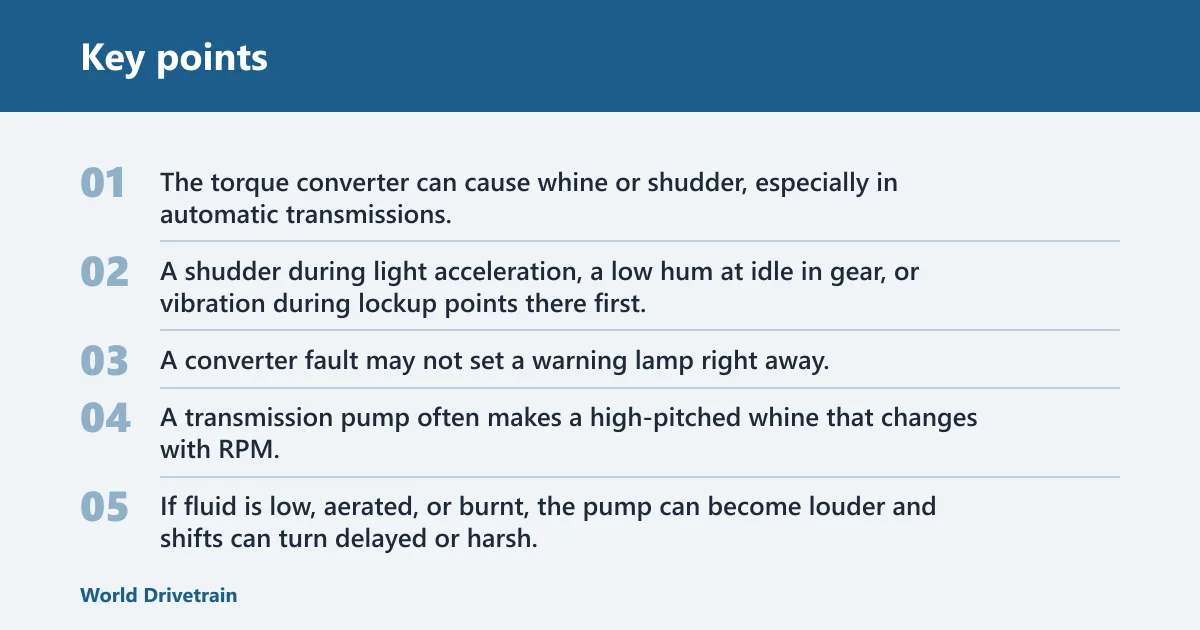
The torque converter can cause whine or shudder, especially in automatic transmissions. A shudder during light acceleration, a low hum at idle in gear, or vibration during lockup points there first. A converter fault may not set a warning lamp right away.
Transmission pump and valve body signs
A transmission pump often makes a high-pitched whine that changes with RPM. If fluid is low, aerated, or burnt, the pump can become louder and shifts can turn delayed or harsh. A valve body problem more often shows up as delayed engagement, busy shifting, or a buzz during shift events.
Check for dark or brown fluid, burnt odor, or fine metallic debris if the vehicle has a pan that can be inspected. Those clues make a noise more serious because they point to wear inside the unit, not just a temporary pressure drop.
Planetary gear set failure signs
A planetary gear set can produce whine, clunking under load, or a rough mechanical sound that follows gear changes. Once the gears, pinions, or carriers are damaged, the noise often comes with slipping, missing gears, or debris in the fluid. That is tow-now territory.
Manual transmission noise patterns
Manual transmission noise often sounds different from automatic noise. Gear whine, bearing noise, and clutch-related chatter are common. Noise during shifting matters more here, because synchronizer wear or clutch drag can create grinding that an automatic transmission would not produce.
Gear whine and bearing noise
A manual transmission with worn bearings often whines or hums in a specific gear and gets louder under load. If the noise changes with road speed and not just engine speed, that points toward rotating hard parts inside the gearbox or the differential, not the engine.
Clutch-related noise during shifting
Grinding while selecting a gear, especially with the clutch pedal fully down, often points to clutch drag, worn synchronizers, or internal wear. A rattling sound at idle that changes when the clutch is pressed can also point to the input shaft or release bearing area.
Noise that follows engine RPM in neutral but drops away when the clutch pedal is pressed often points to the transmission input side. Noise that follows road speed in gear points more toward the gear train, differential, or wheel-end parts.
How to tell transmission noise from wheel bearing or differential noise
Wheel bearing noise usually changes with road speed and gets louder when you steer left or right. Differential noise often comes from the rear and changes with load. Transmission noise changes more with gear selection, shift timing, and fluid pressure.
Speed and turning clues
If the hum gets louder when you turn left, suspect the right wheel bearing. If the sound barely changes with steering but grows as speed rises, the differential or a wheel bearing is more likely than the transmission. A transmission problem usually does not change much just because you turned the wheel.
Location and mount clues
A clunk from under the floor on takeoff can be a transmission mount. A mount allows the unit to move too far under acceleration, which can sound like a collision. That noise often arrives with a thump, vibration, or visible engine movement.
The rear axle is another common source of confusion. A rear-end whine that changes on acceleration and deceleration points toward the differential. A front-center whine that changes with gear selection points more toward the transmission.
Quick checks
- Match the trigger. Note whether the noise changes with RPM, road speed, gear selection, turning, or throttle. That split is the fastest way to separate transmission noise from wheel bearing or differential noise.
- Check the fluid. If the vehicle has a dipstick, check level with the engine at the correct temperature range listed by the maker. Look for dark color, burnt odor, foam, or glitter, since each points to a different failure pattern.
- Watch the engagement. Pay attention to delayed drive, harsh reverse, slipping, or a flare between gears. Noise plus poor engagement raises the urgency from monitor to inspect soon.
- Decide on driving. If the noise is light and stable, short-distance monitoring may be reasonable. If it grinds, bangs, slips, or loses drive, stop driving and arrange towing.
Frequently asked questions
What does a bad transmission sound like?
A bad transmission often sounds like whining, humming, clunking, grinding, buzzing, or a shudder that changes with gear selection or load. The most serious versions come with slipping, delayed engagement, harsh shifts, or lost drive. Those signs mean you should stop driving rather than wait for the noise to settle down.
What does a bad transmission sound like in reverse?
In reverse, a bad transmission may clunk, grind, delay engagement, or shift with a hard bang. Reverse loads the unit differently, so problems in pressure control, mounts, or internal wear often show up there first. A smooth reverse engagement with no slip is a better sign than a noisy or hesitant one.
What does a bad transmission sound like at idle?
At idle, a bad transmission may whine, hum, or chatter more clearly in Drive than in Park. That pattern often points to a pump, torque converter, or fluid-pressure problem. If the noise appears only when the vehicle is in gear, it is less likely to be a wheel bearing.
What does a bad transmission feel like when driving?
A bad transmission often feels like delayed engagement, slipping, harsh shifts, shuddering, or a sudden clunk when you get on and off the throttle. You may also feel a vibration that changes with gear changes rather than road speed. Those feel clues matter because they separate transmission trouble from a simple road-noise problem.
Can a bad transmission make noise without a check engine light?
Yes. A bad transmission can make noise without a check engine light, especially when the fault is mechanical, fluid-related, or still early. Many pressure, bearing, mount, and torque converter problems do not trigger a lamp right away. Noise plus changing shift behavior is enough reason to inspect it soon.
Can low transmission fluid cause the same noise?
Yes. Low transmission fluid can cause whining, humming, shuddering, delayed engagement, and harsh shifts because the pump may pull air instead of a solid fluid column. Burnt odor, dark color, foaming, or metallic debris makes the problem more serious. If the level is low, find the leak before more driving.