Should You Use 4WD on the Highway?
Use 4WD on the highway only if your vehicle uses full-time 4WD or the road is covered in snow or ice; never use part-time 4WD on dry pavement at highway speeds. Doing otherwise can bind the driveline, reduce steering control, and may damage the transfer case or tires. This guide gives a yes/no decision for dry pavement, rain, snow, and ice, split by 2WD, full-time 4WD, and part-time 4WD. (Motortrend)
What to know before engaging 4WD on the highway
The answer depends on road surface and drivetrain type. On dry pavement, part-time 4WD should stay off the highway. On wet, snowy, or icy roads, 4WD can work if the vehicle is built for it and the owner’s manual allows highway use at the speed you plan to drive.
The short answer by road surface
Dry pavement usually means 2WD, full-time 4WD, or AWD. It does not mean part-time 4WD in 4H for long stretches. Rain, slush, packed snow, and ice change the answer because they cut tire grip and make 4WD more useful for traction. Gravel or dirt also favors 4WD, but that is no reason to leave part-time 4WD engaged once you return to high-traction pavement.
The short answer by drive system
Part-time 4WD is generally intended for low-traction surfaces and uses a locked front-to-rear drivetrain in 4H. Full-time 4WD and AWD can generally be used on pavement because they use a center differential or coupling. 4WD Low is generally for slow, high-torque work, not highway driving.
Is AWD the same as 4WD on pavement?
No. Full-time 4WD and AWD are made for continuous on-road use, while part-time 4WD is not. That difference matters on paved highways, where the front and rear wheels travel different distances in turns and the drivetrain must handle that mismatch without binding.
Full-time 4WD and AWD
Full-time 4WD and AWD can stay engaged on dry pavement because a center differential or coupling lets the front and rear axles rotate at different speeds. Vehicle-specific speed limits and traction rules still apply, so the owner’s manual remains the first source for when a mode is allowed and how fast you may drive in it.
Part-time 4WD
Part-time 4WD is usually found in trucks and SUVs. In 4H, it locks the front and rear drives together, which helps on low-traction surfaces but creates driveline bind on dry, high-grip pavement. That is why part-time 4WD should not be treated as a normal highway mode.
Part-time 4WD on dry pavement
Part-time 4WD on dry pavement is the wrong setup. The tires get enough grip to force the front and rear axles to turn at slightly different speeds, and the locked drivetrain has nowhere to relieve that mismatch. The result is bind, extra steering effort, and tire scrub.
Why driveline bind happens
Driveline bind comes from front-rear wheel speed mismatch. On a dry highway, especially in turns, the front axle wants to travel a different path than the rear axle. A locked part-time system cannot let that difference slip away, so stress builds in the transfer case, driveshafts, and tires.
What the steering wheel and tires may do
Common symptoms include hopping, tight steering, and a feeling that the vehicle wants to push through a turn. Tires may scrub or chirp at low speed in a parking lot exit or on an off-ramp, then feel worse as the turn gets tighter. If those signs appear, the mode is wrong for the surface.
Say your truck is in 4H on a dry interstate and you take a cloverleaf exit at 25 mph. If the steering suddenly feels heavy and the front tires chatter, that is a classic sign of bind, not normal highway behavior.
When to switch back to 2WD
Switch back to 2WD as soon as traction is normal again. For part-time systems, that means dry pavement, ordinary freeway cruising, and any stretch where the tires are gripping firmly instead of slipping. If the manual requires you to slow down before shifting, do that first so the transfer case can engage or disengage without damage.
- Confirm the surface. If the road is dry and clear, use 2WD on a part-time system. If the road is slick, keep reading the manual before engaging 4H.
- Check the drive mode. Make sure the dash indicator matches the selected mode. An incorrect light or blinking indicator can mean the transfer case has not finished shifting.
- Return to 2WD early. Once traction is normal, shift out of 4H. That reduces stress on the drivetrain and avoids tire scrub in turns.
4WD High vs 4WD Low
4WD High and 4WD Low are not interchangeable. 4H is the highway-capable traction mode for many systems, while 4L is for slow, controlled movement when torque matters more than speed. If you are moving at highway pace, 4L is the wrong range.
When 4H fits highway speeds
4WD High is used for higher-speed traction needs on wet, snowy, icy, or loose roads. Many vehicles allow 4H at highway-safe speeds if the manual says so. The key is that the surface should need extra traction; constant dry pavement use is the wrong application for a part-time system.
Why 4L stays off the highway
4WD Low is for low-speed, high-torque situations such as steep grades, deep mud, rock crawling, or recovery. It requires a very low vehicle speed and is not intended for highway driving. Using 4L at speed can over-rev the engine, create harsh drivetrain loads, and make control unpredictable.
What the owner’s manual should confirm
The owner’s manual is the primary source for system-specific limits. It should state whether 4H can be used at highway speeds, list any maximum speed guidance, and define approved surfaces. It may also require a certain transmission position, neutral selection, or vehicle speed before the transfer case can shift.
- Read the 4WD section. Look for the approved surfaces, speed limit, and shift procedure for 4H and 4L. Follow the vehicle’s rules, not a generic rule from another model.
- Match mode to task. Use 4H for slippery roads and 4L only for slow, high-load situations. If the manual does not allow the mode at your current speed, do not force it.
- Verify the indicator. Wait for the selected mode light to stop flashing or confirm engagement as specified. A half-engaged transfer case can act poorly on the highway.
4WD highway decision matrix
This table gives a simple right-now answer. If the vehicle is part-time 4WD, treat dry pavement as a no. If it is full-time 4WD or AWD, pavement use is generally allowed, but the manual still controls speed and mode limits.
| Road condition | Part-time 4WD | Full-time 4WD | AWD |
|---|---|---|---|
| Dry pavement | No, locked front and rear driveline can bind on high-grip pavement. | Yes, designed for pavement, though the manual may set mode limits. | Yes, built for continuous on-road use. |
| Rain | Caution, may help on slick patches, but avoid if traction is still normal and the manual says not to use 4H. | Yes, pavement use is generally acceptable. | Yes, intended for wet-road use. |
| Slush | Yes, low traction can justify 4H if the manual allows highway use. | Yes, suited to mixed-traction pavement. | Yes, suited to mixed-traction pavement. |
| Packed snow | Yes, a common 4H use case on snowy roads. | Yes, if the system and tires are set up for it. | Yes, if traction control and tire grip are adequate. |
| Black ice | Yes with caution, 4H may help launch and steady the vehicle, but it does not restore braking or steering grip. | Yes with caution, drivetrain help does not remove ice risk. | Yes with caution, AWD improves traction, not stopping distance. |
| Off-ramp turns | No on dry pavement; caution on slick surfaces only if the manual allows it and speed is reduced. | Yes, within vehicle limits. | Yes, within vehicle limits. |
Can you use 4WD in rain, snow, and ice?
Yes, often you can, but the surface and the system matter. Rain may not need 4WD at all. Snow and ice often do. Part-time 4WD is useful only when traction is low enough to justify it and the manual allows the speed and surface.
Rain and wet pavement
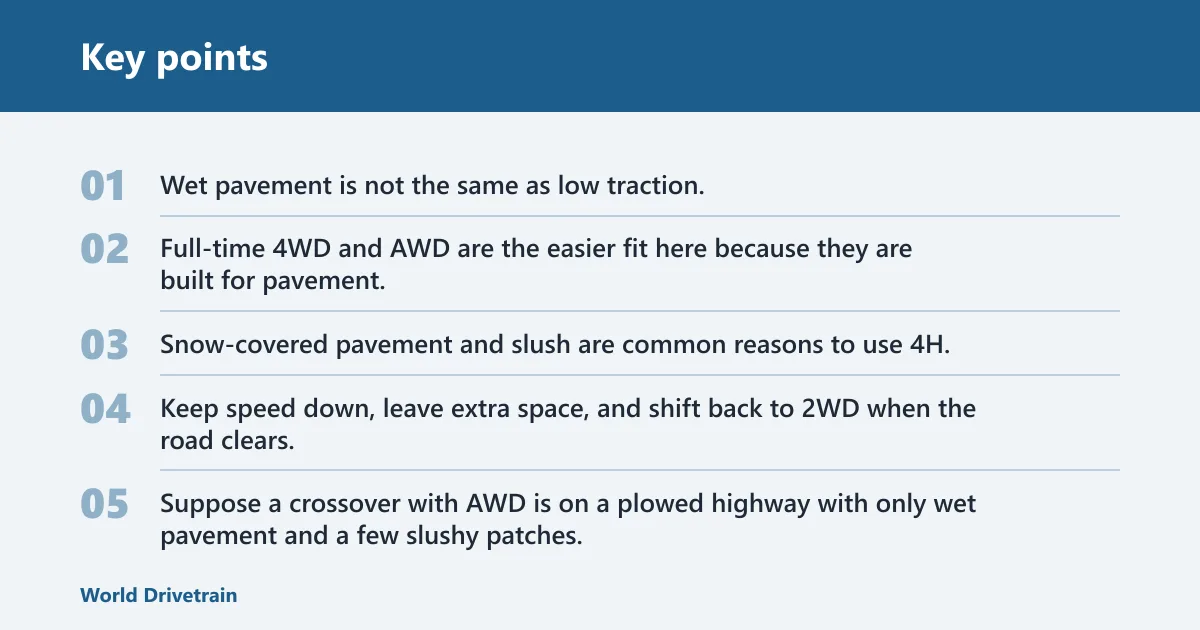
Wet pavement is not the same as low traction. Light rain on clean asphalt may still favor 2WD, while standing water, heavy spray, or slick painted markings may justify 4H in a part-time system if the manual allows it. Full-time 4WD and AWD are the easier fit here because they are built for pavement.
Snow and slush
Snow-covered pavement and slush are common reasons to use 4H. They cut tire grip enough that the locked front-to-rear setup in part-time 4WD can help. Keep speed down, leave extra space, and shift back to 2WD when the road clears.
Suppose a crossover with AWD is on a plowed highway with only wet pavement and a few slushy patches. AWD is fine to leave engaged, but the driver still needs reduced speed and longer following distance because braking traction is still limited.
Ice and black ice
Ice is the most deceptive surface. 4WD can help you start moving and maintain momentum, but it does little for braking on black ice. On any 4WD system, slow down early, avoid sudden steering inputs, and expect longer stopping distances than on bare pavement.
Signs of driveline bind
Driveline bind often feels like the vehicle is fighting itself. The problem is most obvious in turns, on parking-lot maneuvers, or at highway off-ramps where the front and rear axles need different wheel speeds. If the symptoms show up on dry pavement, the drive mode is likely wrong.
Tight steering in turns
Steering effort that rises in a turn is a common clue. The wheel may feel heavy, reluctant to self-center, or as if it wants to spring back when the turn ends. That is especially telling if the issue appears only in 4H and disappears in 2WD.
Tire scrub and hopping
Tire scrub can sound like chirping or feel like a skip-hop from the front or rear axle. It may show up most clearly at slow speed on a dry surface, then worsen in tighter turns. A locked part-time system should not produce that behavior on the road it was not meant for.
What to check next
If the vehicle feels bound up, switch out of part-time 4WD and inspect the mode indicator. Check the owner’s manual for the correct shift procedure, especially if the transfer case is electronic or requires a specific speed or transmission position. If the problem persists after the correct mode is selected, have the drivetrain inspected.
Frequently asked questions
Can you use 4wd on the highway?
Yes, if the vehicle has full-time 4WD or AWD, or if the highway is snow- or ice-covered and the manual allows 4H. No, if you mean part-time 4WD on dry pavement for long stretches. The drivetrain type matters more than the label on the dash.
Can you use 4×4 on the highway?
Sometimes. “4×4” may mean part-time 4WD, full-time 4WD, or a system with automatic engagement. Dry pavement is the wrong place for a locked part-time setup, but full-time systems are built for pavement use. Check the manual before assuming all 4×4 systems behave the same.
Is it safe to use 4×4 on the highway?
It is safe when the system is designed for highway use and the road condition calls for it. Full-time 4WD and AWD are generally fine on pavement. Part-time 4WD is safe on slick, low-traction roads, but not on dry pavement where bind and tire scrub can build quickly.
Can you use 4 wheel drive on the highway?
Yes, in the right system and on the right surface. 4WD High can be used on wet, snowy, icy, or loose roads if the manual allows highway speeds. 4WD Low should stay off the highway. Part-time 4WD should not stay engaged on dry pavement.
What speed can you drive in 4WD on the highway?
There is no universal speed limit. Many manufacturers allow 4H at highway speeds, but the exact maximum varies by vehicle and transfer case. The owner’s manual is the only reliable place to find the number, along with any rule about shifting speed or transmission position.
Will 4WD damage your drivetrain on dry pavement?
Part-time 4WD can, especially in 4H on dry pavement and during turns. The locked front-to-rear drivetrain cannot relieve wheel-speed differences, so bind builds in the transfer case, driveshafts, and tires. Full-time 4WD and AWD are designed to avoid that problem on pavement.
Should you switch back to 2WD before highway driving?
Yes, if your vehicle uses part-time 4WD and the road is dry or traction has returned to normal. Switch back to 2WD once you are no longer on snow, ice, slush, or other low-traction surfaces. That reduces bind, tire scrub, and fuel use.
Does 4WD High hurt gas mileage on the highway?
Usually yes, at least a little. Engaging 4WD High adds drivetrain drag and can increase fuel use compared with 2WD, especially in part-time systems. The size of the difference varies by vehicle, tires, and speed, but 4H is not a fuel-saving mode on dry highway pavement.
When should you use 4WD High instead of 2WD?
Use 4WD High when the road is slippery enough that extra traction matters: snow, slush, packed ice, wet gravel, or steep loose surfaces. Use 2WD when traction is normal. On part-time systems, that switch matters on the highway because dry pavement can cause bind in 4H.