Why Is My AWD Warning Light on?
An AWD warning light can mean the system has shut itself down because of a wheel-speed sensor, transfer-case, or related engine-code fault; if it flashes with grinding, binding, or a red transmission or temperature warning, stop driving. Ignoring it can turn a cheap sensor fix into driveline damage and a much larger bill. This guide shows how to sort sensor or communication faults from real AWD hardware problems and from engine-code cascades before you buy parts.
What the AWD warning light means
An AWD warning light tells you the all-wheel-drive controller has found a fault. It can stay on, come and go, or return after a reset. In many vehicles, the system protects itself by reducing or shutting off AWD while keeping the car drivable in front-wheel or rear-wheel drive.
A stored fault does not always mean the drivetrain is broken. Some faults are active now, while others are historical codes that return because the underlying problem never went away. That is why a warning light that clears and then returns is still a real diagnostic problem, not a random glitch.
Awd warning light triage table
| Symptom pattern | Likely subsystem | First check | Urgency | Safe to drive? |
|---|---|---|---|---|
| Light on only | Sensor, wiring, or module fault | Read DTCs with an OBD2 scanner | Prompt diagnosis | Often yes, with caution |
| Flashing light | Active AWD fault or protection mode | Check for codes and abnormal noises | High | Usually no |
| AWD plus check engine light | Engine, emissions, or network fault affecting AWD logic | Scan both powertrain and AWD codes | Prompt diagnosis | Sometimes, but limited |
| Noise, vibration, or binding | Clutch, differential, transfer case, or driveline damage | Stop and inspect before further driving | Urgent | No, if symptoms are strong |
| Intermittent cold-weather appearance | Wiring, connector, sensor, or fluid viscosity issue | Inspect connectors and pull codes when the light returns | Moderate to prompt | Usually short-term only |
Why is my AWD light on?
Common causes are wheel-speed sensor faults, damaged wiring, and AWD control module faults. Those are the cheapest, most likely checks, and they often trigger the light before any hard mechanical failure shows up. The right scan data can separate a bad signal from a damaged component.
Wheel speed sensor faults
Wheel-speed mismatches can activate the warning light when sensors fail. The AWD system compares front and rear wheel speed information, and if one sensor drops out or reports an implausible value, the controller may shut the system down to protect the driveline. That makes wheel-speed data a first diagnostic target, not a last resort.
Wiring harness damage or loose pins
A damaged wire set can create communication errors and constant fault lighting. Check connectors for corrosion, fraying, loose pins, and disconnects at the sensors, module, and nearby junctions. A connector that looks slightly green or oily can be enough to interrupt a clean signal path.
Say your AWD light appears every damp morning, then disappears by lunch. That pattern often points to moisture in a connector, corrosion on a pin, or a wire that opens when cold and contracts. A full clutch replacement would be the wrong first move.
Awd control module faults
An AWD control module malfunction can cause incorrect fault lighting. The module is the electronic controller for the AWD system, so scan-tool diagnosis matters when the code points at communication or internal logic rather than a specific sensor. Without live data, a module can look guilty even when the wiring is the real issue.
What parts usually trigger the warning?
The warning can come from AWD clutch problems, rear differential faults, transfer case faults, or a vehicle speed output sensor problem. Those are not interchangeable failures. Each one affects AWD logic in a different way, which is why the code path matters before you replace parts.
Awd clutch problems
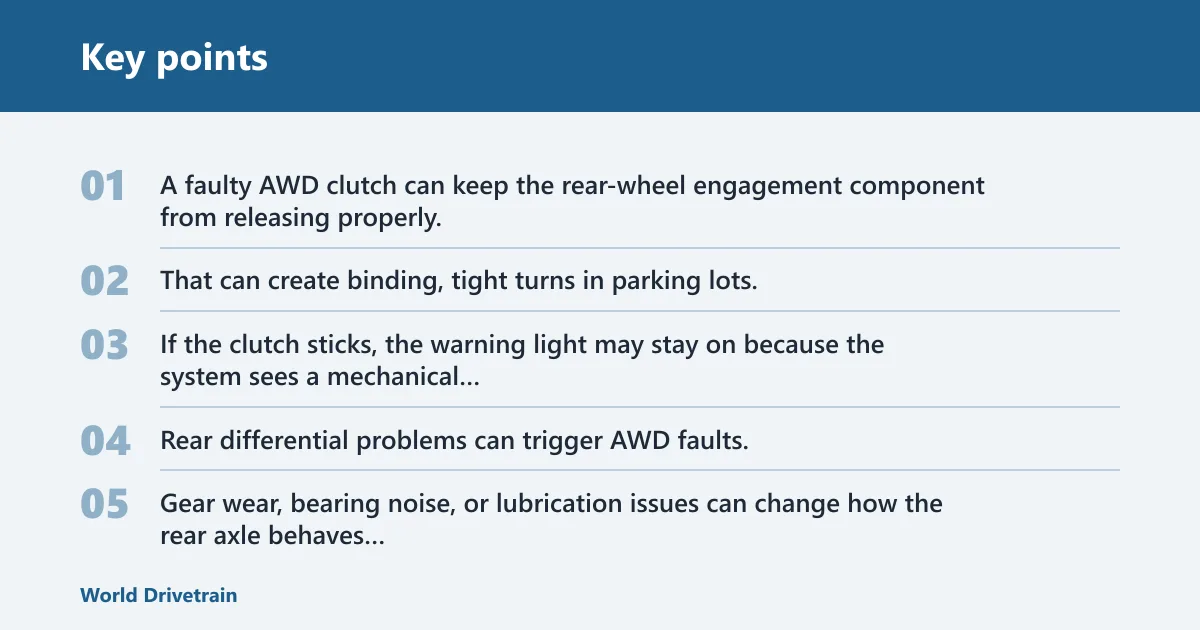
A faulty AWD clutch can keep the rear-wheel engagement component from releasing properly. That can create binding, tight turns in parking lots, or a feel like the vehicle is dragging through a corner. If the clutch sticks, the warning light may stay on because the system sees a mechanical mismatch, not just a bad signal.
Rear differential faults
Rear differential problems can trigger AWD faults. Gear wear, bearing noise, or lubrication issues can change how the rear axle behaves under load, and the controller may detect that as an AWD fault. Noise from the rear of the vehicle is a stronger clue than the light alone.
Transfer case faults
Transfer case faults can illuminate the AWD light. In mechanical coupling systems, the transfer case manages power distribution, so an internal fault can produce a real driveline warning. In some vehicles, especially those with brake-based torque transfer, the fault path may look more like a control or sensor issue than a hard mechanical failure.
Vehicle speed output sensor problems
A vehicle speed output sensor fault can activate the AWD warning light improperly. That sensor feeds transmission-related speed data into the control strategy, so bad output can make the system think wheel speeds or driveline speeds do not match. When that happens, the AWD light may be accurate about a fault, but wrong about the failed part.
How to read codes before buying parts
An OBD2 scanner tool is the first diagnostic step recommended. Read Diagnostic Trouble Codes from every module before buying anything. Then use live data, not just the code text, to see whether the fault is a bad sensor input, a communication drop, or a real driveline mismatch.
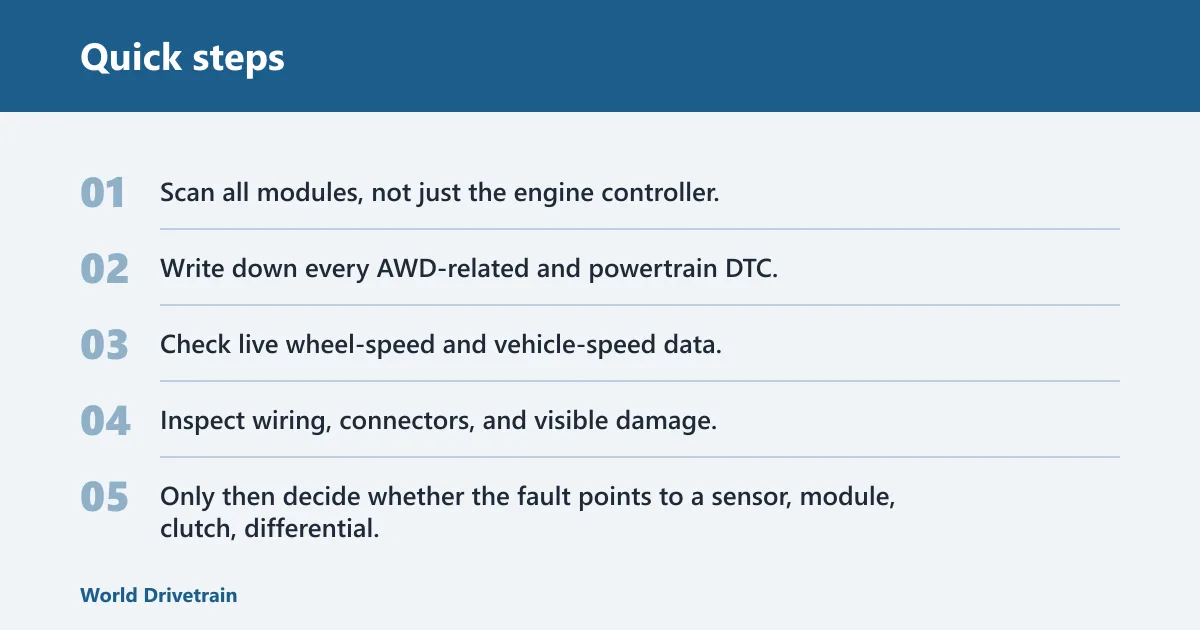
- Scan all modules, not just the engine controller.
- Write down every AWD-related and powertrain DTC.
- Check live wheel-speed and vehicle-speed data.
- Inspect wiring, connectors, and visible damage.
- Only then decide whether the fault points to a sensor, module, clutch, differential, or transfer case.
What matters most is pattern. A single wheel showing zero speed while the others move points toward a sensor or harness issue. A front-rear mismatch under load, especially with noise or binding, points you toward the driveline.
Suppose the scanner shows a wheel-speed code and the live data from one rear sensor drops to zero only over bumps. That points to a connector fault, a broken wire, or a sensor problem. Replacing the transfer case in that situation would be expensive and unnecessary.
Can you keep driving with AWD light on?
You can sometimes keep driving if the light is on by itself and the vehicle feels normal, because the AWD may work at reduced capacity even when the warning light is on. But continuous illumination is not recommended for driving as a long-term plan. Treat it as a prompt diagnosis item, not a warning to ignore.
Noise, vibration, or binding changes the answer. If the vehicle shudders on turns, clunks from the driveline, or feels tight in low-speed maneuvers, stop driving and inspect it. Those signs suggest a mechanical issue, not just a false warning.
If the AWD light flashes and a red transmission or temperature warning appears, do not keep going. That combination points to a problem that can escalate quickly, and a few extra miles can mean more damage.
Why is my AWD and check engine light on?
When the AWD and check engine light are on together, the fault may start in the engine or emissions system and then affect AWD logic. The same can happen when module communication fails and the drivetrain controller loses the inputs it needs. That is why both sets of codes must be scanned together.
Engine or emissions codes that affect AWD logic
Some vehicles limit AWD operation when engine torque, speed, or throttle data is unreliable. A powertrain fault can cascade into AWD warnings even when the AWD hardware itself is fine. In that case, fixing the engine-side code may clear the AWD warning without any drivetrain repair.
Communication faults between modules
Modern AWD systems depend on shared data between the engine controller, transmission controller, and AWD control module. A communication fault can make the AWD module think a sensor has failed when the real issue is a dropped message or corrupted signal. That is another reason a scanner must read more than one module.
Why clearing codes is not a repair
Clearing codes usually only erases the symptom record. If the sensor still fails, the circuit still opens, or the clutch still binds, the light will return. The repair starts with finding the cause, then confirming the fault does not come back after the fix.
Frequently asked questions
What does the AWD light mean?
The AWD light means the vehicle has detected a fault in the all-wheel-drive system and may limit or disable AWD operation. It can point to a sensor, module, wiring, clutch, differential, transfer case, or related speed-signal problem. The code path matters more than the light itself.
Will the AWD system still work if the warning light is on?
It may work at reduced capacity, or it may shut down AWD entirely to protect the drivetrain. Some vehicles default to a front-wheel or rear-wheel drive mode. The only reliable way to know is to read the stored codes and live data.
What causes an AWD light to stay on continuously?
Continuous illumination often comes from a stored fault that keeps returning, such as a bad wheel-speed sensor, wiring damage, an AWD control module issue, a transfer case fault, or a rear differential problem. If the light stays on after every restart, the fault is still active or has not been fixed.
Why is my service AWD light on?
A service AWD light usually means the controller wants diagnosis, not a reset. It can point to the same faults as an AWD warning light: sensors, wiring, clutch, module, transfer case, or differential issues. Read the codes first, then inspect the matching subsystem.