Differential Fluid: Symptoms, Change Interval, Cost
Differential fluid often gets changed somewhere in the 30,000 to 100,000 mile range depending on differential type, but leaks, burnt-smelling oil, chatter on turns, or whining that rises with vehicle speed mean inspect it now because low, wrong, or degraded fluid can mimic gear damage. Ignore it and a fluid service can turn into bearing, ring-and-pinion, or limited-slip clutch repairs that cost far more. This guide sorts symptoms by likely cause, urgency, and whether you should top up, change the fluid, or get the differential diagnosed.
What differential fluid actually protects
Hypoid gears, bearings, and heat load
In a live axle, the fluid protects the ring and pinion gears, carrier bearings, pinion bearings, and axle bearings where applicable. Those ring-and-pinion gears are usually hypoid gears, which slide across each other under high pressure instead of rolling with light contact.
That sliding, wiping action makes heat and high surface stress. That is why many axles call for GL-5 gear oil, with an extreme-pressure additive package meant for hypoid gear mesh. A common viscosity is 75W-90 gear oil, but viscosity alone is not enough, the axle still needs the exact OEM spec.
When the oil level drops or the additive package is worn out, ring-and-pinion teeth are more exposed to micropitting, spalling, and heat damage. Bearings suffer too, and a bad bearing can sound a lot like a bad gear set.
Why clutch-type limited-slip units may need friction modifier
Some differentials also rely on the fluid to control clutch behavior. A clutch-type limited-slip differential uses alternating friction and steel clutch packs, and those packs need the right fluid chemistry to engage without grabbing too hard.
A friction modifier is mandatory when the maker specifies it for a clutch-type LSD. It is used to prevent chatter and binding in turns. It is usually unnecessary in an open differential and in a helical LSD, because a helical unit does not use clutch packs and does not require friction modifiers.
That difference matters during diagnosis. Fresh fluid can settle down an unhappy clutch LSD. It will not repair chipped gear teeth or a failing pinion bearing.
Which differential do you have?
The differential type changes both symptom pattern and service interval. Open differentials are the most forgiving, clutch LSDs react the most to fluid condition, and helical LSDs fall between them because they do not use clutch packs but still depend on clean gear oil and correct GL-5 protection.
Open differential
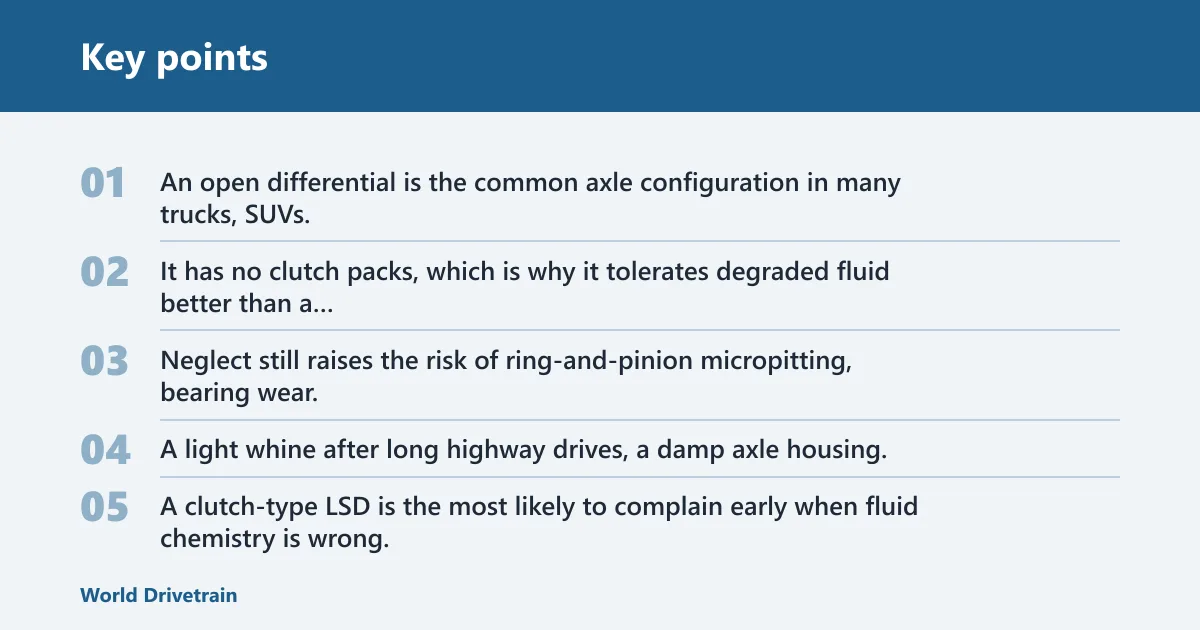
An open differential is the common axle configuration in many trucks, SUVs, and rear-drive cars. It has no clutch packs, which is why it tolerates degraded fluid better than a clutch-based LSD.
Forgiving does not mean safe to ignore. Neglect still raises the risk of ring-and-pinion micropitting, bearing wear, and seal leaks. A light whine after long highway drives, a damp axle housing, or a low level at the fill plug fits the pattern of an open diff that may still respond well to service.
Clutch-type LSD
A clutch-type LSD is the most likely to complain early when fluid chemistry is wrong. Degraded oil, missing friction modifier, or an overdue service can lead to chatter in tight turns, binding at parking-lot speed, glazing, and eventual loss of limited-slip function.
That is why clutch-type LSDs usually need closer attention than open diffs. The clutch packs depend on the right friction behavior, so old oil or a missing additive often shows up first as chatter in slow turns or a grab-release feel during parking maneuvers, while an open diff with the same mileage may stay quiet until wear reaches the gears or bearings. If the symptom is mainly chatter in turns and there is no heavy howl or metal chunks, fluid service is often the first move. If the unit also grinds or howls loudly on and off throttle, diagnosis comes before optimism.
Helical LSD
A helical LSD uses gears rather than clutch packs to bias torque. It still needs clean oil, but it does not require friction modifier.
Its symptom pattern is different. A helical unit is less likely to chatter because there are no clutches to stick and release. Noise from a helical differential more often points to low fluid, worn bearings, ring-and-pinion wear, or a problem nearby such as a wheel bearing or tire.
What are the symptoms of bad differential fluid?
Bad differential fluid usually shows up as whine that changes with load or vehicle speed, clunking, chatter in turns, binding, leaks, and a sharp burnt odor. The key is separating low fluid, aged fluid, wrong fluid, contamination, and mechanical wear, because each points to a different next step.
Whine, howl, and load-sensitive noise
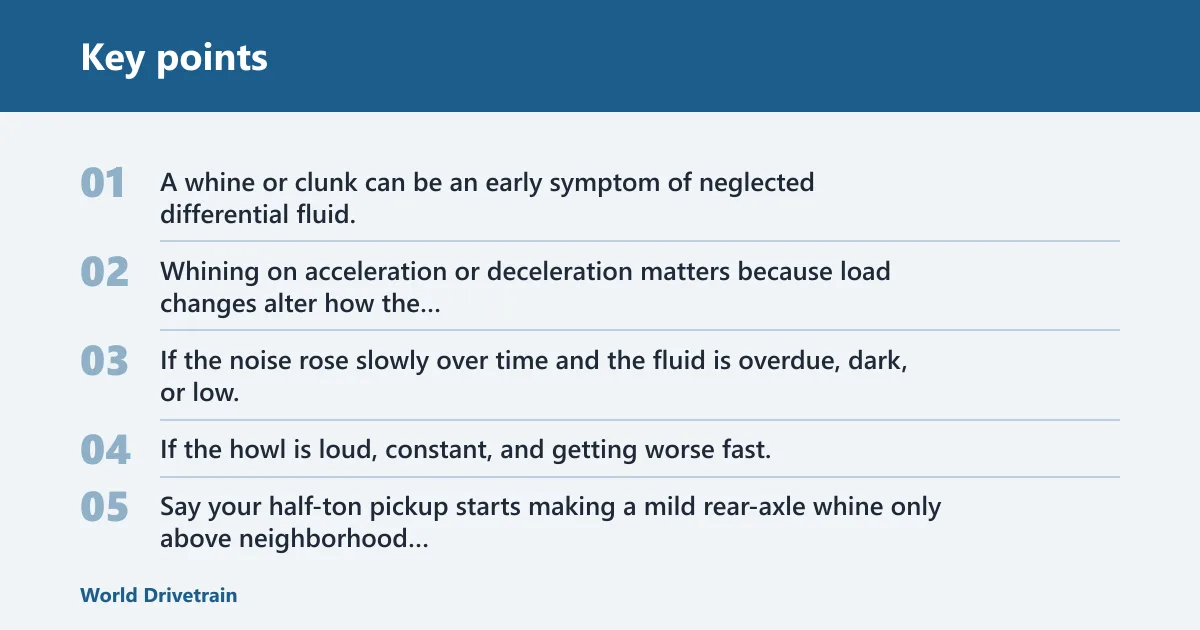
A whine or clunk can be an early symptom of neglected differential fluid. Whining on acceleration or deceleration matters because load changes alter how the pinion contacts the ring gear.
If the noise rose slowly over time and the fluid is overdue, dark, or low, a service may help. If the howl is loud, constant, and getting worse fast, the unit may already have bearing wear or ring-and-pinion damage that fresh oil will not cure.
Say your half-ton pickup starts making a mild rear-axle whine only above neighborhood speed after a long towing weekend. If the housing is damp around the pinion seal and the level checks low, that pattern points first to low fluid, because the noise often gets louder under throttle or after a longer drive as the remaining oil heats and thins, not straight to an automatic gear-set replacement.
Grinding, clunking, and higher-risk symptoms
Grinding is more serious than a mild whine. Persistent grinding points to metal-to-metal contact, heavy debris moving through the housing, or damage that may have gone beyond a simple fluid issue.
Clunking has more possible causes. It can come from excessive driveline lash, worn U-joints, CV joints, mounts, or internal differential wear. If clunking arrives with glittery oil, flakes on the magnet, or a loud coast howl, limit driving and diagnose the axle before damage spreads.
Chatter in turns, binding, and limited-slip clues
Chatter in slow turns is the classic clue for a clutch-type LSD with degraded fluid or missing friction modifier. Binding in a parking garage or during a U-turn fits the same pattern.
That symptom does not automatically mean every limited-slip needs additive. Open differentials do not need it, and helical LSDs do not require it. Adding modifier where it is not specified is unnecessary and can muddy the diagnosis.
Suppose a rear axle is quiet on the highway but chatters only during tight turns into a parking space. If it is a clutch LSD and the service history is unknown, the fluid spec and additive requirement move to the top of the checklist.
Leaks, smell, and visible warning signs
Low differential fluid often starts with a leak, not a noise. Check for wetness at axle seals, the pinion seal, the cover gasket, and along the housing.
Bad fluid often smells sharp and sulfurous when burnt. Normal gear oil already has a strong smell, so odor alone does not prove failure. The warning sign is the burnt, overheated note paired with dark fluid, noise, or debris.
Differential triage table
Symptom-to-action matrix
| Symptom | Likely fluid state | Likely differential type | Urgency | Next step | Cost band |
|---|---|---|---|---|---|
| Wet housing, no major noise, level slightly low | Low | Open, helical LSD, or clutch LSD | Inspect now | Find leak source, verify level at fill plug, top up only with exact spec, then monitor | Inspect/top-up: DIY fluid cost only; shop inspection/top-up commonly lower than a full service |
| Light whine with speed, overdue service, dark fluid, magnet has gray paste only | Dirty or aged | Open differential most often | Service soon | Drain and refill with correct GL-5 fluid; inspect magnet and seals during service | Replace fluid: DIY fluid and supplies; shop service commonly moderate routine-maintenance cost |
| Chatter or bind in tight turns, no heavy howl | Degraded or wrong friction behavior | Clutch-type LSD | Service soon | Confirm clutch LSD, use correct fluid and required friction modifier, then reassess | Service decision: routine fluid-service cost unless clutch damage is already present |
| Burnt odor, dark fluid, higher heat after towing or repeated heavy loads | Burnt | Any hypoid axle; risk rises under load | Limit driving | Inspect for low level or overload use, replace fluid, check for bearing or gear noise after service | Replace/service: higher than a basic top-up; damage risk climbs if noise remains |
| Milky fluid after water exposure or off-road splash, no chunks | Contaminated | Open or LSD | Inspect now | Drain, inspect magnet, refill with correct spec, then recheck for seal or vent problems | Replace fluid/service: routine if caught early, much higher if bearings start howling later |
| Loud howl, persistent grinding, shiny flakes or chunks on magnet | Contaminated by wear debris or severely depleted | Any type | Stop driving | Diagnose before further use; inspect bearings, ring and pinion, carrier, and related driveline parts | Diagnosis/repair: far above maintenance cost; damage path can move from service into rebuild or replacement |
Urgency ladder
Use four action bands. Inspect now fits leaks, low level, or contamination signs without major noise. Service soon fits overdue fluid, light whine, or clutch-LSD chatter. Limit driving fits burnt odor, heat, or worsening noise. Stop driving fits grinding, flakes, chunks, or a loud howl that changes quickly.
Can low differential fluid cause whining or grinding?
Yes. Low differential fluid can cause whining because the ring-and-pinion mesh and bearings lose oil film under load. It can also contribute to grinding, but persistent grinding or a loud howl often means wear has already started. Low fluid, dirty fluid, and internal damage can sound similar, so the pattern and inspection results matter.
Low fluid versus dirty fluid versus internal wear
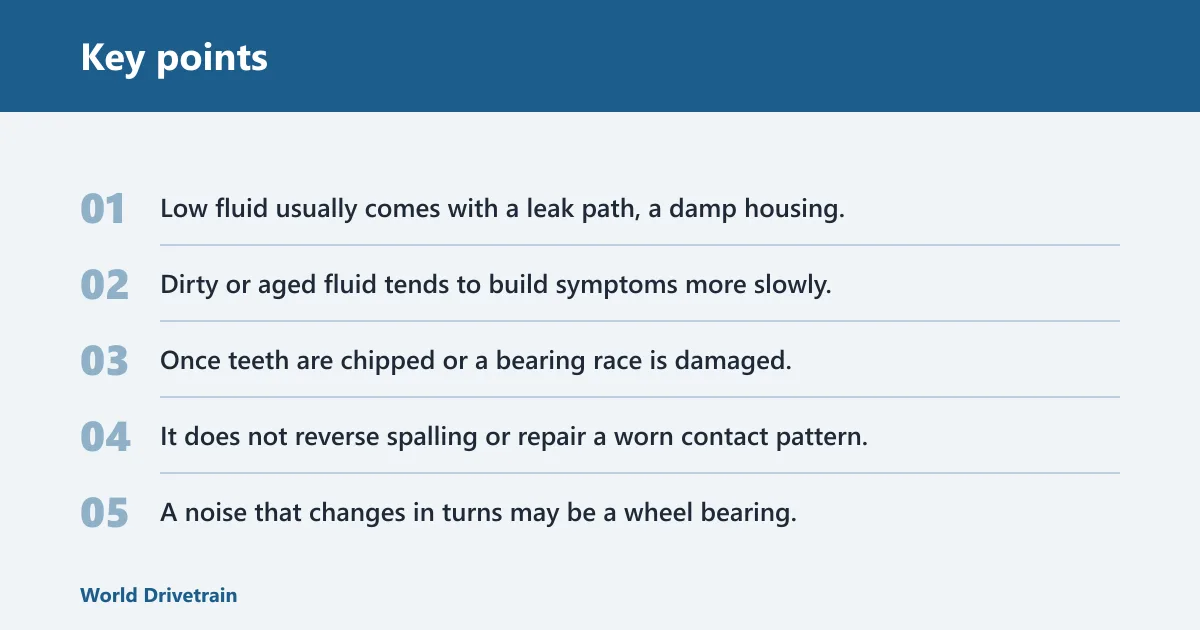
Low fluid usually comes with a leak path, a damp housing, and noise that gets worse after longer drives because heat thins what oil remains. Dirty or aged fluid tends to build symptoms more slowly, especially in open differentials, which are more tolerant than clutch LSDs.
Internal wear is different. Once teeth are chipped or a bearing race is damaged, a fluid change may quiet things briefly at best. It does not reverse spalling or repair a worn contact pattern.
When noise points beyond the fluid
A noise that changes in turns may be a wheel bearing. A hum that follows one tire after rotation may be tire pattern noise. AWD and IRS layouts add transfer cases, front drive modules, CV joints, and driveshaft parts that can mimic differential trouble.
Subaru-style front differential layouts deserve extra caution because front differential failure can, in some models, lead to a transmission replacement rather than a simple standalone axle repair. That is one reason diagnosis should happen before parts are ordered on a guess.
Is it safe to drive with low differential fluid?
Driving a short distance to inspection may be reasonable if the axle is only damp, the noise is faint, and the level is just slightly low. It is not wise to keep driving if the unit is grinding, howling loudly, or leaving active drips.
Low fluid speeds up heat and wear in the highest-load parts first, the pinion bearings and ring-and-pinion contact faces. Once debris starts circulating, damage can spread quickly through the bearings and gears.
How do you check differential fluid level and condition?
Check the differential with the vehicle level, identify the fill plug before opening anything else, and verify that fluid sits at the bottom of the fill hole unless the manufacturer specifies a different method. While checking level, inspect color, smell, leak points, and magnet debris so the result is more than a yes-or-no fluid reading.
Practical check procedure
- Park on level ground and secure the vehicle.
- Locate the differential fill plug and make sure it can be removed before draining anything.
- Remove the fill plug and check whether fluid is at the bottom of the fill hole, unless the manual gives a different procedure.
- Use a clean finger or tool to sample the fluid for color, smell, and grit.
- Inspect the housing, cover, axle seals, and pinion seal for seepage.
- If the axle has a drain plug or the cover is being removed, inspect the plug magnet or differential cover magnet before refilling.
Independent rear suspension and some AWD layouts can be tighter to access. In those cases, model-specific fill procedures matter more because fill height, access, and even fluid type may differ front to rear.
Color, smell, and contamination clues
Healthy used gear oil can be darker than new oil without meaning disaster. What matters is the combination, very dark fluid, burnt odor, visible metallic sparkle, or a milky look after water exposure each changes the call.
Burnt oil smells sharp and sulfurous. Water contamination often turns the fluid cloudy or milky. A wrong-fluid issue may show up less in color and more in behavior, especially clutch-LSD chatter after a service.
What the differential cover magnet tells you
The differential cover magnet is a condition check, not a pass-fail alarm. A soft gray paste is common wear material. Shiny flakes, needle-like fragments, or chunks are not.
If the magnet has only paste and the gears look clean, a service may be all that is needed. If there are flakes or chunks, stop treating the problem like maintenance and move to diagnosis.
How often should differential fluid be changed?
The right interval depends on the differential type, vehicle use, and the owner’s manual, which should take precedence over any generic schedule. A “lifetime” label is usually closer to the powertrain-warranty horizon, around 100,000 miles, than a promise that hypoid axle oil never needs service.
Base intervals by differential type
For an open differential, a common service window is every 60k to 100k miles. For a clutch-type LSD, the usual window is every 30k to 50k miles. For a helical LSD, a common range is every 50k to 80k miles.
Those ranges fit the hardware. Open diffs are more forgiving. Clutch LSDs are more sensitive because clutch packs and friction behavior change as the fluid ages. Helical units sit between them because they do not need friction modifier but still rely on clean GL-5 oil for the hypoid gear set.
When severe service shortens the interval
Towing, repeated heavy loads, hot climates, track use, steep mountain driving, and water exposure all justify earlier inspection and often earlier service. Heat and contamination break down the oil faster than easy highway use.
Picture an SUV that tows a camper in summer and backs a boat into freshwater several times a season. Even if the mileage is modest, that axle sees more heat and contamination risk than a commuter car, so calendar time and use pattern matter as much as the odometer.
Why limited-slip units often need closer attention
Clutch-LSD service intervals are shorter for good reason. Neglect can cause chatter, glazing, and eventual loss of limited-slip function. Helical LSDs avoid the clutch issue, but they still need the right GL-5 oil and clean operating conditions.
How much does a differential fluid change cost?
Differential fluid service is usually cheap compared with the parts it protects. The cost breaks into three buckets: DIY fluid and supplies, routine shop service, and the much larger bill that follows delayed service when bearings or the ring-and-pinion are already damaged.
DIY fluid and supply cost
DIY cost is mostly fluid, sealing materials if the cover comes off, and a hand pump if access is tight. The exact amount and price depend on the axle capacity and whether it needs a friction modifier for a clutch-type LSD.
75W-90 synthetic gear oil is common, but the right answer is the exact axle spec, not the label that happens to be on the shelf. Blind substitution inside the same viscosity grade is risky because additive chemistry and limited-slip requirements vary.
Typical shop service cost
A routine shop fluid change is usually straightforward maintenance, especially on an axle with drain and fill plugs. It gets more expensive when the cover must be removed, sealant and cleaning time are added, or the vehicle has front and rear differentials plus a transfer case.
Most shops charge more for diagnosis than for a simple drain-and-fill, and that is still far cheaper than gear-set or bearing work. As one shop article puts it, differential fluid service is simple, inexpensive maintenance that protects expensive parts.
Damage-risk cost when service is delayed
This is where the real money goes. Once wear moves into bearings or the ring and pinion, the bill changes from fluid and labor to setup work, hard parts, and sometimes a full assembly replacement.
That jump is why the triage table separates service soon from stop driving. A quiet leak is a maintenance problem. Grinding with metal chunks is a repair problem.
Will a fluid change fix the problem?
A fluid change can help when the issue is overdue maintenance, low level, wrong fluid, or clutch-LSD chatter from missing friction modifier. It usually will not fix chipped teeth, heavy bearing damage, or a severe ring-and-pinion howl. The best question is not “Will fresh fluid cure it?” but “What does the symptom pattern say?”
When fresh fluid often helps
Service is most likely to help when the axle has a mild whine, no major debris, no chunks on the magnet, and no serious leak. It is especially worth trying on a clutch LSD that chatters in slow turns and has no other major symptoms.
If the old fluid is low, dark, burnt, or contaminated by water, replacing it quickly may prevent further wear even if it does not make the axle completely quiet.
When fluid will not solve the noise
Fresh oil does not heal damaged steel. If the axle has persistent grinding, loud coast-and-drive howl, visible gear damage, or heavy metallic debris, a fluid change may only buy a little time or slightly alter the sound.
That can mislead owners into thinking the problem is fixed. It is better to treat any temporary improvement as information, not a repair.
When to move from service to diagnosis
Move to diagnosis when the symptom is getting worse, when the magnet shows flakes or chunks, when the level drops again after top-up, or when the wrong fluid was recently installed and the unit still complains after correction.
The differential should also be inspected before taking all noise at face value. Wheel bearings, tires, CV joints, transfer cases, and driveshaft components can produce very similar sounds.
Frequently asked questions
What does bad differential fluid smell like?
Burnt differential fluid usually smells sharp and sulfurous. Normal gear oil already has a strong odor, so smell alone is not enough to call it bad. The warning sign is that burnt note combined with dark fluid, overheating after heavy use, noise, or visible debris during inspection.
How do I check differential fluid level?
Park the vehicle level, remove the fill plug first, and check that the fluid sits at the bottom of the fill hole unless the manufacturer specifies another method. While there, inspect for wet seals, dark or milky fluid, burnt odor, and normal paste versus flakes on the magnet.