Why Does My Transmission Make Noise When Shifting to Reverse?
A noise that appears only as you shift into reverse usually points to a mount, brake, axle, or driveline issue, not a transmission failure, unless it also happens in other gears or with delayed engagement. Ignoring it can let a small problem become a larger repair. This guide shows how the timing, sound type, and vehicle layout point to the likely source so you can judge urgency.
This guidance applies to most gasoline, hybrid, and electric vehicles, but layout details can differ by drivetrain and model year.
What the noise timing tells you
The first clue is timing. A reverse noise that happens at the moment the selector moves into Reverse points somewhere different than a noise that starts only after the vehicle begins rolling backward. That split matters because one is a load-change problem, and the other often comes from rotating parts, brake hardware, or steering angle.
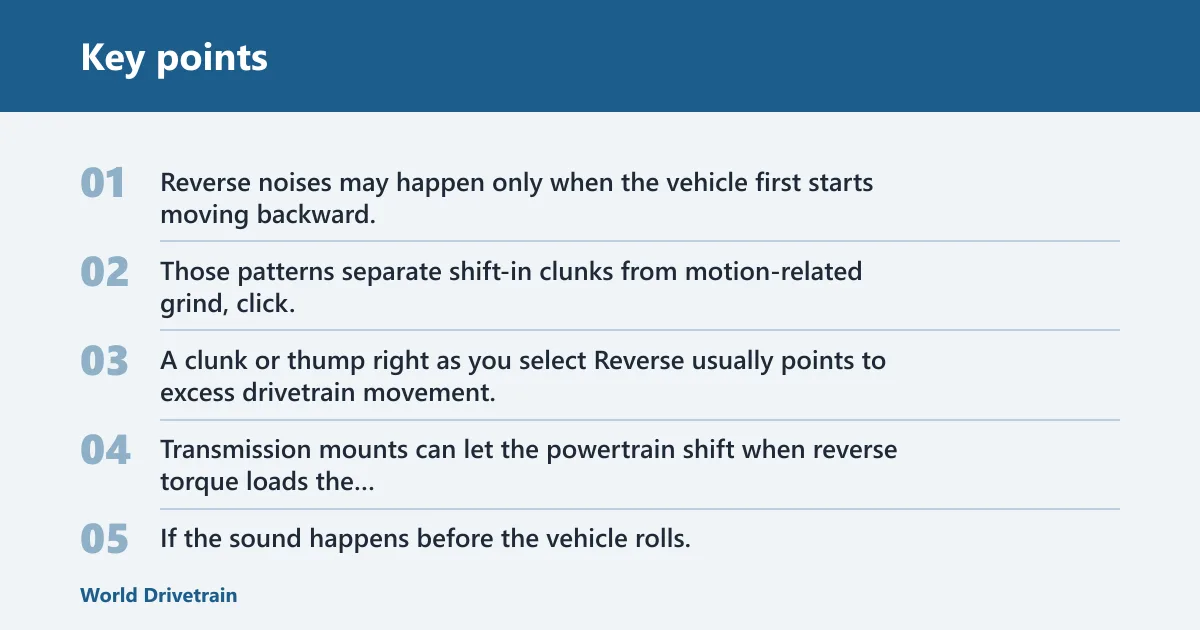
Reverse noises may happen only when the vehicle first starts moving backward, only while turning, only while braking, or the entire time the vehicle is reversing. Those patterns separate shift-in clunks from motion-related grind, click, or scrape sounds.
Noise on the shift to Reverse
A clunk or thump right as you select Reverse usually points to excess drivetrain movement. Transmission mounts can let the powertrain shift when reverse torque loads the drivetrain, and engine mounts can do the same. If the sound happens before the vehicle rolls, start with mounts and driveline play before blaming internal transmission parts.
Noise only while rolling backward
If the noise starts only after the vehicle moves, the cause is more likely on the wheel, brake, axle, or driveline side. Brake pad movement can create noise when the vehicle changes direction, worn brake pads or rotors can make noise in Reverse, and loose brake hardware is a common cause. CV axle or joint issues can also create clicking, popping, or clunking while reversing.
Noise during turning, braking, or load change
Turning while backing up narrows the list further. Clicking or popping that appears only with steering input often points to a CV axle or CV joint. Noise only while braking in reverse points more toward brake hardware, slide pins, or rotor contact. A sound that appears with a quick throttle tip-in or lift-off while reversing can reflect drivetrain movement or differential backlash.
Reverse noise diagnosis matrix
This matrix helps separate a shift noise from a rolling noise and gives you the next inspection step without guessing. Use the timing, the sound type, and the vehicle layout together. If the table is hard to follow on your screen, rely on the surrounding text, which gives the same timing-and-sound clues in plain language.
| When the noise happens | Sound type | Most likely system | Likely next inspection | Red-flag urgency |
|---|---|---|---|---|
| Shift into Reverse, before movement | Single clunk or thud | Transmission mount or engine mount | Check mount rubber, bracket cracks, and drivetrain movement under load | Medium; stop if the clunk gets sharper or spreads to Drive |
| Only when the vehicle starts rolling backward | Grinding or scraping | Brake hardware, rotor contact, dust shield, or underbody interference | Inspect pads, anti-rattle clips, shims, slide pins, and shield clearance | High; quick inspection is warranted |
| While turning and reversing | Clicking or popping | CV axle or CV joint | Look for torn boots, grease loss, and joint play | Medium to high if the noise grows louder or becomes constant |
| Delay, then a harsh engagement into Reverse | Pause followed by a hard clunk | Transmission fluid issue or driveline issue | Check fluid level, fluid condition, and for driveshaft play or backlash | High; do not ignore delayed engagement |
Could it be the transmission?
Yes, but only when the symptom fits transmission engagement, not just any reverse noise. A delayed engagement, harsh clunk into Reverse, or driveshaft play can point to driveline issues. If the complaint is a scrape, click, or pad movement sound only while backing up, the transmission is less likely to be the source.
Harsh or delayed Reverse engagement
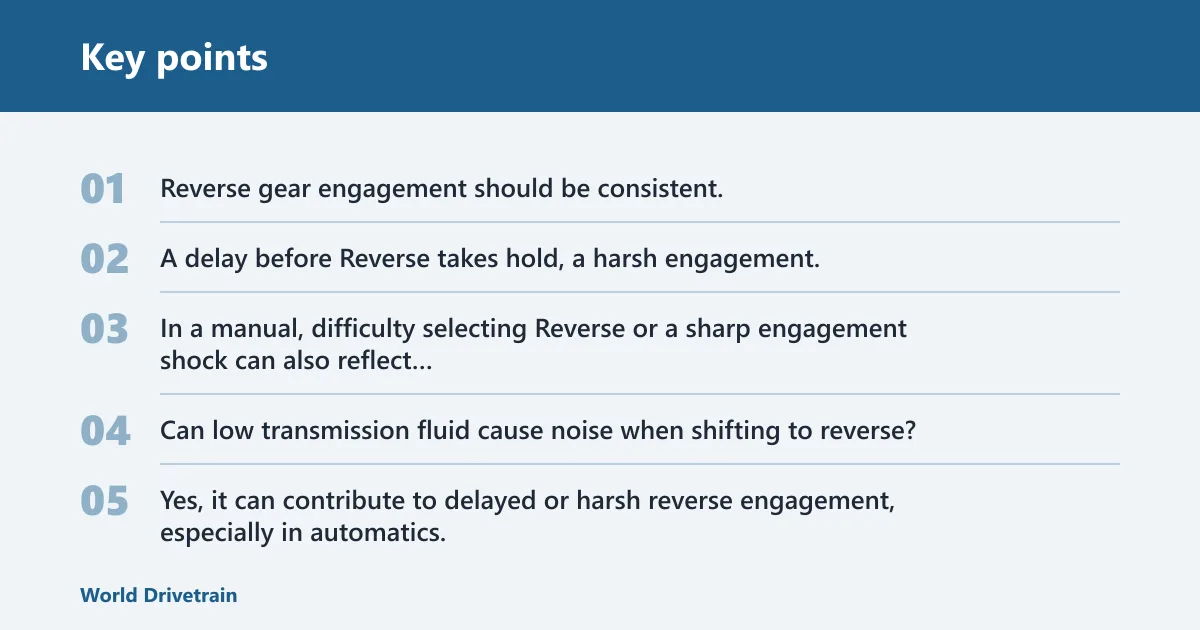
Reverse gear engagement should be consistent. A delay before Reverse takes hold, a harsh engagement, or a loud clunk at the moment of engagement can point to hydraulic, control, or internal wear concerns in an automatic. In a manual, difficulty selecting Reverse or a sharp engagement shock can also reflect clutch drag or linkage issues, but the symptom still needs to be matched to the exact moment it occurs.
Low or degraded transmission fluid
Can low transmission fluid cause noise when shifting to reverse? Yes, it can contribute to delayed or harsh reverse engagement, especially in automatics. Fluid level and condition should be checked when reverse behavior changes. Dark, burned, or contaminated fluid does not by itself prove the transmission is failing, but it can raise concern when it is paired with a late or rough Reverse engagement.
Do not treat fluid as a cure-all. If the noise is a click while turning or a scrape near a wheel, fluid is probably not the primary fault.
When internal gear or valve body concerns rise
Internal transmission concerns move up the list when the noise happens across multiple gears, when Reverse engages late every time, or when the vehicle also slips, shudders, or hesitates in other ranges. On some vehicles, reverse complaint symptoms can overlap with valve body, clutch pack, or hydraulic pressure issues. That is especially true when the problem is not just noise, but a change in how Reverse applies.
Say your automatic sits for two seconds after you select Reverse, then bumps hard into gear when cold. That pattern is more serious than a mild shift clunk from a worn mount, because the timing points to engagement control, not only drivetrain movement.
Can mounts cause the clunk?
Yes. Mounts are a common reason a vehicle clunks when shifting into Reverse. Transmission mounts and engine mounts control how much the powertrain can rotate when load changes. If the rubber isolators are weak, torn, or oil-soaked, the drivetrain can move enough to hit its stops and create a clunk.
Transmission mount movement
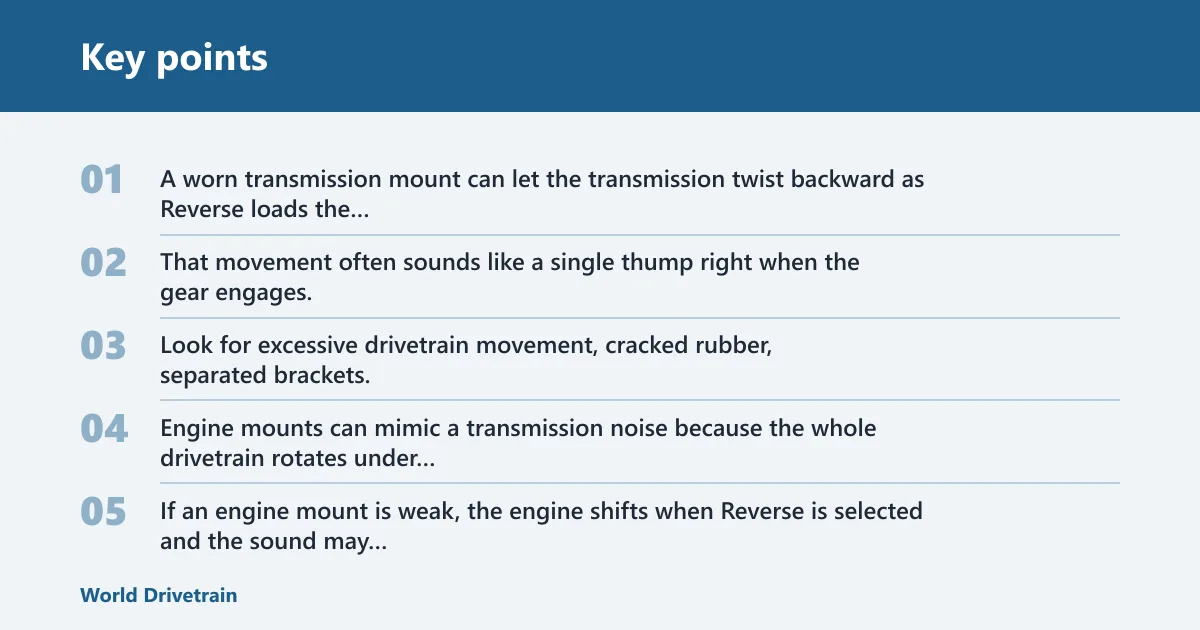
A worn transmission mount can let the transmission twist backward as Reverse loads the drivetrain. That movement often sounds like a single thump right when the gear engages. Look for excessive drivetrain movement, cracked rubber, separated brackets, or a mount that has collapsed lower than the others.
Engine mount movement
Engine mounts can mimic a transmission noise because the whole drivetrain rotates under reverse torque. If an engine mount is weak, the engine shifts when Reverse is selected and the sound may seem to come from the transmission tunnel. Inspect for visible movement, torn rubber, and fresh contact marks where the drivetrain has been shifting.
How torque in Reverse shifts the drivetrain
Reverse changes the direction of torque load. That load reversal can expose mount wear that is quieter in forward driving. On front-wheel-drive layouts, the engine and transmission assembly typically rock more because the powertrain and driven wheels are in the same front end, so mount wear can show up as a pronounced clunk. On rear-wheel-drive layouts, the engine does not sit on the driven axle, so a reverse clunk may come more from driveline lash, mounts, or axle movement than from the engine rocking the same way. On many AWD setups, either pattern can appear depending on where the wear sits.
Why does it click when turning back?
A click or pop while backing up and turning usually points to a CV axle or CV joint, especially on front-wheel-drive and many AWD vehicles. If the sound only appears at steering lock or near-lock, the joint angle is part of the failure pattern. This is less typical of a mount problem and more typical of a moving joint under load.
CV axle and CV joint noise
CV axle and CV joint issues can create clicking, popping, or clunking while reversing. The sound often gets louder when the wheels are turned. A torn boot and grease loss are common clues, because once grease escapes, joint wear accelerates and the joint can start clicking under reverse load.
Torn boots and grease loss
Look for split boots, grease sling around the inner wheel well, and damp grime at the joint. If a boot has been open for a while, the joint may have worn enough to click both in reverse and in forward turns. At that stage, the noise is often only the beginning of a larger axle problem.
FWD, RWD, and AWD differences
FWD vehicles place the CV axles under the most obvious steering-and-load combination, so turning while backing up often makes the noise easier to hear. RWD vehicles are less likely to have front CV joint noise, but rear suspension links, axle shafts, or differential play can still make reverse noises. AWD vehicles can show either pattern, depending on where the wear sits.
Brake and shield noises in Reverse
Brake hardware is one of the most common reverse-noise mimics. Pad movement in the caliper bracket, worn pads or rotors, missing anti-rattle clips, and loose shims can all make noise when the vehicle changes direction. Dust shields and splash shields can also scrape only in Reverse if they are bent near the rotor.
Pad movement and missing anti-rattle hardware
Brake pad movement can create noise when the vehicle changes direction. If anti-rattle clips or shims are missing, worn, or installed incorrectly, pads can shift when Reverse load changes. That can sound like a light clack or a brief rattle, especially at low speed.
Slide pins, caliper brackets, and rotor contact
Sticky slide pins or worn caliper hardware can let one pad hang up and then release with a pop. In some cases, worn brake pads or rotors can make noise in Reverse because the pad edge contacts the rotor differently under the reversed load path. Inspect for uneven pad wear, seized hardware, and rotor scoring.
Dust shields and loose splash shields
A bent dust shield can scrape near the rotor only when the wheel turns backward or when the suspension shifts under reverse load. Loose splash shields and other underbody pieces can do the same. If the sound is a metallic scrape that changes with wheel speed, have the brakes and shields inspected promptly.
Suppose a compact crossover makes a faint scrape only while backing out of a tight space and turning left. If the sound disappears straightening out, a bent shield or brake hardware is more likely than a failing transmission.
Driveline and suspension checks
Driveline and suspension components can shift under reverse load and make a noise that sounds like it came from the transmission. That is why reverse clunks should not be blamed on the gearbox alone. On some vehicles, the noise comes from slack or worn parts that only reveal themselves when the load direction changes.
U-joints and driveshaft play
On rear-wheel-drive and some AWD vehicles, U-joint wear and driveshaft play can make a clunk when Reverse is selected or when the vehicle starts to move. A delayed engagement, harsh clunk into Reverse, or visible driveshaft movement can point to driveline issues. Any free play at the shaft or joint deserves close attention.
Differential backlash
Some backlash is normal, but excessive differential lash can create a clunk as torque reverses. That sound often shows up during the transition into Reverse or when shifting from brake to throttle while backing up. If the noise is repeatable and sharp, the differential should be inspected along with the driveshaft.
Suspension parts that shift under reverse load
Loose bushings, worn sway bar links, and other suspension parts can shift and make noise in Reverse. The sound may seem to come from one corner of the vehicle, then change when the steering angle changes. That is one reason a road test that duplicates the complaint matters more than a quick glance under the hood.
How to narrow it down before you inspect anything
- Reproduce the noise in the same spot and at the same speed.
- Note whether it happens on shift, on first movement, while turning, or while braking.
- Listen for clunk, click, pop, scrape, or grind.
- Check whether it changes with steering angle or brake pedal input.
- Compare the reverse symptom with Drive, Neutral, and forward turns.
- Inspect brakes, mounts, axles, shields, and suspension in that order if the timing points there.
- Check transmission fluid level and condition if engagement is delayed or harsh.
A proper diagnosis starts with duplicating the noise and identifying exactly when it happens. That step is not optional. It is the fastest way to separate a mount clunk from a brake rattle or a CV joint click.
Why does my car clunk when I shift into reverse?
A clunk on the shift into Reverse usually points to mount movement, drivetrain lash, or a driveline issue rather than a brake problem. Transmission mounts and engine mounts can let the powertrain move too far when reverse torque loads the system. If the clunk is delayed or harsh, add driveline and transmission engagement checks.
Why does my transmission grind when going into reverse?
Grinding going into Reverse is generally more urgent than a mild clunk. It can reflect a gear engagement problem, clutch drag on a manual, or a transmission issue in an automatic, especially if Reverse also feels delayed or harsh. Scraping or grinding should prompt inspection, since it can worsen quickly.
Is it normal for reverse to make a noise when I back up?
Some reverse noise can be minor, but it is not something to dismiss without matching the sound to the moment it happens. Light pad movement, a brief mount thump, or a small shield rub may be simple. Grinding, repeated clunking, or a noise that spreads to forward driving is not normal.
Can low transmission fluid cause noise when shifting to reverse?
Yes. Low or degraded transmission fluid can contribute to delayed or harsh reverse engagement, especially in automatics. It is worth checking the level and condition, but fluid is only one part of the diagnosis. If the noise is a click while turning or a scrape from under the car, look elsewhere too.
Why does my car make a noise only when backing up?
Reverse load reverses the direction of torque, which can expose worn mounts, brake hardware, CV joints, shield contact, or driveline play that stays quiet going forward. The key is whether the sound happens on shift, on first movement, while turning, or while braking. Each timing pattern points to a different system.
What causes a delayed or harsh reverse engagement?
Delayed or harsh Reverse engagement can come from transmission fluid problems, internal transmission concerns, or driveline issues such as play in the shafts or differential. If the delay is repeatable and the engagement hits hard, that is more serious than a minor clunk from a worn mount. Avoid hard acceleration or towing until it is inspected.
Could engine or transmission mounts make noise in reverse?
Yes. Mount problems can cause a clunk when shifting into Reverse because the drivetrain twists under load and moves farther than it should. Weak or worn rubber isolators are a common clue. If the noise is a single thump on engagement, mounts belong near the top of the list.
Is a reverse noise more likely to be brakes or transmission?
It is often brakes, mounts, axles, or shields rather than the transmission itself. Brake pad movement, missing anti-rattle clips, worn pads, or rotor contact can all make a reverse noise. A transmission becomes more likely when Reverse engages late, engages harshly, or the problem appears in multiple gears.