Can You Drive with a Bad Transfer Case?
No. Tow it if the transfer case grinds, jumps out of range, leaks heavily, or leaves you with no drive; a small external seep with normal engagement may allow a short, careful trip to a shop. Ignore the wrong symptom, and you can ruin the case, damage the transmission, and turn a repair into a much larger bill. This guide separates minor leaks, electronic faults, and mechanical failure so you can decide drive or tow with less guesswork.
What a transfer case does
The transfer case moves power from the transmission to the front and rear axles in 4WD and AWD vehicles. Some units use chains, some use gears, and some shift by hand while others use motors, sensors, and control modules. Many also offer high-range and low-range operation. (Wikipedia)
4WD versus AWD design
Part-time 4WD systems are built for loose or slippery surfaces. On dry pavement, they can bind and load the driveline hard. AWD systems may use different transfer-case designs than 4WD, and many include electronic control parts that can fail even when the mechanical case still works partly.
High and low range
High range is for normal road speeds. Low range is for slow, controlled crawling when torque multiplication matters more than speed. A transfer case that will not shift into or out of range can leave you stranded, but a shift complaint does not always mean the gears inside the case are broken.
Can you drive with a bad transfer case?
Sometimes, but only when the problem is minor and the vehicle still drives normally. A small external leak or an occasional noise may allow a short move to a shop. If the case grinds, binds, smokes, overheats, or stops sending power, stop driving and tow it.
When a short move may be possible
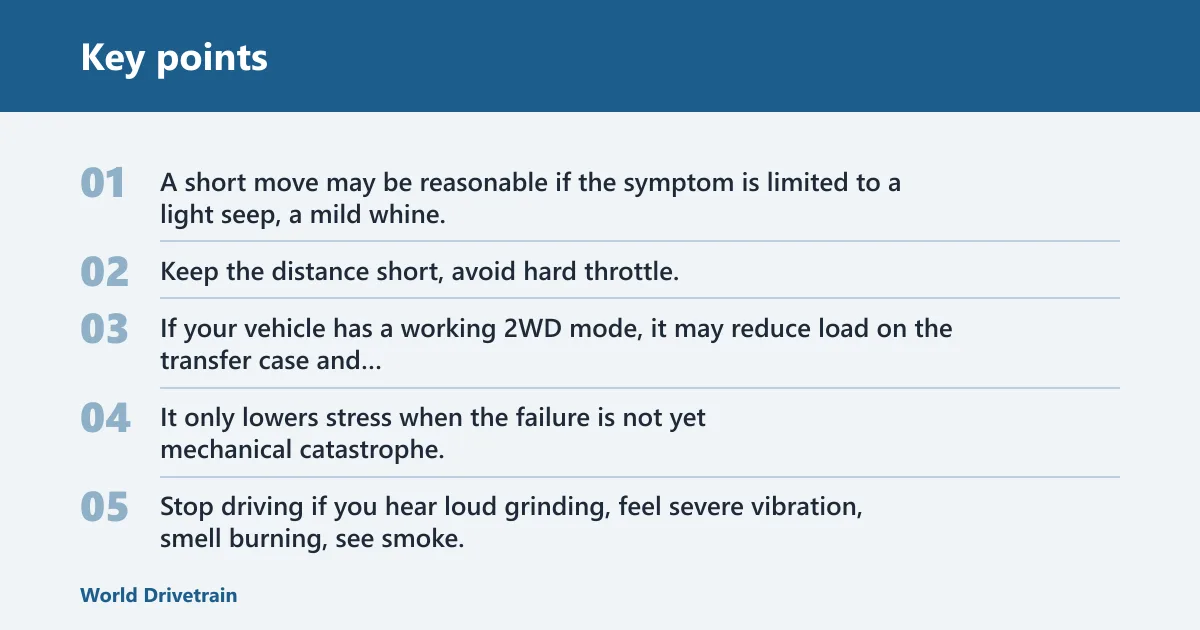
A short move may be reasonable if the symptom is limited to a light seep, a mild whine, or a brief warning light, and the vehicle still engages and disengages as commanded. Keep the distance short, avoid hard throttle, and choose the simplest route to a repair bay.
When 2WD mode may help
If your vehicle has a working 2WD mode, it may reduce load on the transfer case and allow a cautious trip in some situations. That does not make a damaged case safe. It only lowers stress when the failure is not yet mechanical catastrophe.
When you should stop and tow
Stop driving if you hear loud grinding, feel severe vibration, smell burning, see smoke, notice heat at the case, or lose drive entirely. A loud bang followed by engine revving without movement is a warning for potential complete failure. At that point, towing is the safer choice.
Say your AWD crossover develops a light drip after a long highway run, but it still shifts cleanly and drives normally. A short trip to a shop may be reasonable. Now change one detail: the same vehicle starts clunking and shuddering on acceleration. That is no longer a safe drive-it-later problem.
Drive, limp, or tow table
| Symptom tier | Likely failure type | Does 2WD help? | Safest next action |
|---|---|---|---|
| Minor leak or mild, occasional noise | Fluid seep, low fluid, or early wear | Maybe, if available and normal drive remains | Drive only a short distance to a shop; check fluid level and inspect for leaks |
| Warning light, buzzing, delayed shift, partial engagement | Actuator fault, sensor problem, or control-module fault | Sometimes, if 2WD works reliably | Limp carefully to diagnosis; avoid long trips and avoid 4WD use until scanned |
| Loud grinding, heat, smoke, severe vibration, loss of drive | Internal gear, chain, bearing, or catastrophic case failure | No | Stop driving and tow |
What bad transfer-case symptoms look like
The common signs are grinding, clunking, whining, vibration, fluid leaks, low or contaminated fluid, trouble shifting 4WD or AWD modes, warning lights, and loss of drive. Those symptoms can overlap with transmission, differential, driveshaft, axle, wheel-bearing, tire, and engine-mount problems.
Noises and vibration
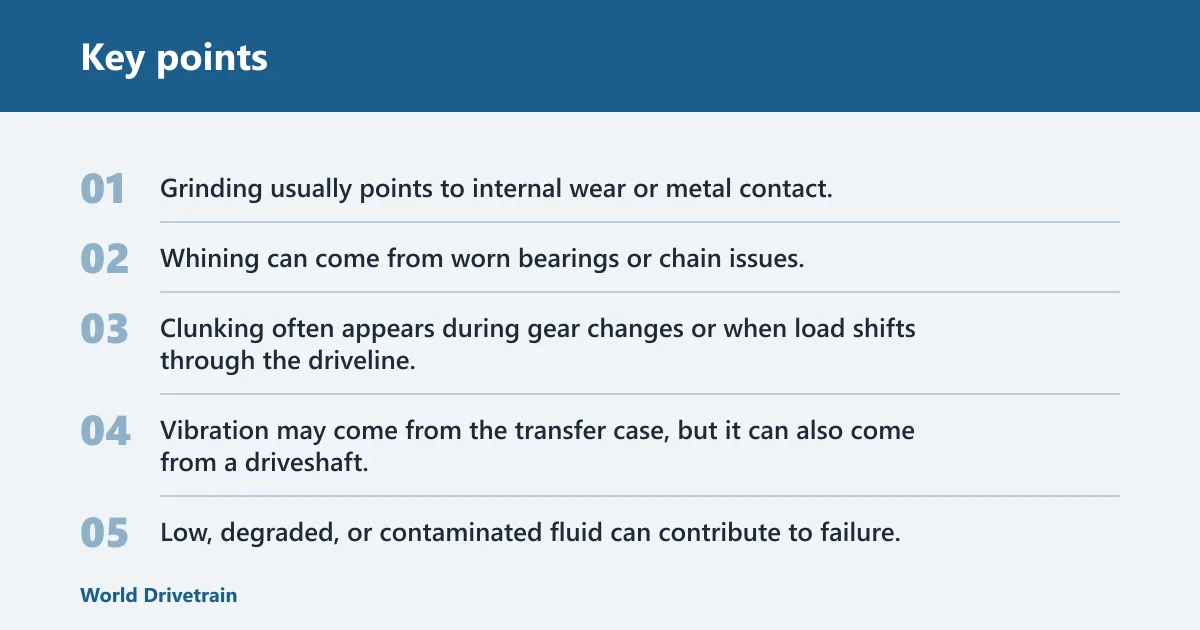
Grinding usually points to internal wear or metal contact. Whining can come from worn bearings or chain issues. Clunking often appears during gear changes or when load shifts through the driveline. Vibration may come from the transfer case, but it can also come from a driveshaft, U-joint, axle, or wheel bearing.
Leaks, fluid problems, and warning lights
Fluid leaks are a common warning sign. Low, degraded, or contaminated fluid can contribute to failure, and incorrect fluid choice can matter by vehicle. A warning light on an electronically shifted system may point to a motor, sensor, or control issue rather than a broken gear set.
Shift problems and mode failures
Difficult shifting into or out of 4WD or AWD modes is a common clue. In electronically shifted systems, a failed actuator can cause buzzing without engagement. In mechanical systems, the lever may move but the case may not finish the shift if internal parts are worn or damaged.
Picture a part-time 4WD pickup on dry pavement. The driver keeps it in 4WD too long, then notices hopping in turns and a sharp bind on parking-lot maneuvers. That may not be a broken transfer case yet, but it can create stress that turns a mode mistake into a repair.
Can you drive in 2WD with a bad transfer case?
Sometimes 2WD mode reduces load and buys you a short, careful trip. It does not erase the defect. If the case is leaking badly, making metal noise, or slipping internally, 2WD may still leave you with a failed driveline and a more expensive repair if you keep going.
When 2WD reduces load
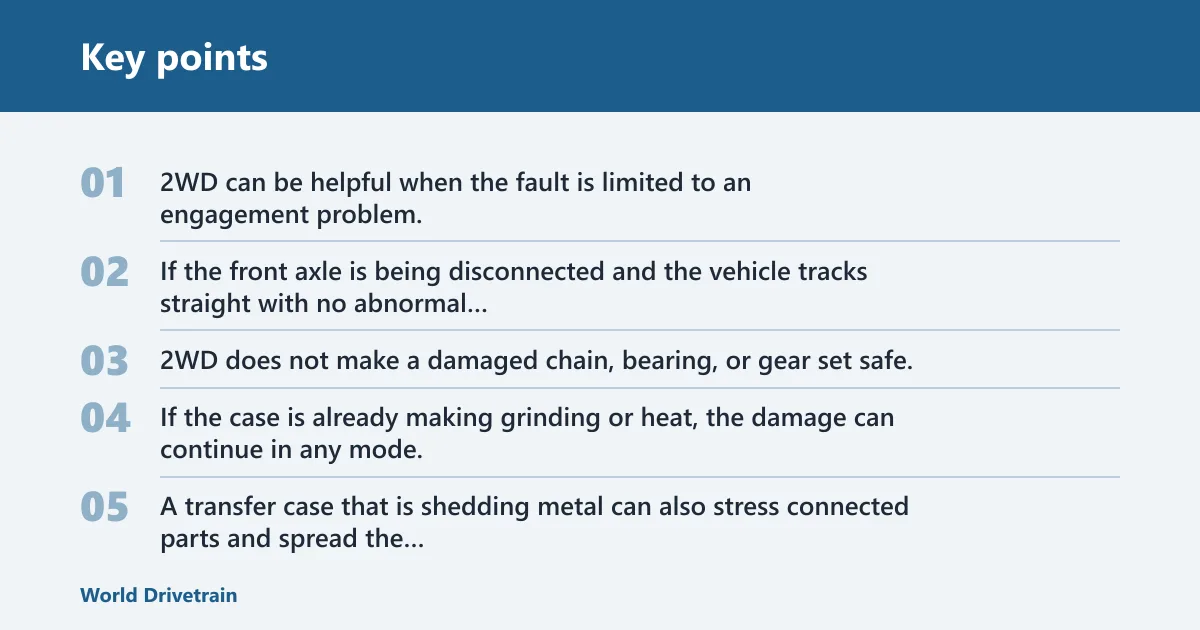
2WD can be helpful when the fault is limited to an engagement problem, especially in some electronic systems. If the front axle is being disconnected and the vehicle tracks straight with no abnormal noise, a short move to a shop may be reasonable. Keep speed low and avoid hills if possible.
When 2WD does not remove the risk
2WD does not make a damaged chain, bearing, or gear set safe. If the case is already making grinding or heat, the damage can continue in any mode. A transfer case that is shedding metal can also stress connected parts and spread the failure.
Why part-time 4WD on dry pavement can bind
Part-time 4WD systems are built for loose or slippery surfaces. On dry pavement, front and rear axles can wind up against each other because the system is trying to turn them together at different speeds. That bind can mimic a bad transfer case or make an existing problem worse.
What a bad transfer case can damage next
A failing transfer case can send shock through the rest of the drivetrain. Severe damage may leave the vehicle unable to move or transfer power to only one axle. Continuing to drive can turn a single-case repair into a longer parts list.
Driveshafts and U-joints
Driveshafts and U-joints can mimic transfer-case symptoms, and they can also be damaged by them. A loose U-joint may clunk or vibrate like an internal case fault. A failed transfer case can also shock the shaft enough to damage joints, slip yokes, or related hardware.
Axles, differentials, and wheel bearings
Axles, differentials, and wheel bearings can create noises that sound like transfer-case wear. They can also take extra load if the transfer case binds or slips. That is one reason a professional diagnosis matters before parts are replaced in a hurry.
Mounts and connected drivetrain parts
Mounts, crossmembers, and nearby drivetrain parts can be stressed by vibration and harsh engagement. If the case is moving on its mounts or the driveline is out of alignment, the symptom may spread beyond the transfer case itself. The repair may need more than one component.
Can you drive with a bad transfer case module or actuator?
A bad module or actuator is often less destructive than a broken gear train, but it can still leave you stuck. If the vehicle still drives in 2WD and the only issue is an electronic shift fault, a short, careful move may be possible. If engagement is uncertain, tow it.
Actuator failure and buzzing without engagement
The actuator moves the case into the selected range in many electronically shifted systems. If it fails, you may hear buzzing, repeated clicking, or motor noise without engagement. That points to an electrical or motor problem, not automatically a full internal mechanical failure.
Control-module faults and scan-tool diagnosis
A transfer case control module can store fault codes and may need scan-tool diagnosis of motors, sensors, and wiring. A scan can separate a bad switch signal from a failed motor or damaged harness. That matters because the repair path is very different for each one.
Why electronic faults can mimic mechanical failure
Electronic faults can produce symptoms that feel mechanical, such as a refusal to shift, a flash of warning lights, or partial engagement. The reverse is also true. A worn chain or bearing can confuse the system and trigger module faults, so diagnosis should look at both sides of the problem.
How long can you drive with a bad transfer case?
There is no safe mileage limit that fits every vehicle. Some minor leaks or occasional noises may allow a short trip to a repair shop, while grinding, heat, smoke, or a sudden loss of drive means stop now. The longer you drive on a failing case, the more damage it can create.
Cost tied to failure mode
Transfer-case repair commonly costs about $150-$4,000 or more. Typical rebuild cost is $1,500-$3,000+, and typical replacement cost is $2,000-$4,000+. A fluid leak is usually less expensive than a bearing, chain, or full-case failure, but delayed driving can push the bill higher.
Roadside triage sequence
- Check whether the vehicle still moves normally in the selected mode.
- Look for puddles, smoke, burning smell, or hot casing.
- Listen for grinding, clunking, whining, or repeated actuator buzzing.
- Confirm whether 2WD works, if your vehicle has it.
- If symptoms are mild, drive only a short distance to a shop.
- If symptoms are severe, stop and arrange a tow.
Frequently asked questions
What happens if you drive with a bad transfer case?
You may turn a repairable problem into a larger failure. Low fluid, worn bearings, or a damaged chain can get worse fast. In severe cases the vehicle can lose drive to one axle or stop moving altogether. That is when towing is safer than trying to limp home.
Can you drive with a bad transfer case module?
Sometimes, especially if the only issue is an electronic shift fault and 2WD still works. A module problem can store fault codes and may need scan-tool diagnosis of motors, sensors, and wiring. If the vehicle will not engage correctly or the drive is uncertain, arrange a tow.
When should you stop driving and tow it?
Stop immediately for loud grinding, severe vibration, smoke, heat, binding, or any loss of drive. A loud bang followed by engine revving without movement is a strong warning sign. Towing is safer when the vehicle may not transfer power reliably or may damage itself further.