Do Differential Noise Additives Really Work?
Differential noise additives work only when the sound comes from fluid condition, seal drag, or a limited-slip clutch issue. They will not fix worn bearings, chipped gears, or setup errors. Use them blindly and you can waste money while the noise gets louder and damage spreads through the ring-and-pinion set. This guide shows how to tell lubricant-related noise from mechanical wear, when a fluid change makes sense, and when repair is the only sensible move.
What the noise usually means
Differential whine often sounds like a whirring, whining, or howling note from the rear axle. When it gets louder under acceleration, at speed, or during turns, the likely causes shift toward ring and pinion wear, pinion bearing trouble, or carrier bearing wear. A lubricant problem can still be part of the picture, but sound pattern matters.
How whine, howl, and whir differ
A steady whir can come from a pinion bearing or carrier bearing, while a more tonal whine often points toward ring and pinion gears. A howl that changes with load can also mean gear contact is wrong. If the noise gets rhythmic, that is a stronger clue that the damage is mechanical rather than chemical.
Load, speed, and turn patterns that matter
Noises that change with road speed but not engine rpm usually point to the differential. If the sound grows on acceleration, the pinion and ring gear mesh deserves attention. If it changes in turns, the carrier bearings or a limited-slip clutch pack may be involved. Additives cannot correct tooth wear or bearing roughness.
If your rear axle starts whining only above about 35 mph after a cold start, then settles down a little after a few miles, that can fit thin, tired, or contaminated lubricant. That pattern can fit thin, tired, or contaminated lubricant. If the same noise becomes loud under throttle and never fades, the odds shift toward wear inside the differential.
Differential noise decision table
This table is a triage aid, not a repair plan. It helps you decide whether an additive may quiet the symptom for a short time, or whether the next step should be fluid service or inspection.
| Symptom | Likely cause | Whether an additive may help | Next step |
|---|---|---|---|
| Whine at speed | Ring and pinion wear or low, degraded oil | Maybe, if the noise is lubricant-related | Check level, then inspect fluid and gear pattern |
| Noise on turns | Limited-slip clutch chatter or carrier bearing wear | Yes, only if the unit needs friction modifier | Confirm differential type before adding anything |
| Metal in oil | Gear or bearing wear | No | Stop, inspect, and plan repair |
| Low fluid | Leak or underfill | No additive should come first | Refill with the correct gear oil and find the leak |
| Limited-slip chatter | Friction pack behavior | Yes, with the right friction modifier | Use the specified additive only |
| Bearing growl | Pinion or carrier bearing failure | No | Inspect bearings and repair as needed |
| Acceleration whine | Gear mesh wear or preload issue | Unlikely | Check backlash, wear, and setup |
| Post-fluid-change noise | Wrong oil, wrong grade, or hidden wear | Sometimes, if the fluid is not correct | Verify spec and recheck for damage |
When can an additive help?
An additive can help when the noise is lubricant-related, not structural. In a rear differential, that usually means a friction modifier for a limited-slip unit, or a compatible friction-reducing package in a gear oil blend that is already correct for hypoid gears. The gain is temporary and indirect. It may reduce friction and calm noise, but it will not rebuild teeth or bearings.
Limited-slip units need the right chemistry
A limited-slip differential may require a friction modifier so the clutch plates engage more smoothly. That is a narrow use case. Not all differentials should receive the same additive, and the wrong chemistry can change clutch behavior instead of fixing noise. Open differentials usually do not need that same treatment.
What an additive can change, and what it cannot
A rear differential gear oil additive may reduce whine if the problem is oil film quality, seal drag, or clutch chatter. It cannot repair worn ring and pinion gears or a damaged pinion bearing. It cannot take up bearing clearance. It cannot erase chipped teeth. That is why fluid condition matters more than additives.
Why fluid level comes first
Low or damaged lubricant can make the differential hard to turn smoothly. Gear lubricant level matters because the fluid must cover the internals and carry heat away. Dirty, burnt, or metal-laced oil can cause noise on its own. If the oil level is wrong, start there before you think about additives.
Check the fluid before you buy anything
Check for wetness at the cover, axle seals, and pinion seal. If the fill plug can be removed, confirm the oil level at the proper opening and inspect the color and smell. Dark, burnt, or glittery oil points away from a simple additive fix. A drain-and-refill with the correct gear oil gives you real information, while guesswork does not.
Suppose a truck begins to whine after a long tow and the axle housing is damp around the cover. The simplest explanation may be low fluid from a leak, not a bad chemical blend. In that case, topping off without finding the leak only delays the real problem.
Basic fluid service steps
- Lift the vehicle at least two feet from the ground for access and support it safely.
- Remove the fill plug first so you know the housing can be opened.
- Drain the oil into a clean pan and inspect for metal.
- Refill with the correct differential oil for the axle.
- Add only the specified friction modifier if the differential is limited-slip.
- Reinstall the plug and torque it with a torque wrench.
Fuel and oil additive experts caution that additive benefits depend on the problem being solved. That is why the right fluid grade comes before any noise product. If the fluid spec is wrong, a bottle of additive does not correct it.
Which noises point to wear?
Wear shows up as structure, not chemistry. Worn ring and pinion gears are a stated cause of differential whine, and the sound often becomes rhythmic as the damaged teeth repeat through each rotation. Pinion bearing and carrier bearing failures can also sound like a whirring or whining rear end, especially under load.
Ring and pinion gear clues
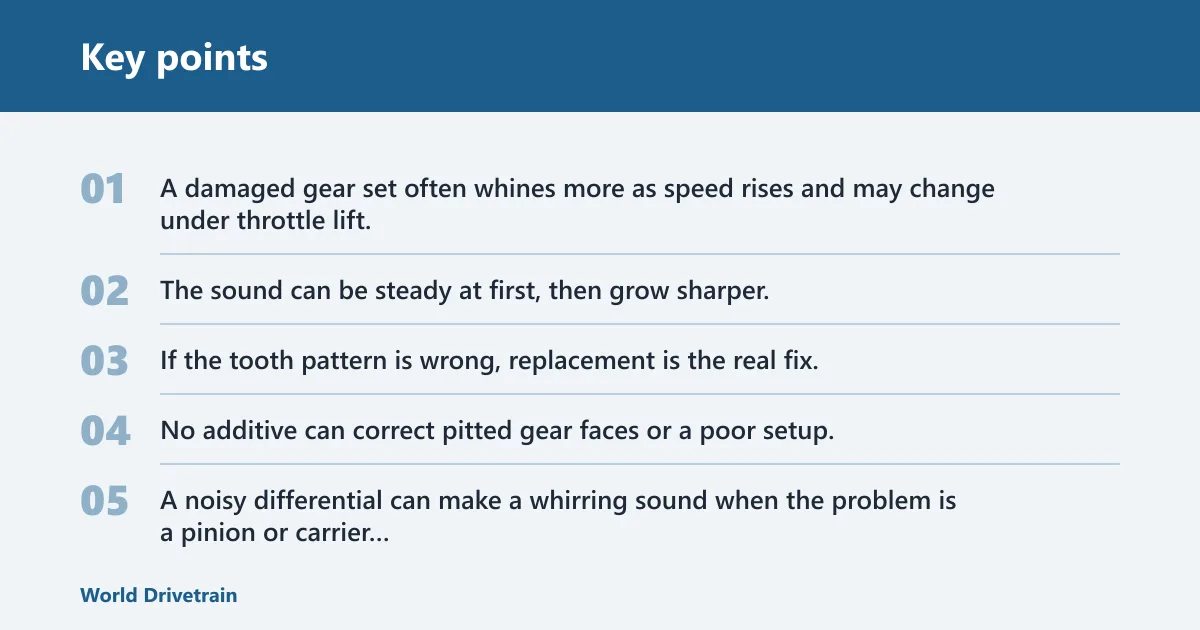
A damaged gear set often whines more as speed rises and may change under throttle lift. The sound can be steady at first, then grow sharper. If the tooth pattern is wrong, replacement is the real fix. No additive can correct pitted gear faces or a poor setup.
Pinion bearing and carrier bearing clues
A noisy differential can make a whirring sound when the problem is a pinion or carrier bearing. A pinion bearing can produce a whir or whine that changes with load. A carrier bearing can mimic gear noise and confuse the diagnosis. Both need inspection, not chemical treatment.
When turning matters
If the noise changes in turns, the limited-slip clutch pack or carrier support parts deserve attention first. If the noise is strongest in a straight line and rises with acceleration, think gear mesh or pinion bearing. Turning noise is a clue, not a reason to pour in an additive and hope.
Additive risks and compatibility
Rear differential additives are not all the same. A limited-use friction modifier belongs in some limited-slip differentials, while other products are closer to viscosity or tackifier style chemistry meant to thicken film. Any product must be compatible with hypoid gear oil. Wrong chemistry can alter clutch behavior or leave the actual fault untouched.
Open and limited-slip differentials are different
An open differential usually does not need a friction modifier. A limited-slip unit may. That difference matters because the wrong bottle can make the clutch pack behave differently, which can create new noise or worsen chatter. Always match the additive to the axle design and the oil specification.
When to stop and avoid a guess
If the noise is severe, the housing is low on oil, or the fill plug cannot be opened, stop guessing. If the fill plug cannot be opened, the guide recommends towing instead of draining blindly. Severe noise and metal in the oil are usually repair signals, not additive signals.
How to quiet a noisy differential at home
The safest home approach is short and methodical: inspect fluid level, inspect fluid condition, then refill with the correct oil before considering an additive. That order keeps you from masking a mechanical fault. If the fluid is wrong or missing, fix that first. If the noise remains, move to diagnosis.
When a fluid change is worth trying
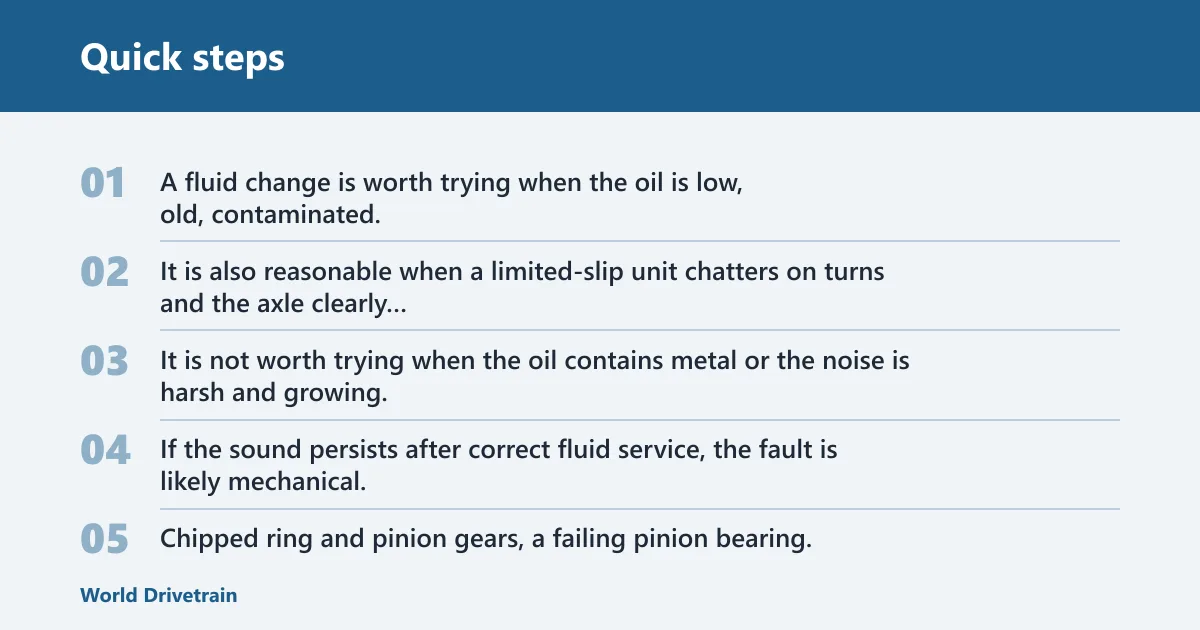
A fluid change is worth trying when the oil is low, old, contaminated, or the axle recently received the wrong gear oil. It is also reasonable when a limited-slip unit chatters on turns and the axle clearly calls for a friction modifier. It is not worth trying when the oil contains metal or the noise is harsh and growing.
When the job should end in repair
If the sound persists after correct fluid service, the fault is likely mechanical. Chipped ring and pinion gears, a failing pinion bearing, or a worn carrier bearing will not respond to additives. At that point, a repair visit is cheaper than repeated bottles and delayed diagnosis.
How to quiet rear differential noise without replacing the whole axle
Start with the fluid. Check level, inspect condition, and drain if the oil looks burnt, contaminated, or wrong for the axle. If the differential is limited-slip, use the correct friction modifier only. If the noise stays after the fluid is right, the axle may need bearing or gear repair rather than replacement as a whole.
How to quieten a noisy differential at home safely
Support the vehicle securely, open the fill plug before draining, and use the correct fluid and torque values on reassembly. Do not guess if the plug is stuck or the noise is severe. Keep hands clear of moving parts, and stop if you find metal in the oil or damage at the drain plug magnet.
Frequently asked questions
Do differential noise additives really work for a whining rear end?
Only sometimes. They can quiet lubricant-related whine or limited-slip chatter, but they do not fix worn gears, damaged bearings, or setup errors. If the noise changes with load, gets rhythmic, or leaves metal in the oil, a repair is the real answer.
Which additive functions have an additive noise effect in a differential?
The functions that matter are friction reduction, limited-slip friction modifier behavior, and sometimes film-thickening from a compatible viscosity or tackifier style chemistry. Those effects can reduce noise only when the cause is lubricant-related. They do not correct tooth wear, bearing wear, or incorrect gear setup.
Will a rear differential additive for noise fix worn gears or bearings?
No. Worn ring and pinion gears need replacement, and a bad pinion or carrier bearing needs inspection and repair. An additive may calm the sound for a while if the oil is the problem, but it cannot restore damaged metal surfaces or reset clearances.
When is a differential noise additive worth trying versus a repair?
Try an additive only after you confirm the fluid level, fluid condition, axle type, and oil spec. It is reasonable for limited-slip chatter or mild lubricant-related whine. If the oil is metal-filled, the noise is severe, or the sound worsens quickly, go straight to repair.
Can an additive stop differential noise when turning or accelerating?
It may reduce noise if the issue is limited-slip clutch chatter or thin oil film, but it will not stop a turn noise caused by a carrier bearing or an acceleration whine caused by ring and pinion wear. Those patterns usually call for diagnosis, not a bottle.
What are the risks of using an additive in a noisy differential?
The main risks are wasted money, delayed repair, and altered clutch behavior in a limited-slip differential. Wrong chemistry can make noise worse or hide a bearing or gear problem long enough for damage to spread. If the fill plug is stuck or the noise is severe, do not guess.