How Much Can Transmission Repair Cost Before Replacement?
A transmission repair is often worth fixing when the bill is under about 30% to 50% of the vehicle’s value. Past that, replacement or retirement is often the better call. Ignore that cutoff, and you can pour money into a unit that still fails, or spend more than the car is worth. This guide explains repair-versus-replace thresholds, what repairs cost, and how failure severity and vehicle value change the decision.
Repair or replace thresholds
A practical cutoff is not one number. Use three checks together: the repair estimate, the vehicle’s current value, and whether the failure is minor, repairable, or a sign of broader internal damage. A small repair on a high-value vehicle can make sense. A large repair on a low-value car often does not.
Start with the estimate from a proper diagnosis. Then compare that number with the car’s value and what the transmission is actually doing. A $700 solenoid job is a different decision from a $4,500 rebuild on a car worth $5,000.
Repair or replace thresholds: symptom or failure type Likely
| Symptom or failure type | Likely repair range | Replacement range | Repair-as-%-of-vehicle-value trigger | Recommended action |
|---|---|---|---|---|
| Shift solenoid fault | $300-$900 | Usually not needed | Above about 15%-20% only if the car is very low value | Fix after diagnosis if the fault is confirmed and no other hard-part damage is found |
| Fluid leak, seal, or service issue | $100-$600 | Usually not needed | Usually below 10% | Repair promptly; do not assume a full transmission failure |
| Valve body problem | $400-$1,200 or $800-$1,800 depending on source | Sometimes a rebuild path | Above about 20%-25% needs careful comparison | Repair if the case is still healthy and symptoms are limited to shifting control |
| Torque converter failure | Often not a simple repair | $800-$2,000 | Above about 25%-30% | Compare converter replacement with rebuild pricing, since it can be mistaken for a full transmission failure |
| Slipping gears | $300-$1,500 if minor; more if internal wear is found | $1,800-$5,500+ | About 30% is the warning line | If the slip returns after service, move toward rebuild or replacement |
| No-drive condition | Often beyond a small repair | $1,800-$5,500+ or more | About 35%-40% or higher | Do not approve major work until diagnosis separates external failure from internal damage |
| CVT failure | Limited repair options in many cases | $2,500-$6,000+ installed | About 30%-40% | Check the price of a remanufactured unit against the car’s market value |
| Repeated failure after prior repair | Often not economical | Often rebuild or replacement territory | Any repeat failure above about 25%-30% deserves scrutiny | Look at warranty coverage, prior repair scope, and whether the unit was ever fully corrected |
| Multiple smaller faults together | $900-$2,000 or more combined | $1,800-$5,500+ if internal wear is present | When the combined bill approaches 30%-40% | Treat the total as one decision, not separate tickets |
That table is the useful threshold: repairs below roughly 30% of vehicle value often deserve consideration, while repairs above 40% usually push you toward replacement if the car has modest resale value or other age-related needs. The middle band depends on condition, mileage, rust, and whether the rest of the car still has useful life.
Say your compact sedan is worth $4,000 and the transmission estimate is $1,100 for a valve body issue. That is about 27.5% of value, so repair can still make sense if the diagnosis is clean and the rest of the drivetrain is sound. Now suppose the same car needs a $4,200 rebuild. That is more than the car’s value, so replacement or retirement becomes the harder-to-ignore option.
When the bill crosses the value line
- Get a diagnosis before authorizing major work.
- Compare the estimate with the car’s private-party value, not the original sticker price.
- Add up related work if the shop flags multiple transmission faults.
- Check whether the car still needs other expensive items soon, such as tires, suspension, brakes, or cooling-system work.
- Use the 30%-40% band as the caution zone, then weigh failure severity and how long you plan to keep the car.
A common first-timer mistake is approving a second or third repair after the first one did not solve the issue. Once the combined total starts matching rebuild pricing, you are no longer comparing separate fixes. You are comparing one large repair path against replacement.
What does a transmission diagnostic cost?
A transmission diagnostic is estimated at $100-$200. That inspection should include a scan, road test, pressure test, and fluid inspection. It is the step that tells you whether the unit is repairable, whether the fault is external, or whether a larger internal failure is likely before major authorization.
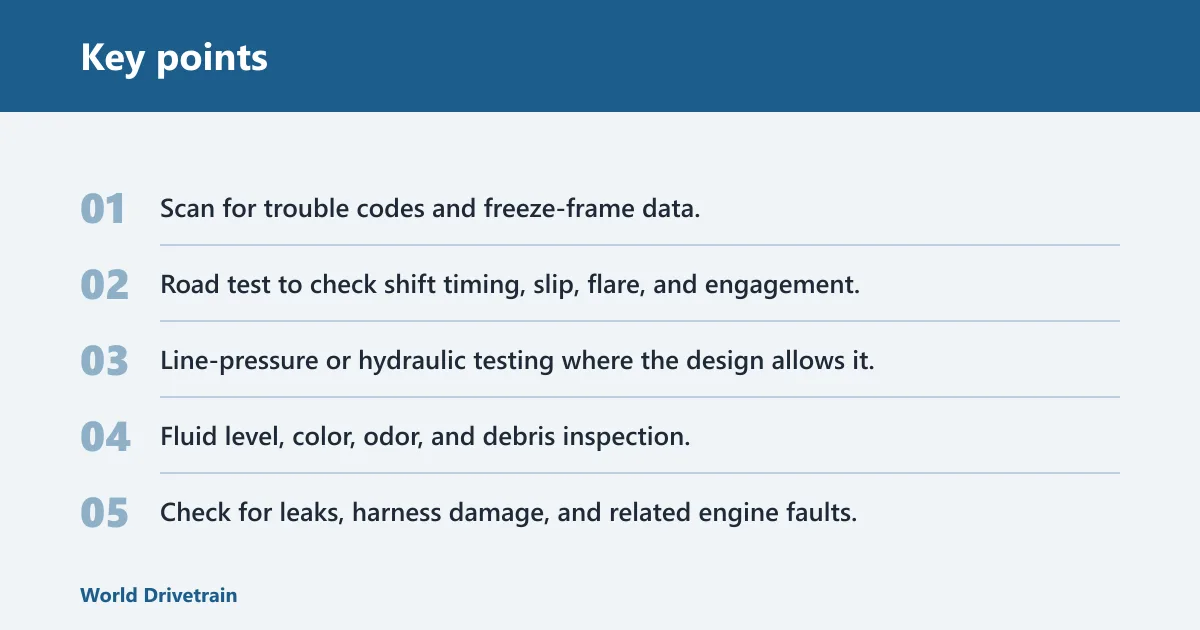
The diagnostic is worth paying for because transmission symptoms overlap. A shifting complaint can come from a solenoid, a valve body issue, low fluid, or torque converter trouble. Without testing, the quote can jump straight to replacement when a smaller repair would have solved it.
What the inspection should include
- Scan for trouble codes and freeze-frame data.
- Road test to check shift timing, slip, flare, and engagement.
- Line-pressure or hydraulic testing where the design allows it.
- Fluid level, color, odor, and debris inspection.
- Check for leaks, harness damage, and related engine faults.
Why diagnostics come before authorization
Diagnostics reduce the risk of paying for the wrong job. A code such as a P0750-type fault can point to a shift solenoid problem, which sits in the minor repair tier and may cost $300-$900. Without confirmation, the same symptom could be misread as a failed transmission.
Do not skip this step because the car still moves. A transmission can be partly failing and still drive poorly enough to need repair now, but the fault has to be identified first.
Which repairs are still worth fixing?
Minor transmission repairs are usually worth fixing when the case is sound and the bill stays well below the 30% line. Shift solenoids, fluid leaks, and some valve body faults are the main examples. These are the repairs that can restore normal shifting without forcing a full rebuild.
Shift solenoid and sensor faults
A shift solenoid repair is listed at $300-$900 and is a common minor repair tier. It often shows up as a P0750-type fault. If the rest of the transmission tests well, this is usually a repair decision rather than a replacement decision.
Sensors and external electrical issues can create similar symptoms. That is why diagnosis matters. A fault code alone does not mean the hard parts are worn out.
Fluid leaks and service items
Leaks are often the cheapest path back to normal function. A seal, pan gasket, cooler line, or low-fluid condition can trigger rough shifts, delayed engagement, or slipping under load. If the unit has not been run dry for long, repair can remain the right move.
Fluid condition matters too. Burnt fluid and debris raise the odds that the problem is deeper than a simple leak, especially if the transmission has already started slipping.
Valve body repairs
Valve body repair often sits between minor repair and rebuild territory. Common pricing can be about $400-$1,200, and some sources place it at roughly $800-$1,800 depending on the vehicle. It can cause erratic shifting or stuck-in-gear symptoms, which makes it one of the more confusing failures.
If the case, clutch packs, and bands still check out, a valve body repair may be enough. If internal wear is already present, that same symptom may be the first sign that rebuild pricing is more realistic.
When does a repair become replacement territory?
Repair becomes replacement territory when the failure points to major internal wear, the quote approaches 30% to 40% of vehicle value, or several smaller repairs together cost nearly as much as a rebuild. At that stage, the question is no longer “can it be fixed?” but “which fixed option makes financial sense?”
Torque converter failure
A torque converter can cost about $800-$2,000 to replace, and it may sometimes be misdiagnosed as a full transmission failure. That matters because a converter problem can mimic slip, shudder, or engagement issues. It can also be part of a broader rebuild decision if debris or wear has spread through the unit.
If the converter failed after internal contamination, a simple converter swap may not be enough. The diagnosis should say whether the rest of the transmission is still worth saving.
Slipping gears and no-drive symptoms
Slipping gears often fall into the warning zone because they can signal clutch wear, band wear, pressure loss, or valve body trouble. A no-drive condition is more serious. If the car will not move in gear, the unit may need rebuild or replacement rather than a smaller repair.
Suppose an SUV worth $7,000 has a $1,600 pressure-related repair estimate. That is about 23% of value, so repair can still be reasonable. If the same SUV needs a $4,800 rebuild after a no-drive diagnosis, the decision shifts fast.
CVT and repeated-failure cases
CVT failures often push costs higher because the unit design is less forgiving when internal wear has spread. Repeated failure after a prior repair is another red flag. If a transmission has already been opened, repaired, and failed again, the same car can move from repair territory to replacement territory even if the second quote is not the highest number on the page.
That is especially true when the previous work did not address the full problem. A repeat failure can mean the first repair solved a symptom, not the cause.
Repair, rebuild, or replace?
Once the bill crosses the low-repair range, compare three paths: rebuild, remanufactured unit, or used unit. A rebuild can be the lower-risk fix for a repairable unit. A remanufactured or used transmission may make more sense when the original unit is too damaged or the labor to open it is not worth the gamble.
Transmission rebuild costs and parts
A transmission rebuild typically runs about $1,800-$5,500+ depending on vehicle type, and some tiered sources place a full rebuild at roughly $1,800-$3,500. It usually involves clutch packs, bands, seals, and teardown. For units that are still salvageable, a rebuild can be cheaper than full replacement.
Rebuilds vary because the shop is reusing the case and selected hard parts. If the case is damaged or the internals are too worn, rebuild stops being the best value.
Remanufactured transmission pricing
A remanufactured transmission is commonly listed at about $2,500-$6,000+ installed, and some sources place rebuilt or remanufactured units at roughly $1,000-$6,000 or more. A warranty is often included. This option often fits when rebuild risk is high or the shop wants a known baseline rather than opening a worn unit.
That price can still be less painful than repeated repairs. For vehicles with high labor cost or difficult packaging, a remanufactured unit can reduce uncertainty even if the upfront number is higher than a local rebuild.
Used transmission pricing and risk
A used transmission can cost $200-$600, and a salvage or junk-yard unit can cost $200-$600 or more. Installed pricing can land around $1,500-$2,500. The lower price is real, but the history is unknown, so the risk is higher than with a rebuild or reman unit.
Used units can fit older cars with limited market value, but they are not low-risk by default. The savings only matter if the unit is healthy enough to justify the install labor.
| Option | Typical cost range | Main upside | Main risk |
|---|---|---|---|
| Repair | $300-$1,500 for minor work; more for major faults | Lowest cost when the transmission case is still good | Can fail again if the root cause was not fully corrected |
| Rebuild | $1,800-$5,500+ | Uses the existing case and replaces worn internal parts | Cost can climb if hard parts are damaged |
| Remanufactured | $2,500-$6,000+ installed | Usually includes warranty and a known rebuild standard | Higher upfront cost than many repairs |
| Used | $200-$600 for the unit; around $1,500-$2,500 installed | Lowest parts cost | Unknown history and unknown remaining life |
Does vehicle type change the answer?
Vehicle type changes the answer because labor time, packaging, and transmission design change the bill. Compact cars, SUVs, pickups, luxury vehicles, front-wheel-drive layouts, European models, and CVTs do not land in the same cost band. A repair that makes sense on one platform may not make sense on another.
Compact cars versus pickups and SUVs
Compact cars can be cheaper to service, but that is not guaranteed. Pickups and SUVs often carry larger or more costly transmissions, and their replacement labor can be harder depending on layout. If the car’s market value is modest, a big-ticket transmission quote can cross the repair threshold quickly.
Vehicle class also affects the decision because the same repair percentage means something different on a $3,500 commuter car than on a $18,000 SUV.
Luxury, European, and front-wheel-drive costs
Front-wheel-drive cars usually require more labor during replacement than rear-wheel-drive cars. European models often cost more to service, and luxury units can push totals higher because of parts price and labor time. CVT and performance applications can also move the bill upward fast.
Labor rate is a major driver. Common shop rates are often about $90-$220 per hour, with dealerships and metro areas often near the higher end. That rate difference can decide whether a rebuild stays in range or a replacement becomes too expensive to justify.
Why labor rate changes the total
Transmission replacement generally takes between six and 12 hours, so labor is a major slice of the final bill. In cited data, labor costs between $1,127 and $1,654, and parts are priced around $5,110 for many cars. That is why the same failure can cost far more in one market than another.
The average transmission replacement costs between $6,238 and $6,764, but it can range from $3,000-$15,000+ depending on vehicle. RepairPal data also shows a 2018 Honda Civic replacement can total $6,763 to $13,151. Those figures are why the vehicle-value test matters more than a single sticker price.
Frequently asked questions
How much can transmission repair cost before replacement makes more sense?
A practical line is about 30% to 40% of the vehicle’s value. Below that, repair often still makes sense if the failure is limited and the rest of the car is sound. Above that, replacement or retirement usually deserves a closer look, especially on older cars with low resale value.
At what repair cost should I replace my transmission instead of fixing it?
There is no universal dollar cutoff, but many owners start leaning toward replacement once the quote reaches a third of the car’s value. If the car is worth $5,000 and the estimate is $2,000 or more, the decision should include the rest of the car’s condition, not only the transmission.
Is a transmission rebuild cheaper than replacement?
Often, yes. If the case is salvageable, rebuilding can cost less than full replacement. If the unit is badly damaged, replacement may be the cleaner option.
What transmission repairs are expensive enough to justify replacement?
Torque converter failure, major slipping, no-drive symptoms, CVT failure, and repeated failure after a prior repair can justify replacement more often than a simple solenoid or leak. The key is whether the quoted fix is only treating one symptom while the unit as a whole is already worn out.
How do I know if my transmission problem is minor or major?
Minor problems usually involve solenoids, small leaks, service items, or a limited valve body fault. Major problems usually involve slipping gears, no-drive symptoms, contaminated fluid, or repeated failure. A scan, road test, pressure test, and fluid inspection are the best way to separate the two.
Can a used or remanufactured transmission save money?
Yes, but for different reasons. A used transmission has a lower parts price, usually $200-$600, but the history is unknown. A remanufactured transmission costs more, often $2,500-$6,000+ installed, and usually includes warranty coverage. The better choice depends on vehicle value and risk tolerance.