What Happens If a Transfer Case Runs with No Fluid?
If a transfer case runs with no fluid, it can fail within minutes to a few miles, and a simple refill only helps if the gears and bearings have not already been damaged. Keep driving and you can turn a fluid leak into seized shafts, broken chain parts, and a repair that jumps from a refill to a rebuild or replacement. This guide explains the damage sequence, the warning signs, and the point where a dry transfer case is still salvageable versus already beyond a fluid refill.
What a transfer case does
A transfer case splits torque between the front and rear driveline in 4WD and AWD vehicles. Some are part-time designs that operate in 2H, 4H, and 4L, while full-time or automatic systems may add an Auto mode that shifts torque as traction changes. Inside, gears, a chain in many cases, bearings, seals, and fluid all work together.
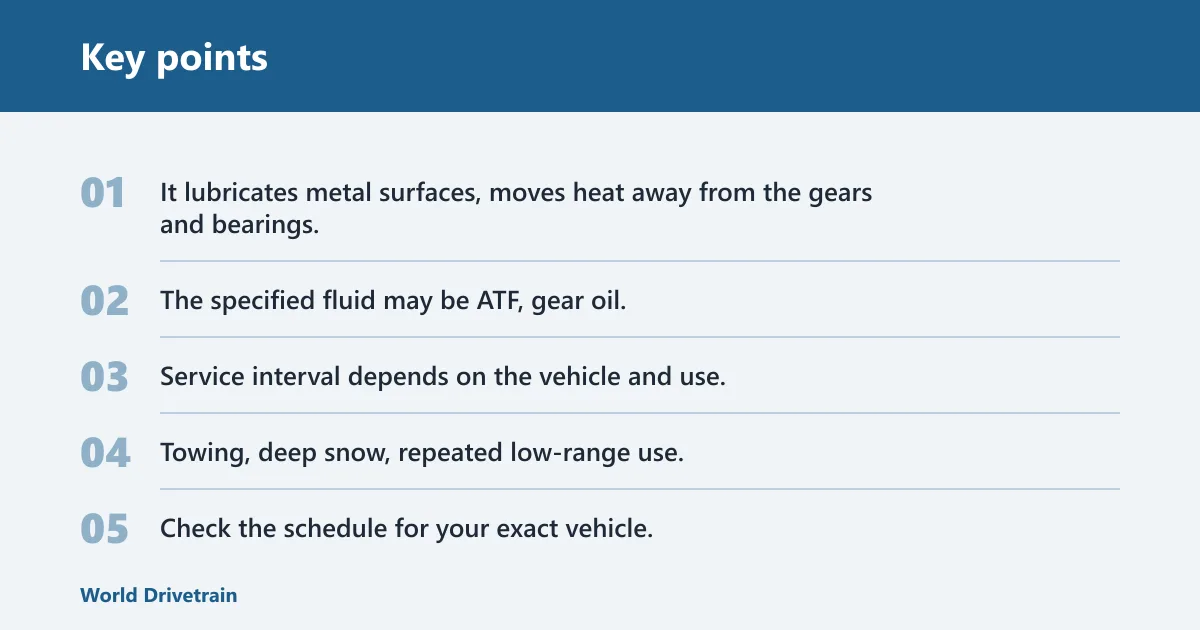
Fluid keeps those parts alive. It lubricates metal surfaces, moves heat away from the gears and bearings, and helps seals last longer by reducing friction at their lips and shafts. The specified fluid may be ATF, gear oil, or a manufacturer-specific transfer case fluid, so the label and owner information matter.
Service interval depends on the vehicle and use. Towing, deep snow, repeated low-range use, and frequent 4WD operation shorten the interval because the case runs hotter and the fluid shears faster. Check the schedule for your exact vehicle, then shorten it further if you tow or drive in mud, sand, or snow often.
Part-time and full-time behavior
Part-time 4WD cases usually see their highest load in 4H and 4L, where both axles are mechanically tied together. Full-time AWD cases may spread load more continuously, and electronically controlled cases may add clutch packs or shift motors that complicate the fault pattern. The damage path still starts the same way: low fluid, more heat, less protection, then wear.
What happens first when fluid is low?
Low fluid removes the full oil film from the hottest parts first, usually the bearings and gear teeth. Heat rises, lubrication thins, and the case starts to make noise before it fully fails. Partial loss often gives warning signs; complete loss speeds wear so fast that the case can seize or shed parts without much notice.
The first stage is usually a change in sound or temperature, not a total loss of drive. A dry or nearly dry bearing can whine, growl, or grind because the rolling elements stop riding on a stable film. Once that happens, the shafts no longer stay centered as well, and the wear pattern spreads to gears and chain surfaces.
Say your SUV has a slow rear seal leak and the fluid level drops over weeks. It may start with a light whine at highway speed in 4H, then turn into a harsher grinding sound as the bearing surfaces overheat and score.
Why partial loss is different from total loss
Partial loss still leaves some fluid to carry heat and protect contact points, so damage may begin as noise, vibration, or a mild burning smell. Total loss removes that buffer. In that state, the case can move from warning signs to hard part damage in a very short time, especially under load in 4H or 4L.
How dry running damages the case
Dry running usually starts with bearings because they spin all the time and rely on a thin fluid film. As they overheat, they can pit, discolor, and lose smooth rotation. That changes shaft alignment and sends extra load into the gears, chain, and seals.
Gear damage follows when tooth faces no longer stay separated by a stable lubricant layer. The result can be pitting, scoring, or edge wear, which adds more noise and heat. In chain-driven cases, the chain can stretch, slap, or skip under load when lubrication is lost, and that may create a shudder or a momentary loss of drive.
Seals are part of the cycle too. A worn input or output seal can start the leak, and a leak can become complete fluid loss if it is ignored. Once fluid leaves the case, the shafts, bearings, and chain run hotter, which can harden or damage the seals further and widen the leak.
Bearings, gears, and chain damage
Bearing failure often shows up first because it produces heat fast and can create a whining or grinding note before seizure. Gear damage may come next, especially if the vehicle keeps being driven in 4WD. Chain-driven cases can also fail by chain stretch or skip, which may feel like a slap, bind, or a sudden loss of pull at the front axle.
What symptoms should you watch for?
Common transfer case failure symptoms include whining or grinding noise, a burning smell, fluid leaking under the center of the vehicle, difficulty shifting into or out of 4WD, and vibration or binding during turns. A fluid loss problem may begin with one of these signs, then stack several of them together as damage spreads.
Noise that rises with road speed often points toward rotating parts inside the case. A burning odor usually means overheated fluid or metal surfaces, while a wet area under the center of the vehicle often points to the transfer case rather than the transmission or a differential. Difficulty engaging 2H, 4H, 4L, or Auto can also point to internal wear or a fault in the shift system.
Suppose a truck with part-time 4WD starts to bind during tight turns after a puddle spot appears under the center of the cab. That combination is more suspicious than a rear differential issue because the symptoms tie together: a center leak, drive mode trouble, and a transfer case load problem.
Symptoms by mode
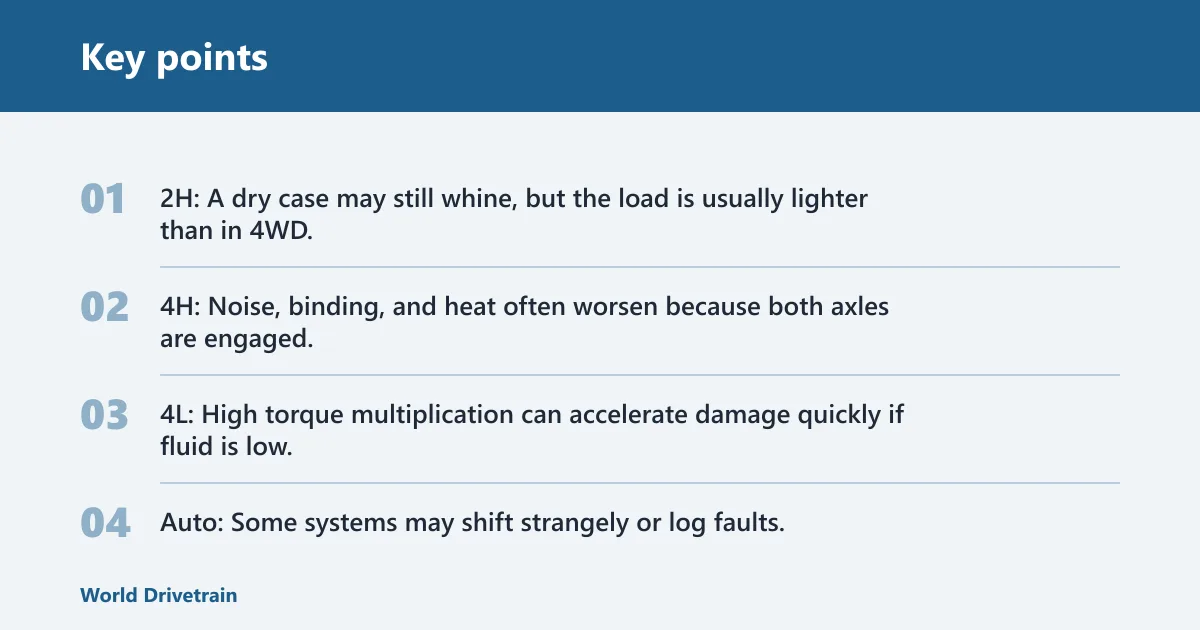
- 2H: A dry case may still whine, but the load is usually lighter than in 4WD.
- 4H: Noise, binding, and heat often worsen because both axles are engaged.
- 4L: High torque multiplication can accelerate damage quickly if fluid is low.
- Auto: Some systems may shift strangely or log faults, but a warning light does not prevent all damage.
Transfer case failure table
This table helps separate a refill-and-inspect situation from a case that likely needs teardown, rebuild, or replacement. The pattern matters more than any single symptom.
| Noise | Smell | Leak severity | Drivability | Likely next step |
|---|---|---|---|---|
| Light whine that changes with speed | None or faint hot-oil odor | Damp case or slow seep | Normal, no binding yet | Refill inspection and leak repair |
| Louder whine, occasional grind | Burning odor after driving | Active drip under center of vehicle | Shifts may be stiff or delayed | Stop driving, inspect, and likely teardown |
| Grinding, slap, or metallic rumble | Strong burned-fluid smell | Heavy leak or empty case | Vibration, binding, or intermittent drive loss | Teardown, rebuild, or replacement |
| Sudden noise followed by loss of drive | Sharp burnt smell or hot metal smell | May be no visible leak if already empty | Unsafe or no longer drivable | Replacement is often more likely than a simple repair |
The table is a triage guide, not a guarantee. A low-fluid case can sometimes return to service after a refill and leak repair if the noise is mild and the vehicle still drives normally. Once grinding, binding, or drive loss appears, the odds shift toward internal damage.
Can you keep driving after a leak?
Driving after a transfer case leak depends on how much fluid remains, whether the noise has started, and whether the vehicle still shifts cleanly. A wet case with no symptoms may allow only enough driving to reach a repair shop. A case that is whining, grinding, or binding should be treated as stop-driving territory.
On some vehicles, a transfer case control module may log a fault code or limit shift actions, especially in electronically controlled systems. That can help diagnosis, but it does not cancel the damage already happening inside the case. If the fluid is gone, the bearings and gears still run dry.
Low transfer case fluid can also be mistaken for transmission or differential trouble because the noise can travel through the driveline. The clue is location and behavior: center-of-vehicle noise, 4WD mode trouble, and a leak near the case point back to the transfer case more often than the transmission or axle.
Stop immediately when these appear
- Grinding or scraping from the center of the vehicle.
- Burning odor that appears after a short drive.
- Binding in turns or a hard-to-shift 4WD mode.
- Visible dripping from the transfer case area.
- Loss of drive to the front or rear axle.
What should you do right away?
Start by checking for leaks and confirming the fluid level. If the case is low, top it up only with the exact fluid spec listed by the vehicle maker. Then inspect the source of the loss, because a refill without leak repair often just delays the next failure.
The first 10 minutes matter. Park on level ground if possible, look for wetness at the input seal, output seals, vent, and case halves, and note whether the symptoms began after 2H, 4H, 4L, or Auto use. If the case was run dry and now whines or grinds, towing is safer than a road test.
How to check fluid level
Some transfer cases use a fill plug, others use a dipstick or a level-check port. The correct check method depends on the vehicle and whether the reading must be taken warm or level. Do not assume transmission fluid and transfer case fluid are interchangeable, because the required specification can differ.
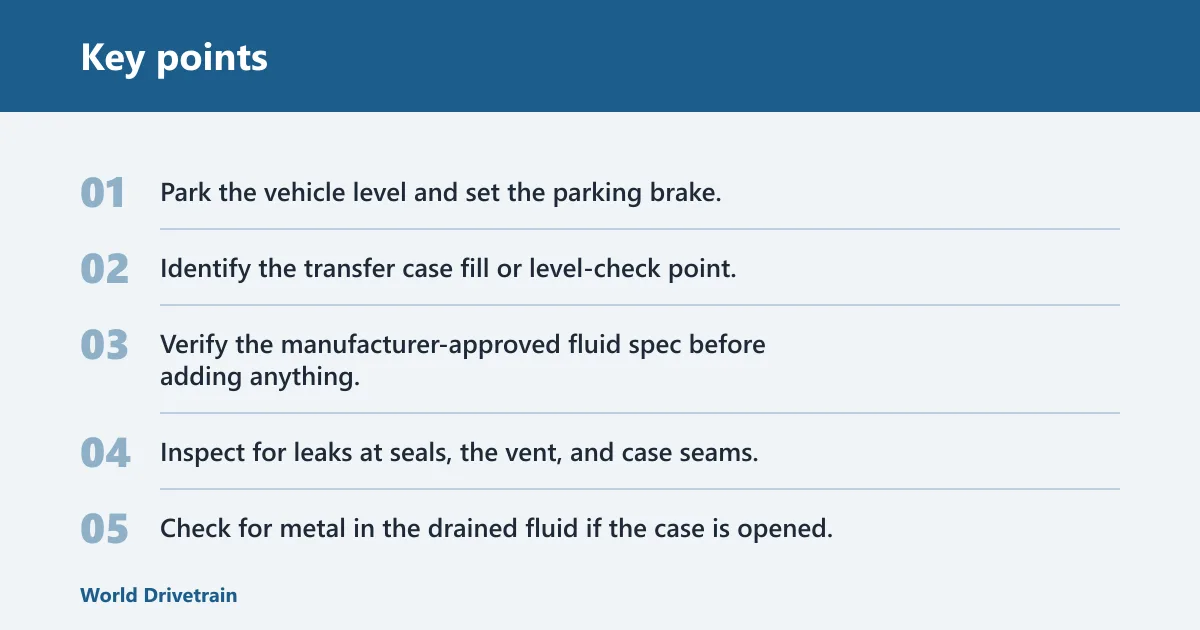
- Park the vehicle level and set the parking brake.
- Identify the transfer case fill or level-check point.
- Verify the manufacturer-approved fluid spec before adding anything.
- Inspect for leaks at seals, the vent, and case seams.
- Check for metal in the drained fluid if the case is opened.
When refill is enough, and when it is not
A refill and leak repair can be enough when the case is only slightly low, the fluid still looks reasonably clean, and there is no grinding, binding, or drive loss. Teardown becomes more likely when noise persists after refill, when the drained fluid contains metal, or when the chain, bearings, or gears show heat damage.
Replacement is more likely when the case has seized, lost drive, or scattered enough internal damage that a rebuild would cost nearly as much as a known-good unit. In practice, the decision turns on symptom severity, how long the case ran dry, and whether the driveline still moves smoothly after fluid is restored.
Frequently asked questions
What happens if a transfer case runs with no fluid?
If a transfer case runs with no fluid, the bearings and gears lose their protection almost immediately. Heat rises fast, noise usually appears, and the chain in chain-driven cases can start to slap or skip. Continued driving can seize shafts or break internal parts, which turns a refill problem into a rebuild or replacement.
How long can you drive with no transfer case fluid?
There is no safe distance to count on. A dry case may fail within minutes, and the exact point depends on load, speed, mode selection, and how long the case has been low. If the fluid is gone or the case is grinding, stop driving and arrange inspection or towing.
What are the first signs of transfer case fluid loss?
The first signs are usually a whine that changes with speed, a slight burning smell, or dampness around the case. Some drivers also notice a harder shift into 4H, 4L, or Auto. A leak under the center of the vehicle is one of the clearest clues that the transfer case needs attention.
Can a transfer case be repaired after running dry?
Yes, sometimes, but only if the damage has stayed limited to seals, fluid loss, or light wear. Once the bearings are noisy, the chain is loose, or the gears are scored, a simple repair is less likely to hold. A teardown is the only reliable way to judge whether rebuild parts will be enough.
Will low transfer case fluid damage the chain or gears?
Yes. Low fluid raises heat and weakens the protective film on the chain, gears, and bearings. In a chain-driven case, the chain may stretch or skip under load. Gear teeth can pit or score, and the resulting metal wear can spread through the case and damage seals as well.
Is a whining noise from the transfer case serious?
A whine from the transfer case should be treated as a warning, not background noise. It often means the bearings are running dry or the gear surfaces are wearing faster than normal. If the sound gets louder with speed or appears with a burning smell, the case needs quick inspection before the damage grows.