Do Transmission Stop-Leak Additives Work?
Sometimes, but only for minor seal shrinkage. If the leak comes from a torn seal, cracked case, or hard line, additives will not fix it. Using one on the wrong leak can buy time at best and let low fluid damage the transmission at worst. This guide gives you a simple yes/no test for when a transmission stop-leak additive is worth trying and when repair is the only real fix.
Do transmission stop-leak additives work?
They can work in a narrow sense. Some products reduce seepage from aging seals and gaskets by conditioning rubber or slightly swelling dried material. They do not repair structural damage, and they are a poor answer when fluid is leaving quickly. The outcome depends on leak source, leak rate, and whether the product matches the transmission type.
What they are designed to do
Most transmission stop-leak products use automatic transmission fluid as the carrier and add conditioners or seal-swelling agents. That means the bottle is built to circulate with the fluid, reach seals, and try to soften or swell material that has dried, hardened, or shrunk with age.
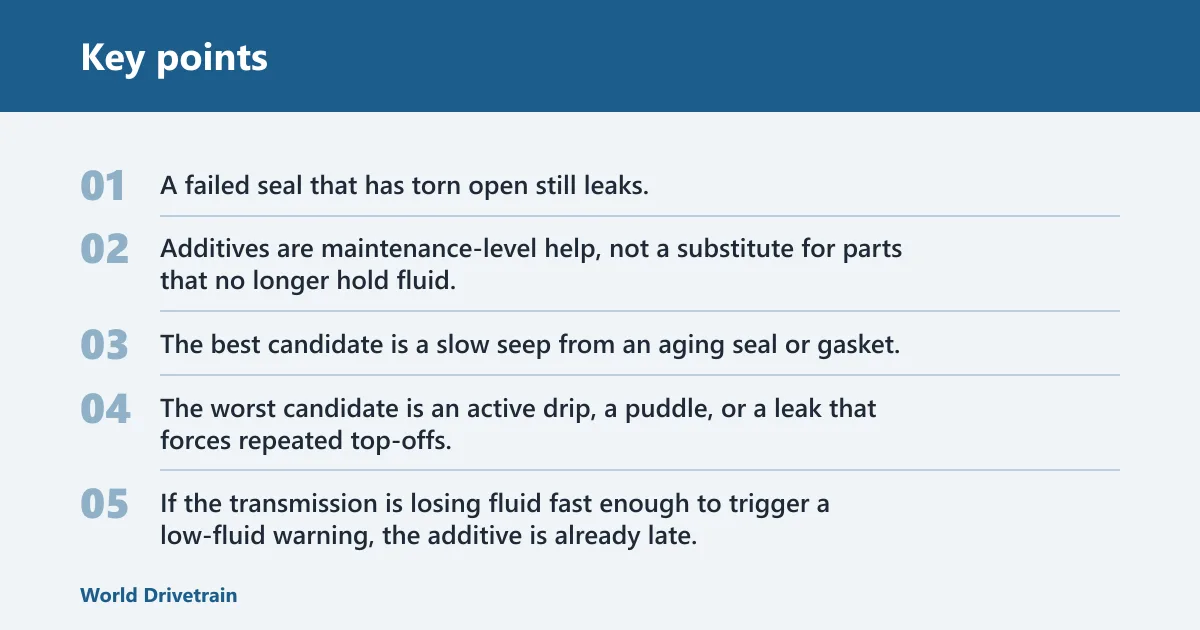
That is different from repair. A cracked pan still leaks. A broken cooler line still leaks. A failed seal that has torn open still leaks. Additives are maintenance-level help, not a substitute for parts that no longer hold fluid.
Why results depend on leak source and fluid loss rate
The best candidate is a slow seep from an aging seal or gasket. The worst candidate is an active drip, a puddle, or a leak that forces repeated top-offs. If the transmission is losing fluid fast enough to trigger a low-fluid warning, the additive is already late.
Suppose a case has a damp output seal and leaves a few drops after parking overnight. That is the kind of symptom where a stop-leak product might slow seepage. Now change one variable: the same spot starts dripping onto the floor after each drive. At that point, the leak is too severe for guesswork.
What can they actually help?
Transmission stop-leak additives are aimed at seepage from aging rubber, especially seals that have dried, hardened, or shrunk with heat and time. They may reduce small leaks at a seal or gasket when the part is still intact. They are not a fix for physical damage, and they are not a universal answer for every transmission complaint.
Aging seals that seep, not fail
When a transmission seal hardens, fluid can work past it even though the seal has not torn. In that narrow case, a conditioner may slow the seepage. The same idea applies to some gasket weeping, although a gasket that is no longer sealing properly often points to a repair instead of an additive.
High-mileage vehicles with slow seepage are common candidates for this trial because age and heat can dry out rubber. That does not mean every high-mileage leak is a candidate. The source still matters more than the mileage number on the odometer.
Seal conditioners versus friction modifiers
Do not mix up a leak-stop product with a shift-quality additive. Some bottles are aimed at seal conditioning, while others are aimed at changing friction characteristics to influence shifting feel or noise. A product marketed for one job may do little for the other.
That distinction matters because a slipping transmission is not the same question as a leak. Slipping can point to wear, low fluid, pressure loss, or clutch problems. A stop-leak additive does not fix those causes just because the bottle also mentions smoother operation.
Transmission leak decision table
| Leak symptom | Likely source | Additive suitability | Risk level | Next step |
|---|---|---|---|---|
| Damp seam with no drip | Seepage at a seal | Possible short-term trial | Low | Confirm fluid level, then monitor after treatment |
| Wet area around pan edge | Transmission pan gasket | Poor candidate | Medium | Plan mechanical repair and inspection |
| Drop forming on floor | Cooler line drip | No | High | Replace or repair the line |
| Fluid at bellhousing opening | Internal seal or front pump area | No | High | Diagnose the source before driving farther |
| High-mileage unit with slow weeping | Hardened transmission seal | Possible short-term trial | Low to medium | Try only if fluid level stays stable |
| Repeated top-offs needed | Unknown or active leak | No | High | Find the source first; additive is not enough |
| Low fluid warning or slipping | Loss from a leak or internal issue | No | High | Check level immediately and inspect for the source |
| CVT labeled on bottle | CVT transmission | Only if explicitly approved | Medium to high | Read the bottle wording before use |
The table gives the basic rule: a slow seep from intact rubber may be worth a trial, but active loss, unknown loss, or structural failure is not. That line matters more than brand marketing.
Which leaks are poor candidates?
Leaks from the pan gasket, cooler lines, and bellhousing are usually poor candidates for stop-leak treatment. These are common leak locations, but they often point to parts that need mechanical repair rather than chemical conditioning. If fluid is leaving from a cracked part, a damaged line, or a failed seal that is no longer holding, the additive is the wrong tool.
Transmission pan gasket leaks
A transmission pan gasket leak often shows up as wetness around the pan rail or drip marks at the bottom of the transmission. That gasket usually needs replacement, not additive treatment. It is one of the most frequent leak culprits, which is exactly why it should not be assumed to be a seal-conditioning job.
Transmission cooler line leaks
Cooler line leaks often come from rusted steel sections or cracked hose sections. Those problems need line replacement or line repair. An additive cannot close a crack or stop fluid from escaping through metal that has rusted through.
Bellhousing leaks and internal failure signs
Fluid at the bellhousing can point to deeper internal leaks, such as a front seal or pump-related issue. If the transmission is slipping, whining, or losing fluid quickly at the same time, treat it as a diagnostic problem rather than a stop-leak question. The product may hide the symptom and leave the cause in place.
Picture a driver who sees a wet bellhousing and adds a stop-leak product because the bottle mentions seals. If the fluid loss continues, the vehicle may end up with lower fluid and more wear before the real fault is fixed. That is the risk that gets overlooked most often.
Are they safe for CVT transmissions?
Compatibility varies, and CVT transmission products need special care. Some stop-leak additives are not recommended for CVT transmissions, while others may be marketed for use in automatic, manual, CVT, and dual-clutch transmissions. The bottle wording, not a general rule, decides whether a product belongs in a specific unit.
How to read the bottle before buying
- Identify the transmission type. Confirm whether the vehicle has an automatic, manual, CVT, or dual-clutch unit before buying anything. Bottle instructions are product-specific, so the same brand may not approve every transmission type.
- Check the exact wording. Look for phrases such as approved, recommended, or not recommended for your transmission type. For example, one product page lists Lucas Transmission Fix as not recommended for CVT transmissions, while another brand, Bar’s Leaks, claims use in automatic, manual, CVT, and dual-clutch transmissions.
- Skip mixed guesses. If the bottle does not clearly approve the transmission type, do not assume compatibility. CVT and dual-clutch units are especially sensitive to fluid and additive differences.
The safest rule is simple: if the bottle does not explicitly fit the transmission, do not use it. That is especially true for CVT units, where the wrong additive can create a new problem while trying to slow an old leak.
Stop-leak trial or repair now?
The choice often comes down to math and leak severity. A transmission leak inspection averages $61 to $90. Pan gasket replacement averages $519 to $668. Cooler line replacement averages $366 to $446. A short additive trial can make sense when the leak is a slow seep from aging rubber, but repair makes more sense when the leak is active or the symptoms point to a failed part.
When the math favors a trial
If the leak is small, the fluid level stays stable, and the source looks like a hardened seal or gasket seep, a stop-leak product may be worth trying before major disassembly. The best case is a maintenance-level problem that is annoying but not yet severe.
That trial should still start with inspection. An inexpensive diagnosis can prevent wasted fluid, wasted time, and a repair that gets delayed past the point where the transmission is still healthy.
When the math favors immediate repair
If the leak is dripping, the fluid level drops quickly, or the vehicle needs repeated top-offs, skip the additive and fix the source. A product cannot close a cracked pan, replace a rusted cooler line, or restore a failed gasket that has already lost its seal.
A common first-timer mistake is treating a low-fluid warning as a reason to add more product and keep driving. That warning means the system needs diagnosis first. More fluid without a fix can buy a short drive and a longer repair bill.
What to do before adding anything
Do not pour in a stop-leak product first and hope for the best. Confirm the transmission type, check the fluid level and condition, and find the leak source before any additive goes in. Those three checks separate a reasonable trial from a risky guess.
- Confirm the transmission type. Identify automatic, manual, CVT, or dual-clutch before shopping. This matters because product compatibility varies by transmission type and cannot be generalized from one brand to another.
- Check fluid level and color. Verify that the fluid is not already low and note any burnt smell, dark color, or contamination. A low-fluid condition can point to a leak severe enough that an additive is not the right response.
- Trace the leak source. Look for wetness at seals, the pan gasket, cooler lines, and the bellhousing area. The location usually tells you whether the problem is a seepage candidate or a repair-only failure.
Transmission stop-leak products are best treated as a narrow tool for slow seepage, not a catch-all fix. If the source is unknown, the fluid loss is fast, or the unit is slipping, diagnosis comes first.
Frequently asked questions
Does transmission stop leak actually work?
It can work on the right leak source. The most realistic case is slow seepage from hardened or shrunken rubber, where conditioners may help the seal hold a little better. For active drips, repeated top-offs, or bellhousing leaks, the odds are poor.
Is there a stop leak for transmissions?
Yes, but the label matters. Some products are made for automatic transmissions, and some also claim use in manual, CVT, or dual-clutch units. That does not mean they are interchangeable, so the bottle instructions must match the transmission type exactly.
Will a transmission stop leak fix a leak from a gasket or seal?
It may slow seepage from a seal or gasket that is still intact but aged. It will not fix a torn seal, a failed pan gasket, or a cracked case. If the leak is wet enough to drip or needs constant topping off, mechanical repair is the right move.
Can stop-leak additives help a slipping transmission too?
Not in the way most drivers hope. A slipping transmission is usually a separate problem tied to low fluid, internal wear, pressure loss, or another fault. A stop-leak additive may address seepage, but it does not repair the cause of slip by itself.
Are transmission stop-leak additives safe for CVT transmissions?
Only when the bottle explicitly says they are. Some products are not recommended for CVT transmissions, while others claim CVT compatibility. Because claims differ by brand, you should read the label before use and skip the additive if approval is unclear.