Axle Seal Leak Symptoms, Causes and Repair Cost
If gear oil is wet at the axle flange or inside the wheel, and the fluid level is dropping, treat it as an axle seal leak. A simple repair is often about $150-$450, but damage to bearings, brakes, or the axle shaft can push the cost past about $1,200. Left alone, it can contaminate brake linings, ruin bearings, and overheat the axle. This guide shows how to identify the leak, separate it from common look-alikes, and estimate the bill by failure severity.
How to spot an axle seal leak
An axle seal keeps gear oil inside the axle housing where the axle shaft exits the rear differential or axle assembly. When it fails, oil can show up near the backing plate, inside the wheel, or on the inner tire sidewall. Heat after a drive often makes a slow seep easier to spot.
What the fluid looks and smells like
Gear oil usually has a heavy, sulfur-like smell. It may look dark amber at first and turn greyish when it is contaminated with wear debris. On the wheel end, a dark mark can appear on the inside of one wheel, on the backing plate, or on the lower edge of the brake dust shield.
A wet patch on the floor near the axle is another clue, but it is not enough by itself. Brake fluid, wheel seal grease, and even road grime can confuse the picture. The smell and location matter.
Where the leak usually shows up
Rear axle leaks commonly show at the axle shaft exit, around the brake backing plate, or on the inside of the wheel. Front axle or front differential layouts can show a similar pattern at the axle end. The diagnosis logic is the same, find the wettest point, then trace it back to the source.
Suppose a pickup leaves a small puddle after a 20-minute drive and the inside of one rear wheel is damp. If the brake fluid reservoir stays full and the fluid smells like gear oil, the axle seal moves to the top of the list. If the wetness is on the caliper body or brake hose, the fault may be elsewhere.
Signs that point to axle oil instead of brake fluid
Gear oil tends to cling, smell strong, and collect dirt. Brake fluid is usually thinner, less odorous, and can travel along painted surfaces faster. If the fluid is around the axle tube, backing plate, or drum area, gear oil is more likely than brake fluid. If the master cylinder level is dropping, brake fluid needs priority.
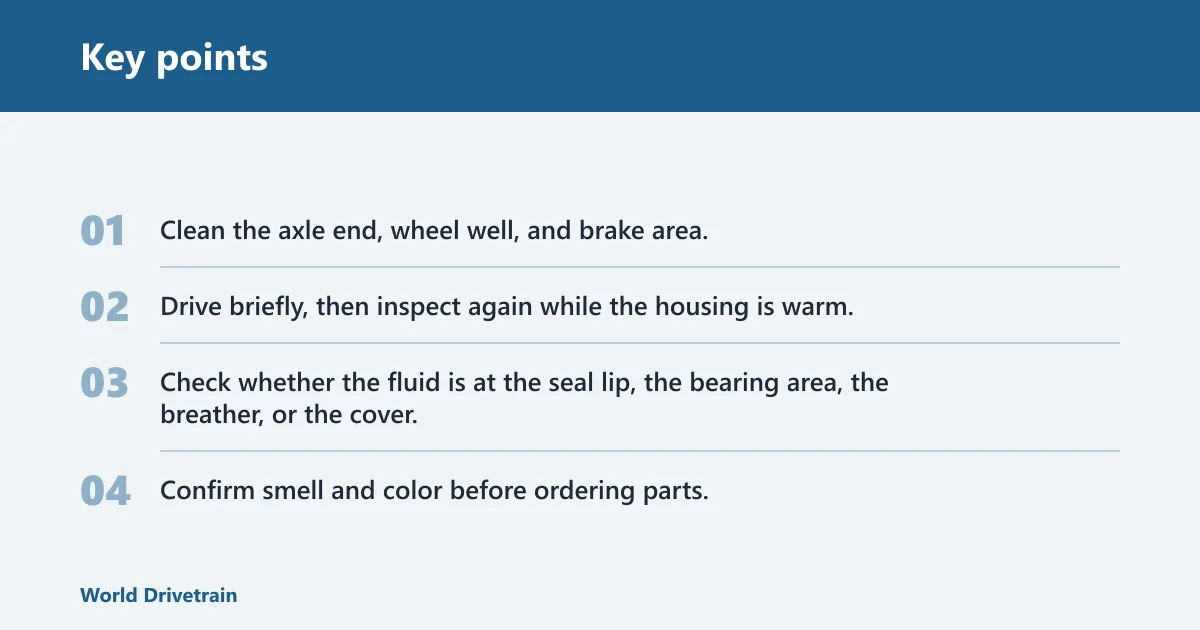
- Clean the axle end, wheel well, and brake area.
- Drive briefly, then inspect again while the housing is warm.
- Check whether the fluid is at the seal lip, the bearing area, the breather, or the cover.
- Confirm smell and color before ordering parts.
What causes an axle seal to leak?
An axle seal can start leaking from age, heat, shaft wear, bearing movement, or pressure inside the housing. A clogged breather can trap pressure and push oil past the seal. Overfilled gear oil can do the same. A seal that is installed correctly can still leak again if the axle shaft or bearing is the real problem.
Heat, age, and seal wear
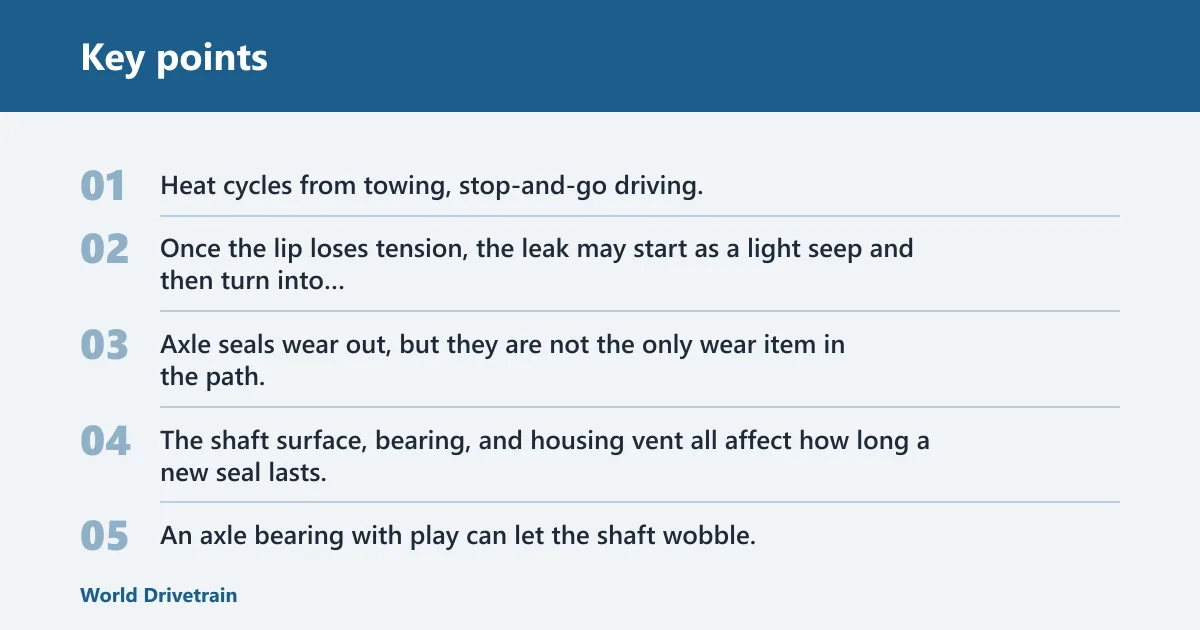
Rubber hardens with time. Heat cycles from towing, stop-and-go driving, and long highway runs can dry the seal lip and reduce its grip on the shaft. Once the lip loses tension, the leak may start as a light seep and then turn into visible wetness after a drive.
Axle seals wear out, but they are not the only wear item in the path. The shaft surface, bearing, and housing vent all affect how long a new seal lasts.
Bearing play and axle shaft movement
An axle bearing with play can let the shaft wobble. That movement wipes the seal lip, opens a path for oil, and can turn a new seal into a repeat failure. If the bearing is rough, noisy, or loose, replacing only the seal often solves nothing for long.
Axle bearing movement is one of the first things to check when a leak returns. The seal may be innocent.
Shaft wear, pitting, and breather pressure
The axle shaft sealing surface must be smooth. Grooves, pitting, or rust at the seal contact area can cut the new lip or let oil bypass it. In that case, a sleeve or shaft replacement may be needed. The seal can be fine; the surface it rides on is the problem.
A blocked breather valve matters too. If the axle housing cannot vent, pressure builds and pushes gear oil past the seal. That is why a technician should check the breather before condemning the seal.
How do I tell an axle seal leak from a wheel bearing or brake leak?
A leaking axle seal often shows up with gear oil smell, wetness near the axle shaft exit, and damp brake backing plates or wheel backs. A wheel bearing problem usually adds play, noise, or roughness. A brake fluid leak points more toward the hydraulic system, not the axle housing. The order of checks matters.
How bearing noise and play change the diagnosis
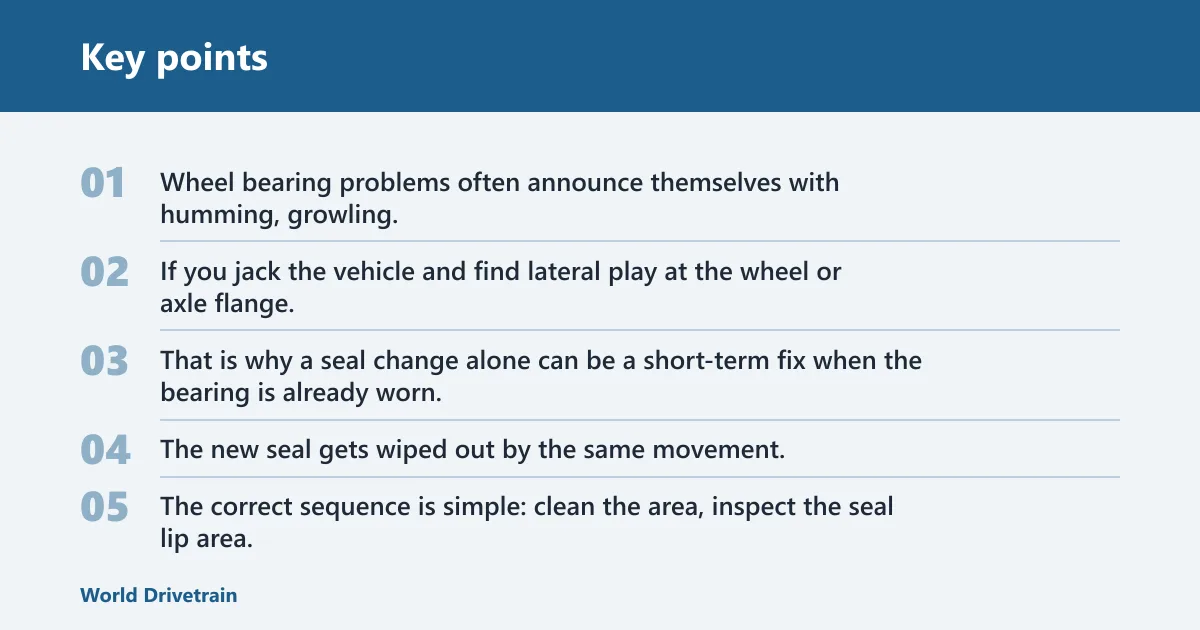
Wheel bearing problems often announce themselves with humming, growling, or a change in noise that follows vehicle speed. If you jack the vehicle and find lateral play at the wheel or axle flange, the seal may be leaking because the bearing is no longer holding the shaft in line.
That is why a seal change alone can be a short-term fix when the bearing is already worn. The new seal gets wiped out by the same movement.
What a technician should check before replacing parts
The correct sequence is simple: clean the area, inspect the seal lip area, check the axle bearing for play or roughness, verify the breather, and confirm fluid level and condition. If the leak path is still unclear, UV dye can be added so the exact source shows after a short drive.
Say your SUV shows a damp inside wheel after a wet winter commute. Cleaning removes the grime, but the next drive leaves dye trails from the axle shaft, not the caliper. That points to the axle seal. If the dye starts at a brake hose or caliper bleeder instead, the diagnosis changes.
Why a worn shaft can make a new seal leak again
A new seal rides on the same shaft surface the old one used. If that surface has a groove from the old lip, the fresh seal can leak almost immediately. Shaft wear, not seal quality, is the reason the job repeats. That is also why some repairs need a shaft, not only a seal.
Rear differential fluid and leak risk
The rear differential houses the ring and pinion gears and depends on gear oil for lubrication. The axle seal sits at the edge of that system. Fluid choice, differential type, and heat all affect leak behavior. Open differentials usually run cooler than limited slip units and make less wear debris under normal use.
Open differential vs limited slip differential
An open differential is the baseline setup for many light-duty trucks and SUVs. It runs relatively cool and typically uses standard GL-5 gear oil. A limited slip differential, or LSD, uses clutch packs, cone clutches, or helical gear sets, which can create more heat and wear debris.
LSDs also need a friction modifier. If the wrong fluid is used, the unit may chatter, run hotter, or generate extra contamination. That does not mean the seal failed because of the fluid alone, but it can add load to the system.
Gear oil specs and what they tell you
For open differentials, 75W-90 or 75W-85 synthetic GL-5 gear oil is the common recommendation. If the oil is dark amber to greyish, contaminated, or visibly low, the axle needs attention. Fresh fluid should not smell burnt. If it does, heat or wear may be part of the problem.
A limited slip differential uses the same general gear oil base, but the friction modifier requirement changes the fill. Skipping that step can create noise and extra wear debris, which may complicate leak diagnosis.
How fluid condition can point to contamination
Heavy contamination can hint at bearing wear, long service intervals, or a leak that has been present for a while. Metal sheen in the oil or a burnt smell points away from a simple seal seep. A clean but low fill points more toward an external leak with limited internal wear.
Axle seal leak table
Use the repair tier that matches the diagnosis. The seal itself is often the smallest part of the bill. Labor access, brake cleanup, and correction of bearing or shaft problems drive the total upward.
| Repair tier | Likely labor drivers | Collateral parts | Warning signs that move the job into this tier |
|---|---|---|---|
| Seal-only repair | Remove wheel, brake parts, axle shaft, old seal, then install and verify | New axle seal; sometimes fresh gear oil top-off | Light seep, no bearing play, no shaft groove, no brake wetness, breather clear |
| Seal plus fluid service | Seal replacement plus drain and refill, clean housing, road test, recheck for leaks | Gear oil, gasket or RTV if the cover is opened, friction modifier for LSD | Oil is low, dirty, or burnt; service history is unknown; differential type requires a correct refill |
| Seal plus bearing or shaft correction | Remove axle shaft, replace bearing or shaft, recheck sealing surface, reinstall and measure play | Axle bearing, bearing retainer or hardware, axle shaft or sleeve if worn | Wheel play, growl, rough bearing feel, seal lip groove, pitted shaft, repeat leak after a new seal |
| Seal plus brake contamination | Seal repair plus brake cleaning, disassembly, inspection, and replacement of soaked friction parts | Pads, shoes, rotors or drums, hardware, brake cleaner, possibly wheel seal cleanup | Oil on pads or shoes, wet rotor or drum, smoke or odor after driving, poor braking or pull |
That tiering explains why the repair can range from a few hundred dollars to well over $1,200. The seal itself is usually the smaller line item. Bearings, shafts, and brake parts are what change the bill.
Can you drive with a leaking axle seal?
A slow seep can sometimes be monitored for a short time if the fluid level stays full, the brakes are dry, and there is no bearing noise or play. Do not treat that as a long-term pass. If the leak is near the brake hardware or the level is falling, the risk rises quickly.
When a slow seep may be monitored
If the leak leaves only a light film, the axle is quiet, and the oil level remains stable, a short interval before repair is usually reasonable. The next step is to confirm the source and schedule the repair before the housing runs low. Monitoring only works if the level is checked.
Warning signs that make it unsafe to delay
A wet brake assembly, a dropping fluid level, bearing noise, or a smell that gets stronger after a drive should move the job up the list. If the vehicle starts to pull, vibrate, or make a growl from the wheel end, the bearing may already be involved. Do not wait for the axle to run dry.
A common first-timer mistake is assuming the leak is harmless because the floor stain is small. A single small stain can hide brake contamination, and a brake shoe soaked in gear oil can lose friction long before the axle housing looks empty.
What can fail if the level drops too far?
If gear oil gets low enough, the ring and pinion can lose lubrication and heat can rise. Bearings can overheat too. In extreme cases, the differential can make noise, shed metal, and damage gears. That is why a leak at the axle end should never be ignored for long.
Why my axle seal leak after replacement
A seal that leaks again usually means the root cause was missed. The common reasons are bearing play, a damaged shaft sealing surface, or housing pressure from a blocked breather. A repeat leak is a diagnosis problem first and a parts problem second. Replacing the seal again without checking the cause often repeats the failure.
Missed bearing play
If the axle bearing is loose or rough, the shaft moves and the seal lip cannot stay centered. The new seal may leak within days or weeks. The fix is to correct the bearing and then verify that the shaft runs true before installing another seal.
Damaged shaft sealing surface
Grooves, pitting, or rust on the shaft can tear the seal lip or create a leak path. The technician should inspect the sealing land before installation. If damage is present, the next step may be a new shaft or a repair sleeve, not another seal alone.
Breather or fill-level issues
If the breather valve is blocked, internal pressure can push gear oil past a good seal. Overfilled fluid can do the same, especially after the axle warms up and expands. Before blaming the seal, the vent and fluid level should be verified.
What should a mechanic check before replacing an axle seal?
Before the seal comes out, the axle end should be cleaned and inspected under real conditions. The right check list prevents repeat work and avoids missing brake contamination, bearing wear, or a vent problem. A seal-only repair is correct only when the rest of the system is sound.
Inspection order that saves time and parts
- Confirm the fluid source at the axle end, not the differential cover or a brake line.
- Check the axle bearing for play, roughness, and noise.
- Inspect the axle shaft sealing surface for grooves or pitting.
- Verify the breather valve is open and the housing is not overfilled.
- Check brake pads, shoes, rotors, or drums for contamination.
- Use UV dye if the leak path is still uncertain after cleaning.
Why fluid type matters in the diagnosis
Open differentials usually run standard GL-5 gear oil without friction modifier. Limited slip differentials need the modifier because of their clutch packs, cone clutches, or helical gear sets. If the wrong fluid was used, the technician should correct that during service so the repair does not end with the seal alone.
The rear differential is also not the only place to look. Some layouts leak at the pinion seal, output shaft seals, or cover gasket, and a rear differential guide may show all three locations. A leak near the wheel is not always an axle seal leak, so the exact source matters.
Frequently asked questions
What are the symptoms of an axle seal leak?
The most common symptoms are wetness near the axle flange, backing plate, or inside wheel, a sulfur-like gear oil smell, and a dark amber to grey fluid mark that appears after driving. If the leak is active, the fluid level may also drop between checks.
What causes an axle seal to start leaking?
Age and heat can harden the seal lip. Bearing play can move the shaft and wear the seal out. Shaft grooves, pitting, a clogged breather, or an overfilled axle housing can also push oil past a seal that otherwise looks serviceable.
How much does axle seal leak repair cost?
Simple seal-only work often falls in the $150-$450 range, but the bill rises when the repair needs fluid service, bearing or shaft correction, or brake parts. Once gear oil contaminates pads, shoes, rotors, or drums, the total can move past $1,200.
Why does my axle seal leak after replacement?
Repeat leaks usually mean the seal was not the root cause. A loose bearing can move the shaft, a worn shaft surface can cut the seal lip, or a blocked breather can build pressure in the housing. The next check should target those items before another seal goes in.
Will a leaking axle seal ruin my brakes or differential?
It can. Gear oil on pads, shoes, rotors, or drums reduces braking performance and may require replacement of contaminated parts. If the leak drops the axle fluid low enough, the differential and bearings can overheat and wear quickly.