What Sound Does a Slipping Clutch Make?
A slipping clutch often does not make one clear noise; signs can include engine revs rising without a matching increase in road speed, along with a hot, paper-like burning smell and, under load, a brief shudder. If you keep driving like that, you can strand the vehicle and heat-soak the clutch, flywheel, or hydraulic parts. This guide explains the sounds slipping clutches make, what they are not, and how gear, load, and temperature change the diagnosis.
What a slipping clutch sounds like
The most common sound is no special sound at all. A slipping clutch often shows up as rev flare: the engine speed climbs, but the vehicle does not accelerate the way it should. A burning smell from overheated friction material is common, and the first sign may be odor rather than noise. Service references from Continental and Schaeffler both describe clutch slip as a loss of transmitted torque under load, often noticed first by rising engine speed without matching vehicle response.
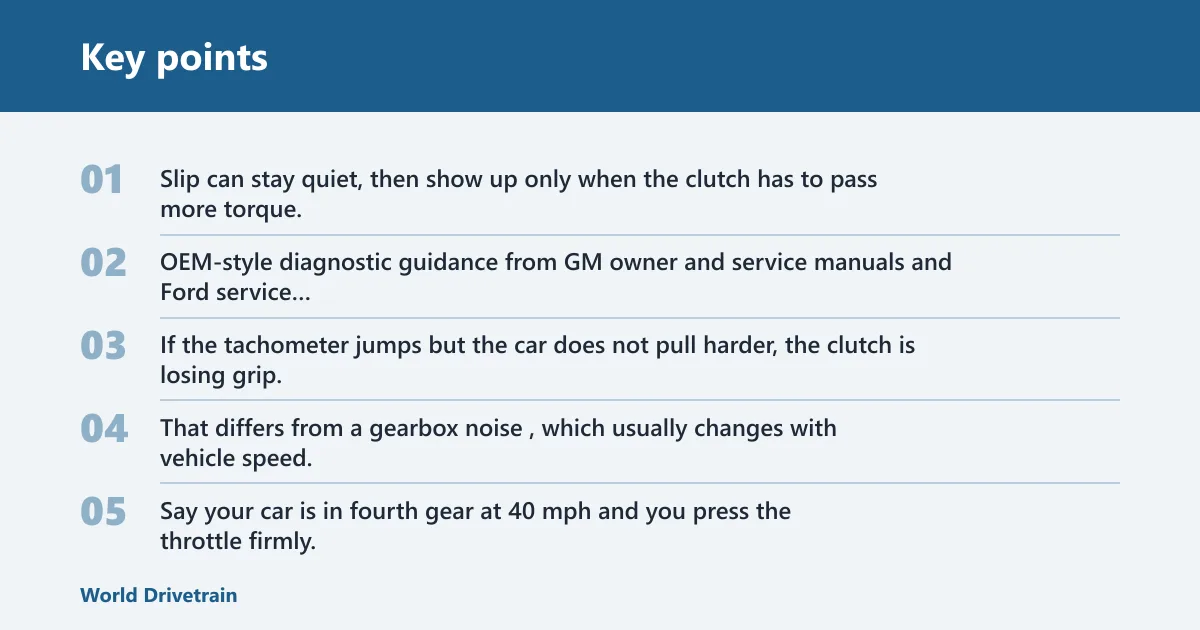
Sound by itself gives a weak clue. Slip can stay quiet, then show up only when the clutch has to pass more torque, such as during a hill start, a high-gear roll-on, or hard acceleration. OEM-style diagnostic guidance from GM owner and service manuals and Ford service literature emphasizes load-based confirmation rather than noise alone.
The main clue is behavior, not volume
Think in pairs: engine speed and road speed. If the tachometer jumps but the car does not pull harder, the clutch is losing grip. That differs from a gearbox noise, which usually changes with vehicle speed, gear selection, or pedal position.
Say your car is in fourth gear at 40 mph and you press the throttle firmly. If the engine flares from 2,000 rpm to 3,200 rpm while the road speed barely moves, that points to slip even if the cabin is quiet.
Why a slipping clutch can be quiet
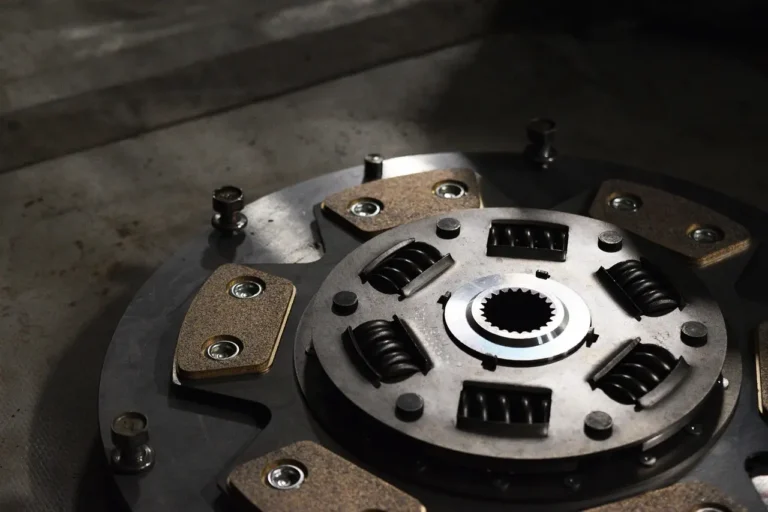
Slip happens at the friction interface between the clutch disc, pressure plate, and flywheel. A clutch disc that is worn, glazed, or oil-contaminated may lose grip without creating a distinct mechanical noise. A worn diaphragm spring in the pressure plate can do the same by reducing clamp force.
That is why a clutch can fail with little more than odor, poor pull, and heat. Noise is optional.
How load, gear, and temperature change the sound
A slipping clutch is often more obvious under load. Higher gears often reveal clutch slip first because the drivetrain faces more torque demand there. DriveAccelerate also notes that slip can be more noticeable on hills and during towing, and delayed response when shifting gears is another clue. This matches common manufacturer-style diagnostics: heavy load, tall gear, and low-rpm pull are the conditions most likely to expose a weak clutch.
Temperature matters too. A cold clutch may hold better at first, then slip after a few hard pulls. Once hot, the friction material can glaze further, and the burning smell may become stronger. When friction material overheats, a hot, burnt smell is a typical warning that the assembly is being asked to transmit more torque than it can hold.
How do I know if the noise is clutch slip or gearbox trouble?
Clutch slip is usually a behavior problem: the engine revs rise without a matching gain in speed. Gearbox trouble more often follows vehicle speed, gear selection, or pedal position. If the symptom changes with load and rpm, think clutch first; if it changes with road speed or specific gears, suspect the gearbox.
- Tach flare: points to clutch slip if road speed lags behind.
- Vehicle-speed-linked noise: points more toward gearbox or driveline.
- Pedal-position-linked noise: suggests release bearing, pedal, or hydraulic issues.
- Shift-selection grinding: suggests incomplete disengagement or synchro trouble.
What should I hear during a clutch slip test?
Use a safe, legal roll-on test in a high gear at low rpm on a clear road, then apply steady throttle. A slipping clutch usually lets the engine rev rise quickly while the vehicle speed increases slowly. Stop immediately if the smell becomes strong, the tachometer flares repeatedly, or the clutch starts shuddering hard.
Do not repeat the test over and over. Each slip cycle adds heat and can damage the disc, pressure plate, and flywheel. One clean confirmation is enough; after that, reduce driving and plan inspection.
Clutch noise diagnostic matrix
Use the sound, the driving condition, and the symptom together. One noise alone is rarely enough. This table separates clutch slip from release-bearing, gearbox, hydraulic, and driveline trouble.
| Sound description | Driving condition | Likely source | Urgency |
|---|---|---|---|
| Rev flare with little or no noise | Hard acceleration in a higher gear | Clutch slip from worn disc, weak pressure plate, or oil contamination | High; monitor closely and limit driving |
| Burning smell with no distinct noise | Hill start, towing, stop-start traffic | Overheated clutch friction material | High; stop stressing the clutch |
| Chatter or jerking at takeoff | Pulling away from rest | Glazed disc, oil on the lining, flywheel surface damage | Medium to high |
| Squeal from the pedal area | Pedal pressed or released | Release bearing, pedal pivot, or linkage noise | Medium; inspect soon |
| Grinding when selecting gear | Shifting into first or reverse | Clutch not fully disengaging, hydraulic fault, or synchro issue | High if persistent |
| Strong vibration from the gearbox | Under load or during slip | Drivetrain vibration, worn mounts, or slip-related shudder | High if paired with rev flare |
| Judder or brief shudder | Hill start or pulling away in a high gear | Uneven clutch engagement, glazed disc, or flywheel damage | Medium to high |
| Delayed response after a shift | Accelerating after gear change | Clutch slip or hydraulic delay | Medium |
What sounds are not clutch slip?
Grinding, squeal, chatter, and bearing noise are not the same thing as slip. A slipping clutch can be silent, and many noises blamed on the clutch actually come from the release bearing, gearbox bearings, hydraulic parts, or a driveline fault. Separate the sound from the driving condition before calling it clutch slip.
Grinding when selecting a gear
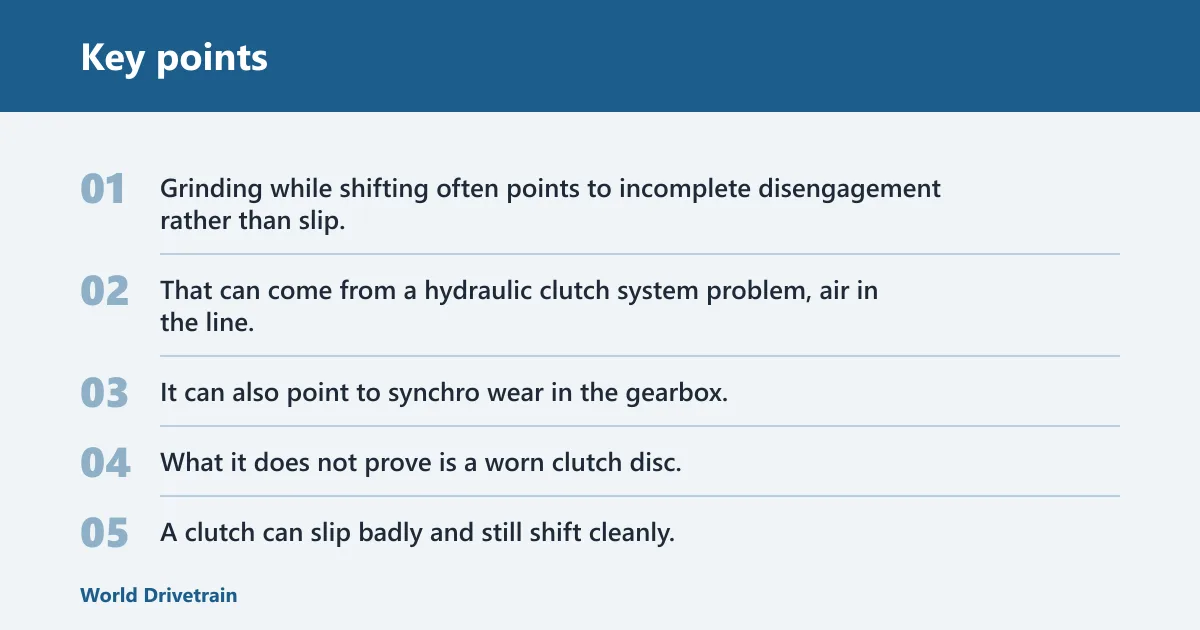
Grinding while shifting often points to incomplete disengagement rather than slip. That can come from a hydraulic clutch system problem, air in the line, a failing master cylinder, a failing slave cylinder, or a cable that is out of adjustment on older vehicles. It can also point to synchro wear in the gearbox.
What it does not prove is a worn clutch disc. A clutch can slip badly and still shift cleanly, or grind while the disc is still capable of holding torque.
Squeal from the pedal area
A squeal near the pedal is more often release-bearing or linkage noise than clutch slip. Spanner RASH notes that modern vehicles are often hydraulically operated, while older vehicles may use a cable-operated clutch that required adjustment. Either system can make noise without the friction surfaces slipping.
Gearbox vibration or bearing noise
FixMyCar says slipping can cause strong vibrations from the gearbox, but vibration alone does not confirm slip. A worn bearing, loose mount, or driveline imbalance can also shake under load. The difference is that gearbox or driveline noise usually follows vehicle speed, not engine flare.
Chatter, judder, and release-bearing noise
Chatter and judder happen when engagement is uneven. That can come from a glazed disc, flywheel heat damage, or contamination. A release-bearing noise often changes when the pedal is pressed, which is a different pattern from clutch slip, where the main clue is loss of drive under load.
Why a clutch slips
Slip usually comes from loss of grip at the friction surfaces. The clutch disc lining wears down, can glaze when overheated, and can lose friction if oil leaks onto it. Pressure plate wear or a weakened diaphragm spring can also reduce clamping force. Any of those can cause slip under acceleration.
Clutch disc wear, glazing, and oil contamination
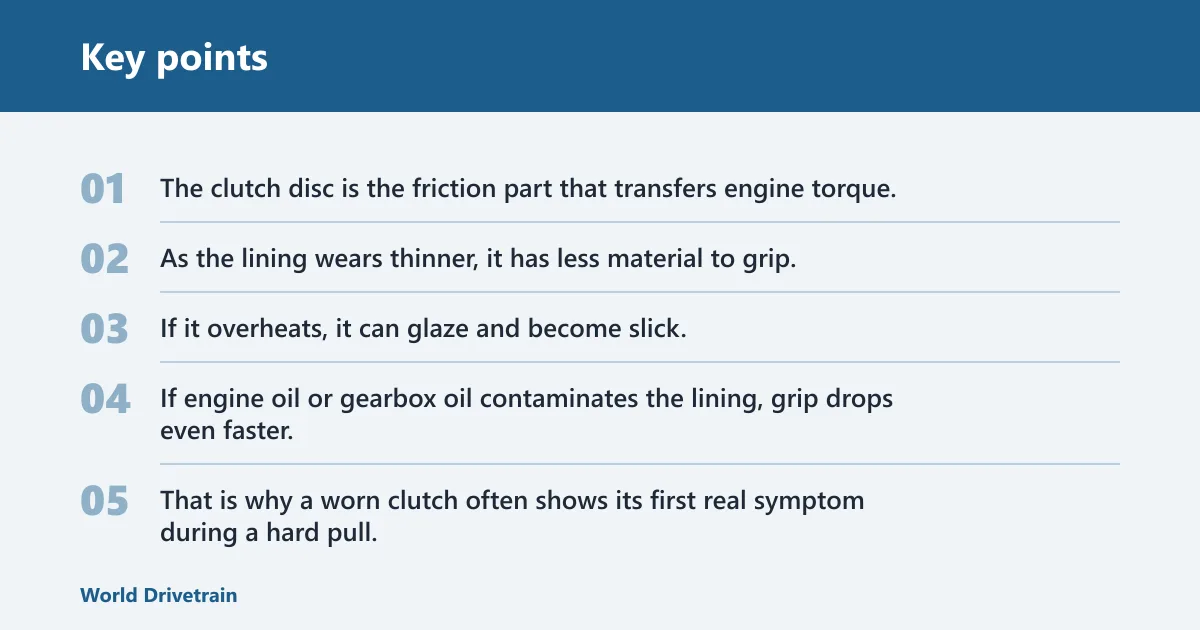
The clutch disc is the friction part that transfers engine torque. As the lining wears thinner, it has less material to grip. If it overheats, it can glaze and become slick. If engine oil or gearbox oil contaminates the lining, grip drops even faster.
That is why a worn clutch often shows its first real symptom during a hard pull, a hill start, or towing. Light driving may hide the problem for a while.
Pressure plate and diaphragm spring loss of clamp force
The pressure plate supplies clamping force, and the diaphragm spring is the modern clamp mechanism inside it. If either loses force, the disc can slip even when the lining is not fully worn out. That can mimic a bad clutch disc and produce the same rev flare.
Flywheel heat damage after repeated slip
The flywheel works with the disc and pressure plate, and it can be damaged by repeated overheating. Heat checking, hot spots, and surface damage can keep the new or old disc from biting properly. If slip continues, the flywheel may need inspection as part of the repair.
Hydraulic problems that mimic slip
A hydraulic clutch system can imitate slip or prevent clean disengagement. Check the master cylinder, slave cylinder, and fluid level. Low fluid, leaks, or internal seal failure can change pedal travel and engagement enough to create symptoms that sound like a clutch problem. Manufacturer repair information from Nissan service information and similar OEM systems often treats hydraulic faults as a primary branch in clutch diagnosis because pedal hydraulics can change how the clutch engages and releases without changing the friction parts first.
Can a slipping clutch be intermittent?
Yes. A slipping clutch can be intermittent and show up only under load, in higher gears, or during hard acceleration. It may behave normally around town and then flare on a hill or when passing. That pattern still points to a clutch fault, even if the symptom comes and goes.
Why higher gears often show it first
Higher gears place more torque demand on the clutch at a given throttle opening. That is why slipping may be obvious on hills or during towing, as DriveAccelerate notes. The clutch has to hold harder, so a weak disc or pressure plate gives up sooner.
Why cold and hot behavior can differ
A cold clutch can feel normal, then slip once it heats up. Heat changes the friction material and can make glazing or contamination more obvious. A hot clutch may also give off a stronger burning smell because the friction material is overheating.
Picture a manual SUV that pulls out of a parking lot cleanly in first gear, then starts to flare in fourth while climbing a long grade. That pattern is much more suspicious than a one-time squeal at idle, because the fault appears only when the clutch is asked to transmit more torque.
What should you check first?
Start with the easiest checks that separate a clutch issue from a hydraulic or adjustment problem. Look at fluid level, check for visible leaks, note pedal feel, and pay attention to where the clutch starts to engage. On cable-operated systems, incorrect adjustment can matter. It is not a fix for worn friction material.
- Check the clutch fluid level and inspect for leaks at the master cylinder and slave cylinder.
- Press the pedal and note whether it feels soft, spongy, or changes position suddenly.
- Watch the engagement point. A high biting point can point to a worn clutch.
- On a cable-operated clutch, confirm adjustment is within spec and the cable moves freely.
- Test for rev flare under load in a safe, legal setting without forcing repeated slip.
Simple stop-driving signs
Stop driving if the clutch slips badly in several gears, the smell is strong and persistent, or gear changes become difficult enough to cause grinding. Those signs suggest the clutch is already overheating or the hydraulics are failing to disengage cleanly.
- Strong burning smell that returns after each pull
- Rev flare in more than one gear
- Grinding when selecting gears
- Poor acceleration even with normal engine speed
- Hard shifting or a pedal that feels abnormal
What to do if the clutch keeps slipping
If slip keeps returning, limit driving and plan for inspection. Continued driving can overheat the flywheel and pressure plate and raise repair cost. The check should include the clutch disc, pressure plate, flywheel, and hydraulic system. If the vehicle uses a cable clutch, the adjustment should also be verified.
Most worn clutches eventually need replacement. If the problem is only misalignment or a cable adjustment issue, correction may help. That is the exception, not the rule. A worn friction lining will not be fixed by adjustment.
What a proper inspection should include
Look for clutch disc wear, glazing, and oil contamination. Check the pressure plate and diaphragm spring for loss of clamp force. Inspect the flywheel for heat damage. Then verify the master cylinder, slave cylinder, fluid level, and pedal travel so a hydraulic fault is not missed.
Frequently asked questions
What noise does a slipping clutch make
Often, no distinct noise at all. The main clue is rev flare without matching road speed, sometimes with a hot, burnt smell. Under load, you may also notice a brief shudder or vibration. If you hear grinding or squeal, that usually points to another fault that needs a separate check.
What does a slipping clutch sound like?
It may sound like the engine racing without the car picking up speed. In many cases, that is all you get. Some drivers also notice a burning smell from overheated friction material. Sound alone is not enough, so compare it with gear, load, and temperature.
What noise does a bad clutch make
A bad clutch does not make one fixed noise. It can be silent, squeal near the pedal, chatter at takeoff, or cause difficulty changing gears. Grinding during shifts often points to incomplete disengagement or a gearbox issue, while slip itself is more often a behavior problem than a noise problem.
What does a slipping clutch look like?
It looks like the engine revs rising faster than the vehicle speed. On a tachometer, you may see rpm jump while acceleration stays flat. A high biting point can also be a clue. If the clutch is slipping badly, you may smell overheating friction material after a hill start or hard pull.
Can a slipping clutch make a grinding noise?
It can be associated with grinding, but grinding is not the standard sound of slip. More often, grinding means the clutch is not fully disengaging, or the gearbox synchros are unhappy. If the main symptom is rev flare under load, think slip first. If the symptom is grinding while selecting gear, check the release system and hydraulics.
Does a slipping clutch always make a burning smell?
No. Burning smell is common when the friction material overheats, but slip can be silent. A driver may notice rev flare first, especially in a higher gear or on a hill. If the smell appears, it usually means the clutch has already been heated enough to lose grip.