Manual Transmission Grinding: Causes, Fixes & Cost
Manual transmission grinding is commonly linked to incomplete clutch release, low or incorrect gear oil, linkage misadjustment, or worn synchronizers; a grind in one gear often points to that gear’s synchronizer, while a grind in all gears points first to clutch release or fluid. If the problem is ignored, a fluid or linkage fix can sometimes turn into a clutch job or a transmission rebuild that may cost roughly $1,500 to $4,000. This guide ties common grinding patterns to likely faults, safe-to-drive calls, checks you can do, and typical repair costs.
Mechanically, a grind happens when the gear you are selecting and the shaft driving it are still turning at different speeds during engagement. That is why the exact moment matters more than sheer noise: a grind at a stop into reverse can suggest clutch drag, while a grind only on one upshift usually points more directly to a worn synchronizer in that gear.
The quickest home checks come first: confirm the correct transmission fluid level and condition, look for clutch hydraulic leaks or a stretched cable, and inspect linkage play before you assume the transmission needs internal work. In some model lines, a 2017 recall addressed similar complaints, so check vehicle-specific recalls and service bulletins before paying for parts.
What manual transmission grinding usually means
Shift grind versus other noises
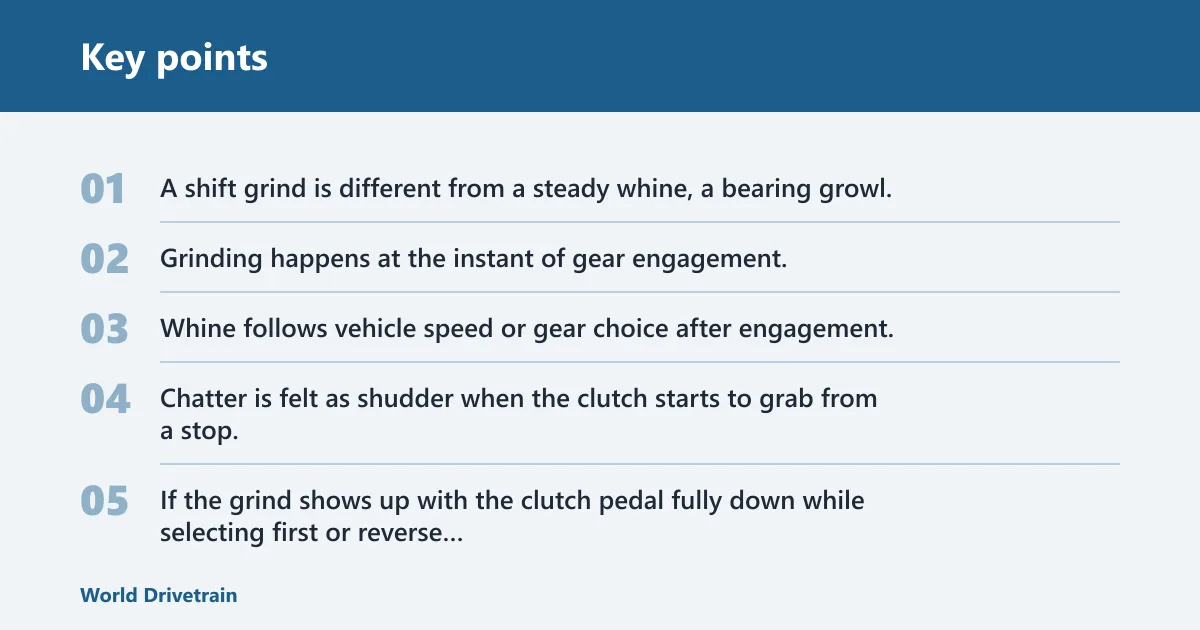
A shift grind is different from a steady whine, a bearing growl, or clutch chatter on takeoff. Grinding happens at the instant of gear engagement. Whine follows vehicle speed or gear choice after engagement. Chatter is felt as shudder when the clutch starts to grab from a stop.
Why timing beats loudness
If the grind shows up with the clutch pedal fully down while selecting first or reverse at a stop, start with clutch release problems. If it happens only going into one forward gear while the others stay clean, start with that gear’s synchronizer. If the shifter feels vague, blocked, or off-center, inspect linkage before blaming synchros.
What “grinding” means inside the transmission
Synchronizers are small friction assemblies that match shaft speeds before the dog teeth engage. When they wear, gear engagement slows and the teeth clash. Reverse is a useful exception because it often lacks a synchronizer, so a reverse grind at a standstill is often a clue that the input shaft is still spinning from clutch drag.
Why is my manual transmission grinding when I shift?
Grinding during a shift usually comes from two branches: the clutch is not releasing fully, or the selected gear’s synchronizer is worn. One-gear-only grinding points inward to that synchro; grinding in several gears, especially at low speed or from a stop, points first to clutch release, fluid, or linkage.
Grinding on upshifts
On an upshift, the synchronizer has to slow or speed the selected gear to match the shaft. A worn manual transmission synchronizer loses that ability, so the shifter resists entry and then grinds as the teeth meet at different speeds. This usually starts in one gear, often second or third, before spreading.
If the clutch is dragging, the input shaft stays too fast even with the pedal down. Then several gears may grind, and reverse often complains first. A worn clutch disc loses friction material over time, but clutch drag can also come from warped clutch parts, lost release travel, or pilot bearing drag.
Grinding on downshifts
Downshifts load the synchronizer harder because the transmission input speed must rise to match the lower gear. If grinding shows up mostly on 3-2 or 2-1 downshifts, suspect synchronizer wear first. If rev-matching or double-clutching makes the shift cleaner, that is another strong clue.
One gear versus several gears
One gear only: think synchronizer, shift fork wear for that rail, or gate alignment for that selection path. Several gears: think low clutch release travel, low fluid level, the wrong fluid specification, hydraulic faults, cable faults, or major linkage misadjustment.
Suppose second gear grinds on every 2-3 shift, but first, fourth, fifth, and reverse stay clean and the clutch pedal feels normal. That pattern leans away from the clutch and toward the second-gear synchronizer or that gear’s shift path. A fluid change can improve shift feel, but it rarely fixes a clearly worn synchro for long.
Why double-clutching matters
Double-clutching temporarily matches shaft speeds with your feet instead of asking the synchronizer to do all the work. If a gear that usually grinds goes in smoothly when you double-clutch, the synchronizer for that gear moves much higher on the suspect list.
Why does my manual transmission grind into reverse?
Reverse grind at a standstill usually points to clutch drag before it points to bad reverse gear teeth. Reverse often lacks a synchronizer, so any continued input shaft rotation shows up there first. If waiting in neutral for a moment reduces the grind, incomplete clutch release is even more likely.
Why reverse is the early warning gear
Because reverse often does not have a synchronizer, it cannot mask a dragging clutch the way forward gears sometimes can. If the clutch pedal is on the floor and reverse still clashes, the input shaft is likely still turning.
Quick checks you can do at home
- With the engine idling, clutch fully down, pause in neutral for three seconds, then select reverse.
- If it still grinds, shift into a synchronized forward gear first, then try reverse again.
- Watch for vehicle creep with the clutch pedal fully down in first gear.
- Note whether the clutch engages very close to the floor, which can suggest low release travel.
- Check the clutch fluid reservoir on hydraulic systems, or cable free play on cable systems.
If the car creeps with the pedal down, that is strong evidence of clutch drag. The guide source also notes that hydraulic clutch leaks in the master or slave cylinder can cause shifting failure, and air bubbles in hydraulic lines can create a spongy pedal and incomplete clutch release.
Say your compact sedan grinds going into reverse only when backing out of a flat driveway, yet first and second feel mostly normal once moving. Pause in neutral, count to three, and try again. If the grind lessens, the reverse gear itself is less suspicious than clutch release or a pilot bearing that keeps the input shaft turning.
Can a bad clutch cause gear grinding?
Yes. A bad clutch can cause gear grinding when the disc and release system fail to separate the engine from the transmission fully. That leaves the input shaft spinning during shifts, which makes reverse grind first and can cause hard engagement in first, second, and other gears.
Clutch disc wear and drag
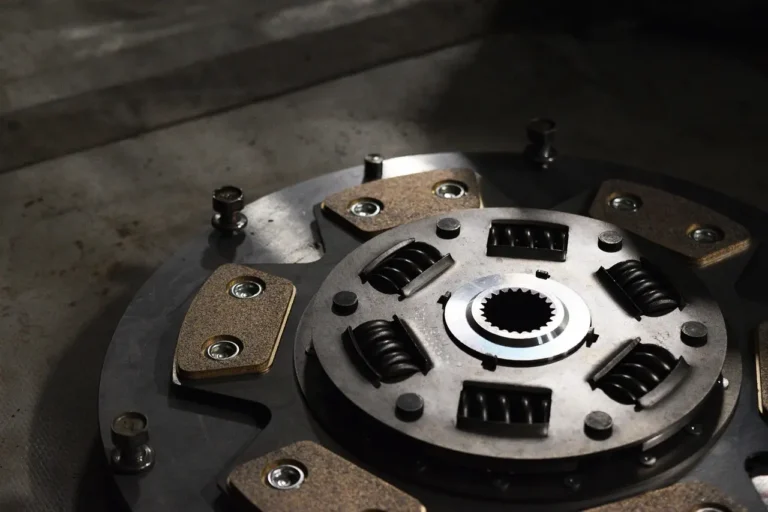
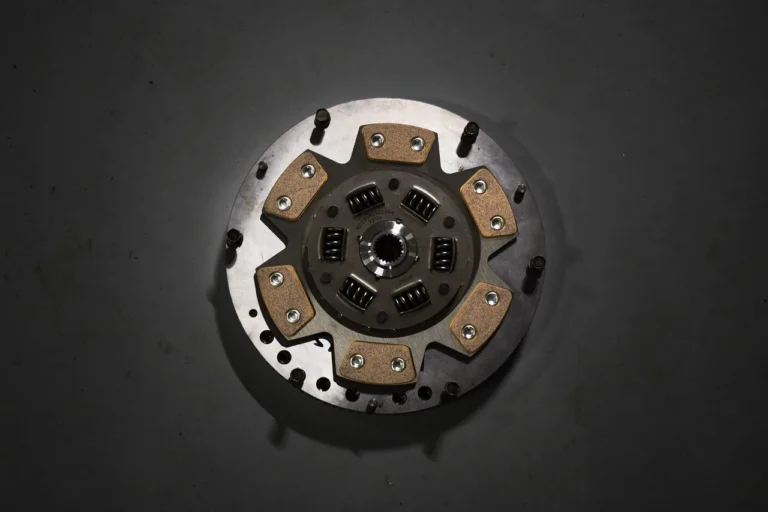
A worn clutch disc loses friction material over time. Wear alone often shows up first as slip under load, but a damaged disc, warped pressure plate, or release problem can also cause drag. Drag means the disc keeps brushing the flywheel or pressure plate when the pedal is down, so the transmission input shaft does not slow enough.
Master cylinder and slave cylinder faults
On hydraulic-clutch vehicles, the master cylinder creates fluid pressure when you press the pedal, and the slave cylinder turns that pressure into release movement at the clutch fork or release bearing. Fluid leaks, internal seal bypass, low fluid, or air in the system all reduce release travel.
Pedal feel helps here. A sinking pedal, wet carpet near the pedal, low reservoir level, or fluid around the bellhousing area all point outward to hydraulics. A spongy pedal fits air in the system. A firm pedal with poor release can still mean a failed slave cylinder that is not moving far enough.
Clutch cable stretch, binding, and adjustment loss
On cable-operated systems, clutch diagnosis changes. Cable stretching or fraying reduces the clutch’s ability to disengage fully, and rust and corrosion inside the cable housing raise friction. That can produce a heavy pedal, an uneven release point, or a pedal that does not return smoothly.
Many older compact cars and some light trucks use a cable rather than hydraulics. On those vehicles, measure free play against the service specification if adjustment is provided. If the cable feels rough, binds through part of the stroke, or shows broken strands, replace it rather than over-adjusting it.
Pilot bearing drag
The pilot bearing supports the transmission input shaft in the crankshaft or flywheel. If it seizes or drags, the input shaft can keep spinning even with the clutch pedal down. Symptoms overlap with clutch drag: hard engagement into first or reverse at a stop, creep, and grind despite a clutch pedal that feels normal.
Why grinding can remain after a clutch job
Post-clutch-replacement grinding is common enough to deserve its own checklist. The new disc may be fine, but release travel may still be short because of air in the hydraulic line, an old master cylinder, a weak slave cylinder, a misadjusted cable, a seized pilot bearing, bent release hardware, or incorrect clutch stack height from mismatched parts.
- Bleed the hydraulic system again if pedal feel is soft or inconsistent.
- Verify master and slave stroke against service data if available.
- Check that the clutch disc orientation is correct and that the release fork is seated.
- Confirm the pilot bearing was replaced and spins smoothly.
- Inspect shifter linkage adjustment after the transmission was reinstalled.
Can low transmission fluid cause grinding?
Yes, low transmission fluid can cause grinding in a manual transmission by reducing lubrication and raising friction. It can also make worn synchronizers behave worse. Fluid problems are more likely when several gears feel stiff, shifts improve after warm-up, or the transmission sounds dry or noisy in more than one gear.
Low level, wrong fluid, and degraded fluid
Low transmission fluid reduces lubrication and raises friction. That affects synchronizer performance because the friction surfaces and gear cones need the right oil film to work as designed. Wrong fluid can be just as harmful. A fluid that is too thick, too slippery, or outside the required specification can change shift quality sharply.
Why cold-only grinding happens
Cold-only grind has three common branches: thick old fluid, marginal synchronizers, or borderline clutch release that improves once parts and fluid warm up. If second gear baulks only for the first mile, suspect fluid condition and synchro wear before you suspect a fully failed clutch.
Picture a pickup that shifts clean after fifteen minutes but grinds lightly on the first 1-2 shift each morning at 35°F. If reverse is clean and the pedal feels steady, fluid condition moves up the list. If reverse also grinds cold, clutch release or pilot bearing drag becomes more likely.
When fluid service is worth trying
Fluid service is worth trying when the level is low, the service history is unknown, shifts worsen in cold weather, or the fluid is clearly degraded. It is less likely to solve a one-gear-only grind that improves with double-clutching, because that points more directly at synchronizer wear.
Some manuals have a fill plug rather than a dipstick, and many manufacturers list level-check procedures that require the vehicle to sit level and the fluid to be checked at a specific temperature. Use the exact fluid specification for your transmission, not a generic “gear oil” guess.
Could the shifter or linkage be the problem?
Yes. The shifter or linkage can cause grinding when worn bushings, cable misadjustment, bent rods, or binding keep the selector from moving fully into the intended gate. Linkage faults often feel vague or misaligned across several gears, while internal synchronizer failure tends to repeat in one gear.
How linkage faults create a grind
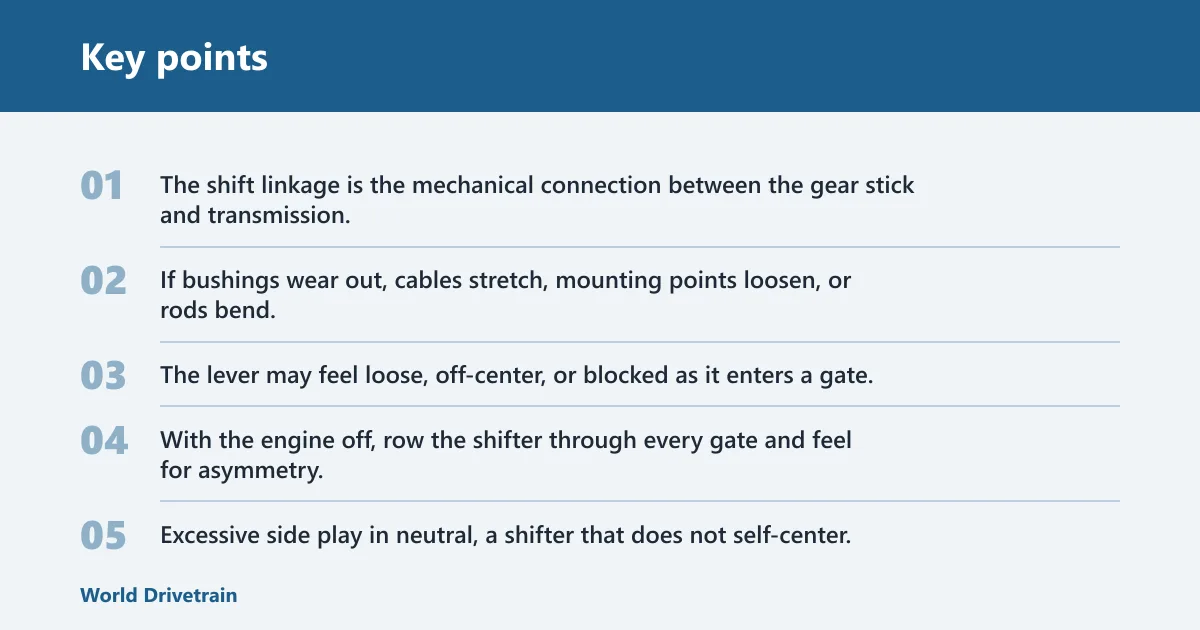
The shift linkage is the mechanical connection between the gear stick and transmission. If bushings wear out, cables stretch, mounting points loosen, or rods bend, the transmission may not reach full engagement cleanly. The lever may feel loose, off-center, or blocked as it enters a gate.
Home checks for linkage issues
With the engine off, row the shifter through every gate and feel for asymmetry. Excessive side play in neutral, a shifter that does not self-center, or contact with console trim can all point to external issues. Underhood cable ends and bushings can often be inspected for torn rubber, missing clips, or binding.
How linkage differs from synchronizer failure
Linkage problems often affect gear selection position before they create tooth clash. You may miss third and hit first-second gate resistance, or struggle to find reverse at all. A worn synchronizer, by contrast, usually lets you find the gate but protests only when you try to complete engagement under shaft-speed mismatch.
The source guide notes that a stuck gear can leave the vehicle immobile or operating only in a single gear. If the shifter jams in one position, do not keep forcing it. External linkage failure can do this, and so can internal rail or fork problems.
Grinding symptom cost table
| Symptom pattern | Likely failed component | Quick home check | Shop confirmation test | Typical repair cost range |
|---|---|---|---|---|
| Reverse grinds at a stop; first gear hard to engage; car creeps with pedal down | Clutch drag from worn clutch disc, warped clutch parts, or poor release travel | Pause in neutral, then try reverse; check for creep and low engagement point | Measure clutch release travel; inspect clutch assembly after trans removal if needed | $800 to $1,800 for clutch replacement; more if flywheel machining or replacement is needed |
| Pedal spongy or sinking; several gears grind; reservoir low | Master cylinder or slave cylinder leak, or air in hydraulic line | Check fluid level; inspect for wet firewall, line fittings, and bellhousing area | Pressure test, bleed test, stroke measurement, leak inspection | $150 to $350 for bleed and minor service; $250 to $700 for one cylinder; $400 to $1,000 for both |
| Heavy or rough pedal on cable-clutch vehicle; release point changes; reverse grind | Clutch cable stretch, fraying, binding, or seizure | Inspect cable sheath and free play; feel for rough travel | Cable travel and adjustment check; inspect pedal quadrant and fork travel | $80 to $180 for adjustment; $200 to $450 for cable replacement |
| One gear grinds on upshift or downshift; improves with double-clutching | Worn synchronizer for that gear | Double-clutch and compare; note whether other gears are clean | Road test pattern, fluid inspection, teardown confirmation | $1,500 to $4,000 for rebuild, depending on parts damage and labor access |
| Shifter vague, off-center, or blocked across gates; gear entry inconsistent | Shift linkage wear, misadjustment, bent rod, or bushing failure | Engine off gate check; inspect bushings, clips, and cable ends | Linkage alignment procedure; bushing and cable movement inspection | $100 to $400 for bushings or adjustment; $250 to $700 for cables or linkage parts |
| Cold-only stiffness or light grind in multiple gears; service history unknown | Low, wrong, or degraded transmission fluid | Check level and condition per manufacturer procedure | Fluid level verification; refill or service with correct spec fluid | $90 to $220 for fluid service; more if leaks must be repaired first |
| Reverse and first grind despite normal pedal feel; drag remains after clutch job | Pilot bearing dragging the input shaft | Note persistent drag with pedal down and clean hydraulic operation | Diagnosis during clutch service or transmission removal | $150 to $400 added during clutch job; much higher if done separately because labor overlaps clutch removal |
How much does it cost to fix a grinding manual transmission?
Fix cost depends on which branch the symptoms follow. External fixes such as fluid, bleeding, cable adjustment, or linkage work are often under $400. Clutch jobs usually land around $800 to $1,800. Internal synchronizer or gear damage is the expensive branch, commonly $1,500 to $4,000.
Lower-cost repair paths
Start with the least invasive checks because they are also the least expensive fixes. A fluid service is often $90 to $220. Bleeding a hydraulic clutch and topping off fluid may stay in the $150 to $350 range if no hard parts are needed. Linkage bushings or adjustment often cost less than a clutch.
Mid-range repair paths
Replacing a master cylinder or slave cylinder usually costs less than replacing the clutch, though some concentric slave cylinders require transmission removal and can push the bill higher. Cable replacement on cable-clutch cars usually stays below a full clutch job unless access is unusually poor.
Higher-cost repair paths
Clutch replacement often includes the disc, pressure plate, release bearing, and labor to remove the transmission. Pilot bearing work is cheap if done during that job because labor overlaps. It is expensive if done later for the same reason.
If the issue is internal, your choices are usually a rebuild, a remanufactured unit, or a used transmission. A rebuild makes sense when the case is good and the rest of the car is worth keeping. A used unit may cost less upfront, but condition can be uncertain unless there is a solid warranty and known mileage.
Is it bad to drive with a manual transmission grinding?
Yes, but the risk depends on the pattern. A light, repeatable grind in one gear can often be driven gently to a shop. Severe clutch drag, inability to select gears, pop-out, metal in drained fluid, or a stuck gear is a tow-now condition because damage can spread fast.
Tow-now symptoms
- The car creeps hard with the clutch pedal fully down.
- Reverse and first are nearly impossible to engage.
- The shifter jams in gear or the transmission is stuck in one gear.
- There is visible hydraulic fluid loss and the pedal falls to the floor.
- Drained fluid shows heavy metal debris.
Drive-to-shop symptoms
- Light grinding limited to one gear.
- Cold-only stiffness that improves after warm-up.
- Vague shifter feel without total loss of engagement.
- Minor reverse clash that improves after a pause in neutral.
Why delay gets expensive
Continued grinding rounds dog teeth, wears hubs and sleeves, and can add gear damage to what started as a release or synchronizer issue. A low-fluid case can also damage bearings and gears if ignored. That is the difference between a service visit and a rebuild bill.
Frequently asked questions
What causes a manual transmission to grind going into gear?
Most often, the clutch is not releasing fully, the fluid is low or incorrect, the linkage is misadjusted, or the target gear’s synchronizer is worn. The pattern matters: one gear suggests that gear’s synchro, while several gears at a stop point first to clutch drag or low release travel.
Can a bad clutch cause gear grinding in a manual transmission?
Yes. A bad clutch can leave the input shaft spinning with the pedal down, which creates speed mismatch during engagement. Worn disc material, warped clutch parts, low hydraulic travel, air in the line, a weak slave cylinder, or a stretched cable can all produce that result.
Can low transmission fluid cause grinding in a manual transmission?
Yes. Low fluid reduces lubrication and raises friction, which hurts synchronizer performance and can make several gears feel stiff or noisy. It is a stronger suspect when grinding is worse cold, affects more than one gear, or comes with a dry, mechanical feel rather than one-gear-only symptoms.
Why does my manual transmission grind only when cold?
Cold-only grinding usually points to thick or degraded fluid, marginal synchronizers, or borderline clutch release that improves once the system warms. If reverse also grinds cold, inspect clutch release first. If only one forward gear complains and double-clutching helps, the synchronizer is more likely.
How to diagnose common manual transmission problems – atlas transmission
Use a pattern-first approach: note whether the grind happens at a stop, on upshifts, on downshifts, in reverse, or in one gear only. Then separate clutch release, fluid, linkage, and internal synchronizer branches with quick checks before authorizing parts. That order cuts wrong-part replacement risk.