Differential Noise: Causes, Diagnosis and Repair Cost
Differential noise usually points to worn bearings, ring-and-pinion setup errors, or low/contaminated gear oil. A howl on drive or coast often points to gear wear, while a rumble that changes in turns often points to bearings. If it is ignored, a relatively low-cost fluid service can sometimes lead to a much more expensive rebuild or even complete axle failure. This guide maps noise type, speed and load clues, urgency, and typical repair costs before teardown.
The useful split is simple: track the noise by vehicle speed, throttle position, and turning input before you guess at parts. That pattern usually separates ring-and-pinion gears, pinion or carrier bearings, spider gears, wheel bearings, and common lookalikes such as CV joints, tires, and driveshaft parts.
What does differential noise sound like while driving?
Differential noise usually changes with road speed, not engine RPM. A steady-speed whine or howl often points to ring-and-pinion wear or backlash error, a rumble or hum under load often points to bearings, and clicking or snapping in tight turns often points to spider gears. Front, rear, and AWD layouts can sound different.
Match the sound to speed, throttle, and turns
Identify the sound first, then pin down the exact condition that triggers it, steady cruise, throttle-on, coast, tight turns, or lane-change load shift.
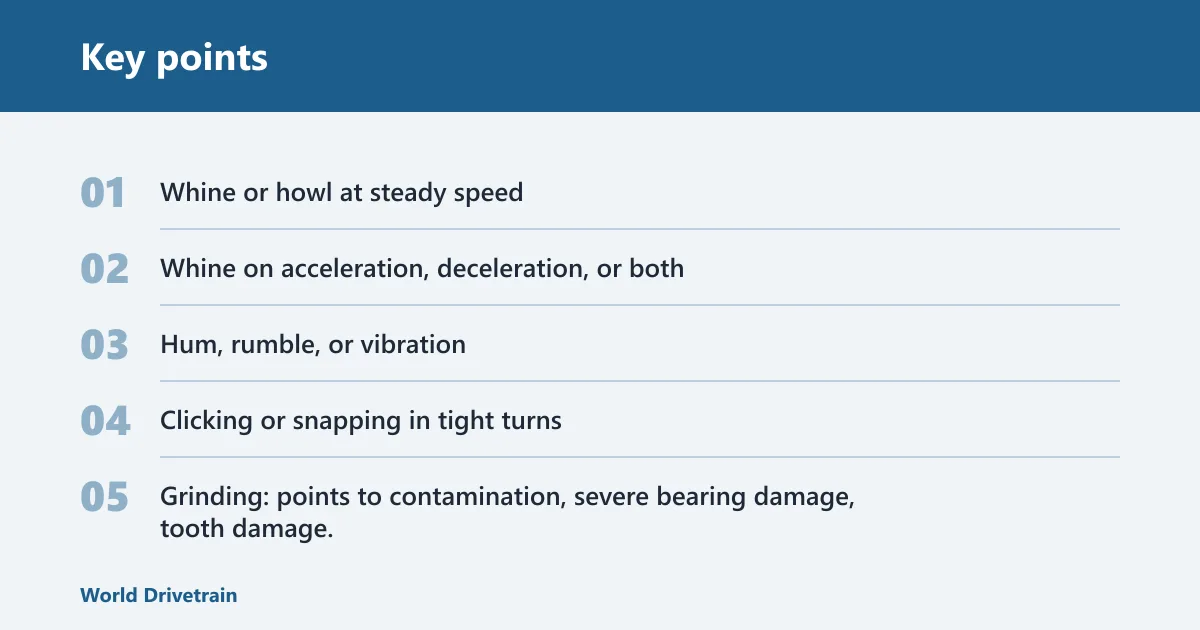
- Whine or howl at steady speed: commonly tied to ring-and-pinion gears, gear mesh wear, or incorrect backlash. Whining or howling at steady speed is linked to worn ring-and-pinion gears or incorrect backlash.
- Whine on acceleration, deceleration, or both: often points to pinion bearing wear, preload loss, or pinion end-play.
- Hum, rumble, or vibration: often points to carrier bearings, though wheel bearings can sound very similar.
- Clicking or snapping in tight turns: points to spider gears carrying different wheel speeds across the axle. Clicking or snapping during tight turns indicates worn or broken spider gears.
- Grinding: points to contamination, severe bearing damage, tooth damage, or on some limited-slip units, clutch-pack wear. Grinding that diminishes after warm-up can indicate metal contamination or LSD clutch pack wear.
- Clunk on throttle apply or lift-off: often points to carrier bearings, driveline slack, or excessive backlash. A clunk on throttle application or lift-off points to carrier bearings or excessive backlash.
Why speed matters more than engine RPM
A differential turns with the driveshaft and axle shafts, so its noise usually rises and falls with vehicle speed. Engine and accessory noises usually track RPM instead. If the pitch stays the same in a coast test while road speed stays the same, the source is more likely in the axle, wheel end, or driveline than in the engine.
Front differential whine that tracks speed and stays present in neutral coast suggests ring-and-pinion mesh or pinion bearing issues. On AWD vehicles, that same pattern can overlap with transfer case or center coupling noise, so source location matters.
Rear, front, and AWD patterns
Rear differential noise is often easier to isolate because it sits away from the engine bay and front wheel wells. Rear-axle repair cost is stated as $500 to $2,000 depending on vehicle and repair type, but the low end usually applies only when the damage has not spread through gears and bearings.
Front differential noise is harder to separate from tire roar, wheel bearings, and CV joints because all of them sit near the driver. Front differential failures are described as roughly 40 percent of AWD and 4WD drivetrain failures, which is one reason AWD diagnosis needs a more careful road test than a simple rear-drive axle.
AWD systems add another confusion point: a front differential, a rear differential, and a transfer case or center coupling can all make speed-based noises. If the sound appears only in turns at full steering lock, do not jump straight to the differential. Outer CV joints and some couplings can mimic it.
Differential noise decision table
Symptom-to-cause-to-cost map
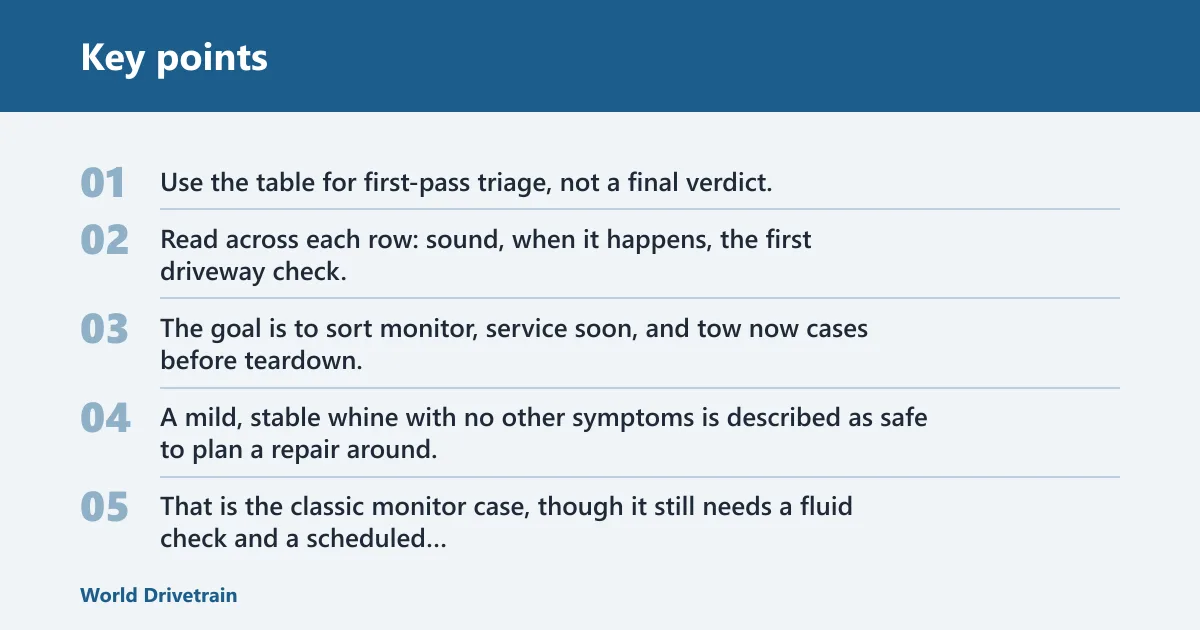
Use the table for first-pass triage, not a final verdict. Read across each row: sound, when it happens, the first driveway check, the shop test that confirms it, the urgency level, and the usual repair tier. The goal is to sort monitor, service soon, and tow now cases before teardown.
| Layout | Sound type | When it happens | Likely culprit | What to check first | What shop test confirms it | Urgency | Typical repair tier |
|---|---|---|---|---|---|---|---|
| Rear differential | Light whine or howl | Steady cruise, tied to road speed | Ring-and-pinion wear or backlash error | Fluid level, burnt odor, metal glitter, leak at pinion or axle seals | Road test, backlash measurement, gear contact pattern check | Monitor if mild and stable; service soon if worsening | Fluid service first if fluid is old; gear setup correction or rebuild if wear is confirmed |
| Rear differential | Whine on acceleration or deceleration | Throttle on, throttle off, or both | Pinion bearing wear, preload loss, pinion end-play | Pinion seal leak, low oil, driveshaft play | Play check at pinion flange, chassis ears, bearing inspection after opening | Service soon; tow now if loud and hot | Bearing replacement and setup; rebuild if metal contamination is heavy |
| Rear differential | Rumble, hum, vibration | Load-sensitive, often worse under throttle | Carrier bearings | Fluid condition, axle play, tire condition, wheel bearing comparison | Lift run test, stethoscope at housing, side-to-side wheel-end checks | Service soon | Bearing replacement; rebuild if races and gears are damaged |
| Rear differential | Clicking or snapping | Tight parking-lot turns | Spider gears | Fluid level, metal in oil, limited-slip chatter versus open-diff click | Turn test, teardown inspection of side and spider gears | Service soon; tow now if clunking becomes harsh | Rebuild with internal gear replacement |
| Front differential | Whine that persists in neutral coast | Road-speed related, present on drive and coast | Ring-and-pinion mesh or pinion bearing | Front case fluid, seal leaks, tire noise comparison | Road test, chassis ears, backlash and contact pattern check | Service soon | Fluid service if caught early; bearing or gear repair if confirmed |
| Front differential | Hum that changes with steering input | Lane-change load shift | Often wheel bearing, sometimes carrier bearing | Which side gets louder, tire cupping, wheel play | Wheel bearing load test, lift inspection, stethoscope comparison | Depends on severity | Wheel bearing replacement if isolated; differential bearing work if housing noise is confirmed |
| AWD rear or center-related system | Grinding, shudder, chatter | Turns, parking maneuvers, or warm-up changes | LSD clutch wear, contaminated oil, coupling issues | Correct fluid spec, burnt smell, metallic paste, service history | Fluid inspection, module or coupling checks where equipped, chassis ears | Service soon; tow now if binding or severe grinding | Fluid service if early and fluid-spec related; rebuild or unit replacement if hard parts are worn |
| Any layout | Loud clunk plus burning smell | Turning or under load | Severe internal damage or major fluid loss | Stop and look for leaking gear oil and overheated housing | Visual confirmation, tow-in inspection, teardown | Tow now | Seal failure with secondary damage, bearing failure, or rebuild/replacement |
Monitor, service soon, and tow now
A mild, stable whine with no other symptoms is described as safe to plan a repair around. That is the classic monitor case, though it still needs a fluid check and a scheduled inspection. Once the noise grows louder, starts changing with throttle, or adds vibration, the case moves into service soon.
A loud clunk while turning combined with a burning smell is described as a stop-driving condition. The same guidance generally applies to visible metal in drained oil, a severe leak that lowers the fluid level, fresh grinding, or a housing hot enough to smell after a short drive.
What causes differential noise when turning?
Turning noise usually points to parts that handle left-right wheel speed difference. Clicking or snapping in tight turns often means spider gears, limited-slip chatter can point to fluid or clutch-pack issues, and a growl that changes when the vehicle loads one side often points to a wheel bearing instead of the differential.
Spider gears under wheel-speed difference
Spider gears carry the speed difference between the left and right axle shafts in an open differential. In a tight parking-lot turn, they work harder than they do in straight-line driving. Low fluid, contaminated oil, and high mileage can wear the gear faces and thrust surfaces until the differential clicks, snaps, or clunks.
If the sound appears only at full-lock, low-speed turns and is absent on straight roads, spider gears move higher on the suspect list than ring-and-pinion gears. Broken spider gears can also produce intermittent lockup or a sudden bang as the load shifts across the axle.
Limited-slip chatter versus internal damage
Limited-slip differentials use clutch packs or other locking hardware, and they can chatter in turns even when the ring and pinion are otherwise fine. If the chatter started soon after a fluid change, the first question is whether the correct gear oil and any required friction modifier were used. If the fluid is burnt, dark, or full of metallic paste, it is no longer a fluid-only problem.
Suppose an AWD crossover chatters only during slow U-turns after a recent service, with no steady-speed whine and no leak under the housing. That pattern fits fluid-spec or limited-slip clutch issues more closely than a failing ring and pinion.
When turning noise is more likely a wheel bearing or CV joint
Wheel bearings are a common false diagnosis in both directions. A bad wheel bearing often gets louder when steering shifts vehicle weight onto that side, while differential noise usually does not switch side-to-side so cleanly. CV joints, especially outer joints, commonly click rhythmically in turns and the symptom is often most noticeable at the front axle during acceleration with the steering near full lock.
Cupped tires can also hum louder in curves and fool the ear. Run a hand across the tread blocks when the tire is cool and stationary. Sawtooth wear can sound surprisingly mechanical.
Why does the differential make noise when accelerating or decelerating?
Noise that changes between throttle-on and throttle-off points to load-sensitive parts. Pinion bearings and lost preload often whine on acceleration, deceleration, or both; ring-and-pinion setup faults change contact pattern under load; and worn carrier bearings can add hum or vibration as torque loads the differential case.
Pinion bearing wear and preload loss
The pinion gear runs on bearings that must hold exact preload. When preload drops from wear, improper setup, or damage after low oil operation, the pinion can move enough to change gear mesh and bearing load. That often creates a whine on acceleration, a different whine on deceleration, or both, depending on where the worn surfaces now contact.
Visible leakage at the pinion seal matters here because fluid loss often starts the wear chain. A simple seal leak can progress into pinion-bearing damage if the oil level falls far enough.
Ring-and-pinion mesh, backlash, and contact pattern
Ring-and-pinion gears are sensitive to backlash and tooth contact pattern. Too much backlash, too little backlash, or wear that shifts the contact patch can create the classic steady-speed howl. This is one reason used-gear swaps and poor setup work often fail early: the gears may look usable but still run on the wrong pattern.
Backlash measurement and contact pattern checks are the dividing line between a noise that might stay at the bearing-and-seal level and a noise that already requires rebuild-level gear work. If the pattern is off and the teeth are pitted or chipped, fluid service will not fix it.
Carrier bearings and load-sensitive vibration
Carrier bearings support the differential case and ring gear assembly. When they wear, the case can shift under torque, adding a rumble, hum, or vibration that gets worse under throttle. Because that noise reaches the axle tubes and wheel ends, it can sound like a wheel bearing from the cabin.
Picture a pickup that is quiet at 35 mph cruise but develops a deep hum at 50 mph only when climbing a grade, then goes quieter on coast. That pattern fits a load-sensitive carrier or pinion bearing more closely than tire noise.
How do you diagnose differential noise before a shop visit?
A useful at-home diagnosis follows a fixed sequence: confirm whether the sound tracks road speed, compare throttle-on versus coast, test slow tight turns, check for leaks, and inspect fluid if the housing has a fill plug that is safely accessible. Grinding, severe leaks, burnt smell, or visible metal mean stop driving.
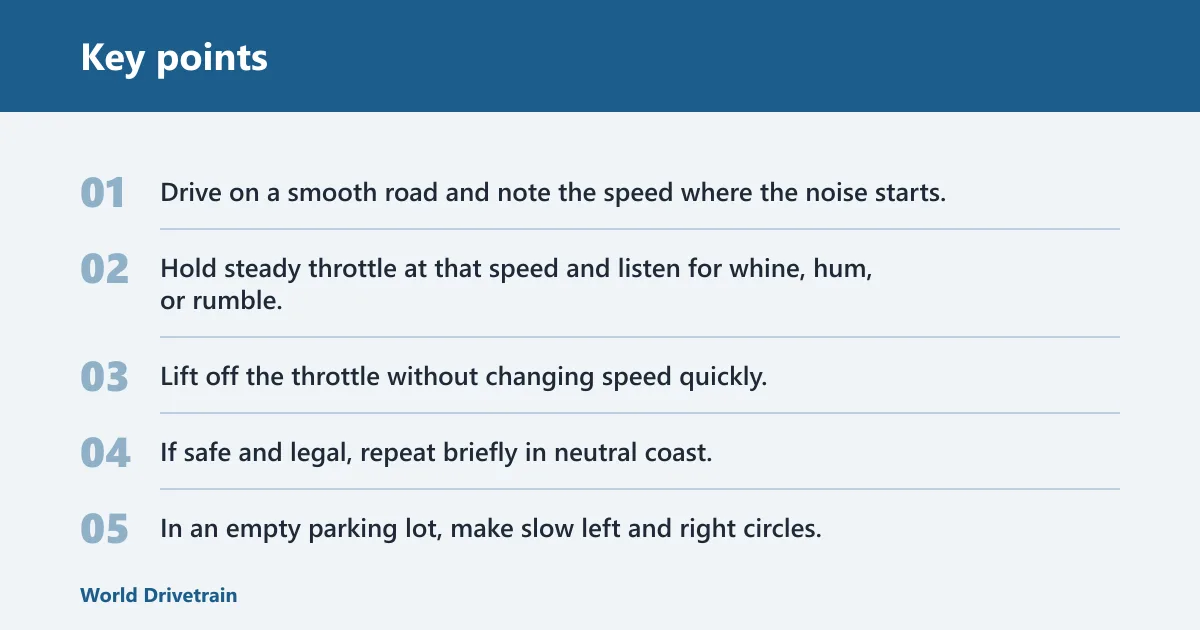
Road-test sequence
- Drive on a smooth road and note the speed where the noise starts.
- Hold steady throttle at that speed and listen for whine, hum, or rumble.
- Lift off the throttle without changing speed quickly. If the sound changes, note whether it gets louder on coast or on drive.
- If safe and legal, repeat briefly in neutral coast. If the noise stays tied to road speed, driveline or wheel-end parts move higher on the list.
- In an empty parking lot, make slow left and right circles. Listen for clicking, snapping, chatter, or side-specific hum.
- Do one gentle lane-change test on a clear road. If the noise changes with side load more than with throttle, suspect wheel bearings or tires.
Leak checks and fluid clues
Check the ground and the housing. Pinion seal leaks usually show near the driveshaft yoke area, while axle seal leaks show near the axle ends or backing plates. Fluid spots under the housing matter because they can move the repair from a seal job to bearing or gear damage once the level falls.
If the fill plug is accessible and the vehicle is safely supported on level ground, inspect the fluid condition. Trouble signs include:
- Low level: leak, neglect, or both.
- Burnt odor: overheated oil and friction damage.
- Dark fluid: oxidized oil and suspended wear debris.
- Metallic glitter: active hard-part wear.
- Heavy paste on the magnet: wear has been building.
- Milky fluid: water contamination.
Stop-driving findings
Stop driving and arrange a tow if the differential grinds, clunks hard, smells hot or burnt, leaks heavily, or shows visible metal in the oil. Approximately 30 percent of rear-axle failures traced to differential noise left unchecked for three months or longer, which is a strong argument against stretching a noisy axle through “one more week.”
How does a shop confirm the source?
A shop confirms differential noise by repeating the road test, isolating the sound on a lift, checking wheel and driveline play, and inspecting the fluid. Chassis ears or a stethoscope help locate the loudest point, while backlash measurement and contact pattern inspection separate bearing noise from rebuild-level gear damage.
Lift inspection and side-to-side comparison
On the lift, a technician checks wheel bearings, axle shaft play, driveshaft joints, and pinion flange movement before opening the housing. Side-to-side comparison matters because wheel bearings and tires often create a stronger difference between left and right than internal differential damage does.
Stethoscope or chassis ears
Electronic chassis ears or a mechanic’s stethoscope can compare noise at the differential housing, axle tubes, knuckles, transfer case, and transmission tail housing. That matters on AWD vehicles, where front differential noise, transfer case noise, and front wheel bearing noise can blend together from the driver’s seat.
Backlash and contact pattern checks
If the housing is opened or the cover comes off, backlash measurement becomes one of the most useful decision points. Normal-looking fluid with acceptable backlash may support a bearing-first repair. Excessive backlash, a poor contact pattern, chipped teeth, or broad pitting moves the job toward ring-and-pinion setup or full rebuild.
Will a fluid change fix differential noise?
A fluid change can help early noise caused by aged, contaminated, or incorrect gear oil, and it can reduce limited-slip chatter when the correct fluid or additive was missing. It will not repair worn bearings, damaged ring-and-pinion teeth, broken spider gears, or lost pinion preload.
When fluid service can help
Fresh gear oil is most likely to help when the noise is mild, recent, and not accompanied by metal, vibration, or a leak-driven low level. It can also help limited-slip units that chatter in tight turns because the friction behavior of the old or incorrect oil has drifted away from what the clutch packs need.
When fluid service is already too late
If the oil smells burnt, carries visible glitter, leaves heavy paste on the magnet, or comes out milky, the fluid is now evidence of internal wear rather than the solution to it. The same goes for a speed-based howl that has grown louder over time. Fresh oil may mask it briefly, but it will not reverse gear or bearing damage.
How much does differential repair usually cost?
Differential repair cost depends more on failure stage than on noise alone. The cheapest tier is fluid service and inspection, then seal repair, then bearing work with setup, and finally gear-set or full rebuild work. For rear differentials, published repair cost commonly falls in the $500 to $2,000 range, with major rebuilds higher.
Cost by repair tier
Fluid service and inspection: this is the lowest-cost tier and the reason early diagnosis matters. It addresses degraded oil, confirms leaks, and may solve limited-slip chatter when the correct fluid was missing.
Seal repair: pinion seal and axle seal jobs stay in the lower-middle tier if the leak is caught before bearings run dry. Once the leak causes heat and metal debris, the bill moves up fast.
Bearing replacement and setup: pinion or carrier bearings raise labor because the axle often needs setup work, preload checks, and in some layouts substantial disassembly. If the gears are still healthy, this can stop the damage chain before a rebuild.
Gear-set, rebuild, or replacement: once backlash, contact pattern, and tooth condition are out of spec, the job becomes parts-heavy and setup-sensitive. That is where the $1,500-$3,500 level from the opening warning becomes realistic, especially for AWD or when the housing has been contaminated by metal.
What changes the final price
Axle type, limited-slip hardware, front versus rear location, parts availability, and labor time drive the number. AWD systems cost more to diagnose because more than one gear case may be involved, and front differential jobs often take longer due to packaging.
Is it safe to keep driving with a noisy differential?
Sometimes, but only in narrow cases. A mild, stable whine with no vibration, no leak, and clean fluid can usually be scheduled for repair, while growing whine, load-sensitive rumble, fresh turning clunks, grinding, burning smell, or metal in oil moves the problem into service-soon or tow-now territory.
Low-risk versus high-risk cases
Low-risk cases are limited to a mild, stable noise with no supporting damage signs. That does not mean ignore it. It means verify the fluid level, plan the inspection, and avoid towing, heavy loads, and long delay.
High-risk cases include any combination of grinding, heavy vibration, burnt smell, severe leak, or visible metal in the oil. Those signs point to active hard-part wear and heat. Continued driving can damage bearings, gear teeth, axle shafts, and in severe cases the housing itself.
How failure usually progresses
The common chain is predictable: fluid drops or degrades, bearings start to wear, the wear creates play, that play shifts gear contact, metal contaminates the oil, and the howl turns into grinding or clunking. By that point the repair is no longer a service item.
A common first-timer mistake is hearing a faint 45 mph whine, finding a damp pinion seal, and deciding to wait until the next oil change. If the leak lowers the gear oil enough, the next symptom may be a coast-side howl and metal on the drain magnet rather than another easy seal appointment.
Frequently asked questions
Can differential noise be confused with wheel bearing noise?
Yes. Wheel bearings are one of the most common lookalikes because they can produce hum, rumble, and vibration at road speed. The best clue is steering input: wheel-bearing noise often changes as weight shifts side to side, while differential noise usually changes more with throttle, coast, or tight-turn load.
What symptoms mean the differential is already badly damaged?
Grinding, harsh clunking, heavy vibration, a hot or burnt smell, severe leaks, and visible metal in the oil all point to advanced damage. A loud clunk while turning combined with a burning smell is a stop-driving condition. At that stage, the next step is usually tow-in diagnosis, not more road testing.
How do I diagnose differential noise at home before a shop visit?
Track whether the sound follows road speed, compare throttle-on versus coast, do a slow parking-lot turn test, and inspect for pinion or axle seal leaks. If accessible, check the gear oil for low level, burnt odor, metallic glitter, heavy paste, or milky contamination. Those clues shape the repair tier.