Why Is My Manual Transmission Grinding After Clutch Replacement?
If your manual grinds after a clutch replacement, the clutch itself is usually not the problem; check hydraulic travel, adjustment, release hardware, then the transmission in that order. Skip that order and the gears can keep dragging, synchros can wear faster, and a simple fix can turn into a transmission rebuild. This guide shows the fastest diagnostic sequence for post-clutch-job grinding.
What the grinding means
Grinding after a clutch job usually points to incomplete clutch release or to a gearbox that already had worn synchronizers. The key is to separate true gear clash from clutch drag. They can feel similar from the driver’s seat, but they do not lead to the same repair.
Clutch drag versus true gear grinding
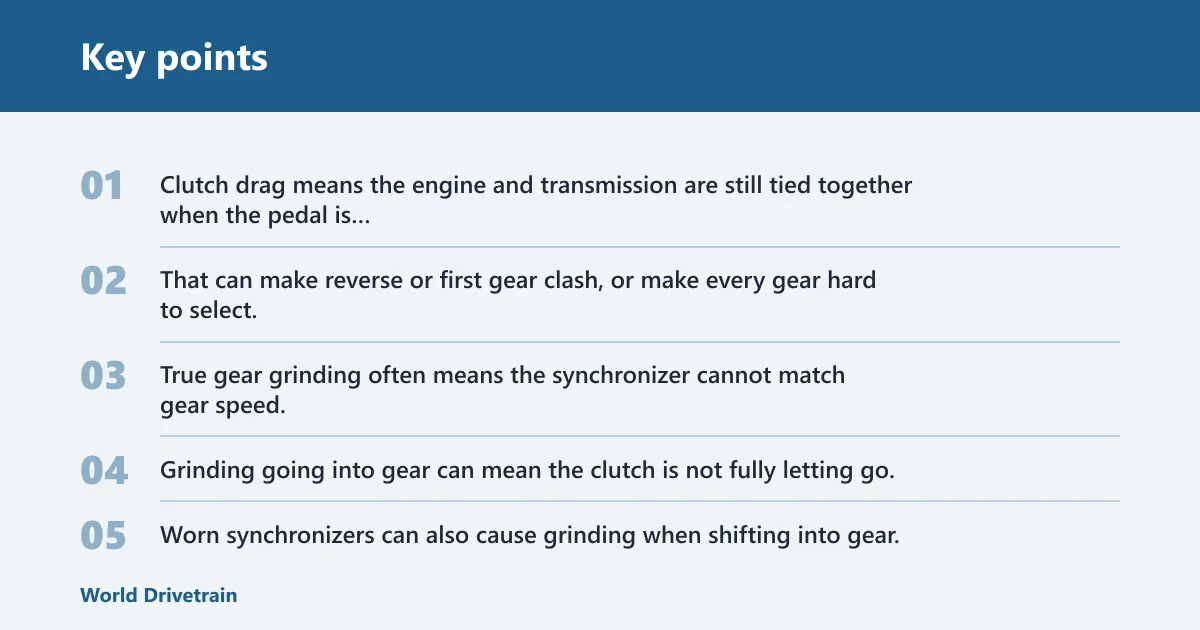
Clutch drag means the engine and transmission are still tied together when the pedal is down. That can make reverse or first gear clash, or make every gear hard to select. True gear grinding often means the synchronizer cannot match gear speed, even though the clutch is releasing enough for basic shifting.
Grinding going into gear can mean the clutch is not fully letting go. Worn synchronizers can also cause grinding when shifting into gear. Both can happen after a clutch replacement, which is why the diagnosis order matters.
When the noise points to the clutch side
If the grind happens in reverse, first gear, or all gears right after the pedal hits the floor, suspect clutch release problems first. A soft or sinking pedal, low fluid, a leak, or short slave travel all fit that pattern. So do misadjusted pedal free play and a hydraulic system that still has air in it.
When the noise points to the gearbox
If the clutch pedal feels normal, the gears are easiest to engage with the engine off, and the grind remains after the system is bled and checked, the gearbox becomes a more likely suspect. Worn synchronizers, a worn shift fork, or another internal fault can survive a clutch replacement and become more obvious once the old clutch drag is gone.
Why is my manual transmission grinding after clutch replacement?
After a clutch replacement, the issue is often outside the new disc itself: air in the hydraulic system, low fluid, a leak, insufficient slave-cylinder travel, incorrect pedal adjustment, linkage problems, or an installation error. A recent clutch job can also expose worn synchronizers that were already near the limit.
Air, leaks, or low fluid in the hydraulic clutch system
The hydraulic clutch system includes the master cylinder and slave cylinder. If fluid is low, air is trapped, or a seal leaks, the pedal may feel soft or sink under pressure. That limits release travel and leaves the clutch dragging.
Start with the reservoir and visible lines. Check for wet fittings, seepage at the master cylinder, and fluid around the slave cylinder boot. If the pedal slowly drops while held down, that is a strong clue that the hydraulic circuit is losing pressure.
Insufficient slave-cylinder travel or pedal adjustment
Even with clean fluid, the slave may not move far enough to fully release the pressure plate. Incorrect pedal free play, a worn master cylinder, or a weak slave cylinder can shorten travel by just enough to cause grinding. That can show up most clearly in reverse or first gear.
Measure pedal feel against the service procedure for the vehicle. The point is not a generic “firm pedal.” The point is whether the release system moves the fork or concentric slave through its full specified range.
Linkage or cable issues that mimic clutch failure
Shift linkage or cable faults can feel like a bad clutch. Worn bushings, a bent selector rod, a loose cable end, or a misadjusted shifter can block a clean gear selection and create a false grinding complaint. Check this branch before assuming the transmission needs internal work.
Suppose reverse grinds and third feels vague, but the clutch pedal and hydraulics check out. A stretched or misadjusted cable may be keeping the lever from reaching the detent cleanly, which can sound like clutch drag even when the clutch is releasing correctly.
Grinding after a clutch job from install errors
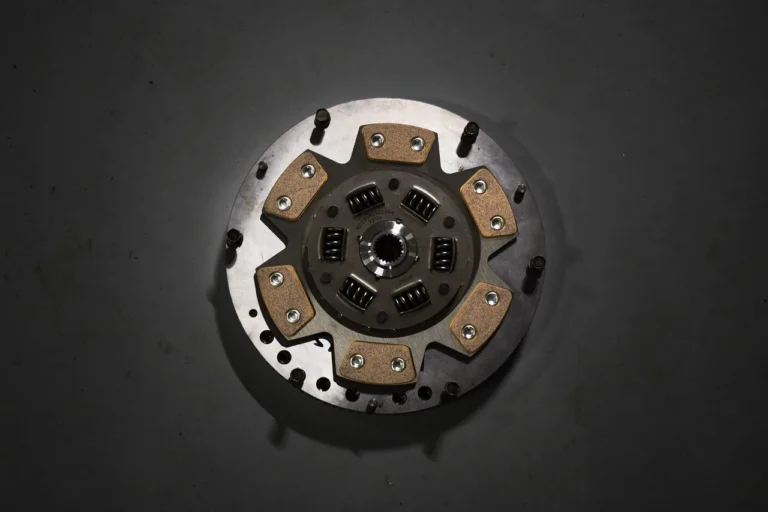
Installation errors can create grinding even when all the new parts are correct. Incorrect disc orientation, missed dowel pins, bent pressure plate fingers, or damage during alignment can leave the clutch from fully releasing. Those faults often show up immediately after the repair.
Incorrect clutch disc orientation
A clutch disc installed backwards can create flywheel-bolt contact. A warped or burnt clutch disc can also make the transmission hard to get in or out of gear. If the problem started right after the job, the installed orientation deserves a hard look.
Missed alignment can damage the disc hub splines after recent clutch replacement. That damage can make the disc hang on the input shaft and keep the clutch from releasing cleanly.
Missed dowel pins or misaligned parts
Missing dowel pins or poor alignment can keep the pressure plate and flywheel from locating properly. That can bend the assembly slightly, create uneven clamp load, and leave the disc dragging when the pedal is down. It is a small assembly fault with a large effect.
If the bellhousing or transmission was forced into place, suspect alignment damage. A clutch that “sort of” works but grinds at low speeds often points to a release problem created during installation rather than a failed new disc.
Bent pressure plate fingers or damaged release bearing
Pressure plate fingers can be worn, broken, too low, or bent. Any of those can prevent full disengagement. The release bearing matters too. A noisy release bearing is associated with a noise that starts when you press the pedal, and a damaged bearing can upset release geometry.
A clutch replacement usually means a new clutch disc, pressure plate and release bearing. If those parts are not seated correctly, or if the fork and bearing stack height is wrong, the pedal may move normally while the clutch still drags.
Flywheel and pilot bearing checks
The flywheel and pilot bearing are part of the diagnosis, not an afterthought. The flywheel surface, step height, and wear state affect how the new clutch clamps and releases. The pilot bearing can freeze and make the input shaft keep spinning, which causes hard shifting after clutch work.
Warped flywheel or poor surface finish
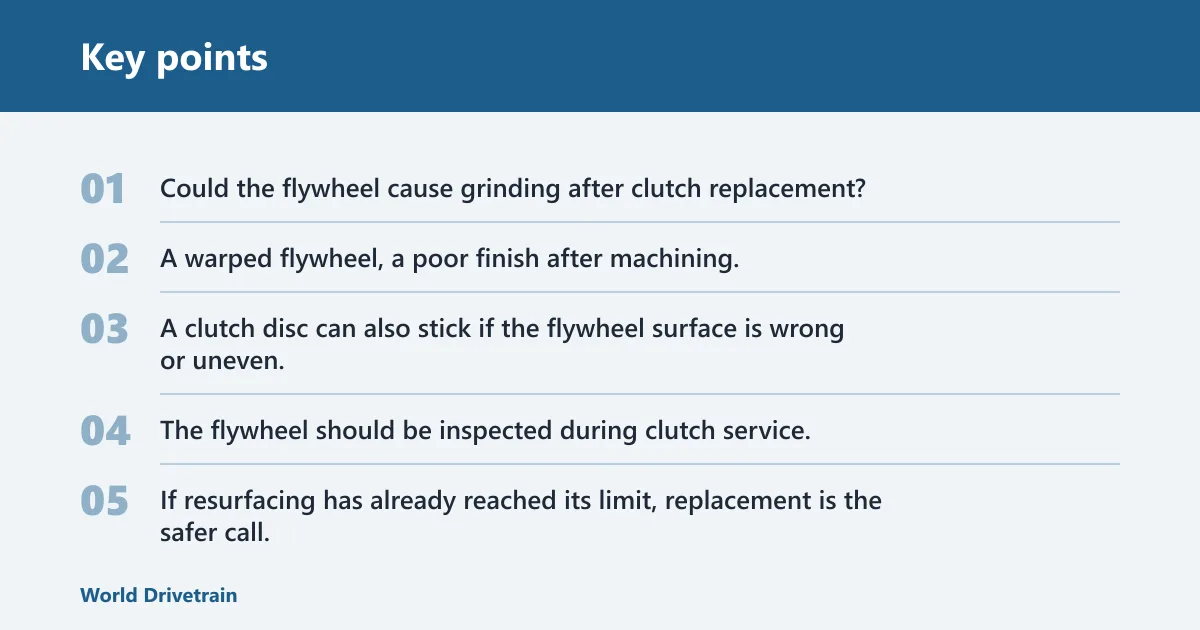
Could the flywheel cause grinding after clutch replacement? Yes. A warped flywheel, a poor finish after machining, or a step-height error can keep the disc from disengaging fully. A clutch disc can also stick if the flywheel surface is wrong or uneven.
The flywheel should be inspected during clutch service. If resurfacing has already reached its limit, replacement is the safer call. Do not assume every flywheel is reusable; heat spots, cracks, or an out-of-spec surface can make a new clutch act old.
Dual-mass flywheel wear and replacement limits
A dual-mass flywheel is normally replaced rather than resurfaced when it is worn. Once the internal damping wears out, machining the face does not fix the movement or the release problem. That is why a clutch can still drag after a new kit if the flywheel assembly is left in service when it should not be.
If the pedal feel changed after the job but the grind remained, the flywheel stack height may be wrong. That small error can leave the release bearing travel short, even though the clutch parts are fresh.
Seized pilot bearing and hard gear selection
A frozen pilot bearing can keep the input shaft turning with the engine, which makes first gear and reverse hard to select. Clutch troubleshooting notes this as a common cause of hard shifting after clutch work. It can look like a release problem because the clutch pedal still feels normal.
Picture a compact car that grinds every time reverse is selected, but only after a full clutch replacement. If the pilot bearing is seized, the input shaft stays loaded and the transmission never quite stops spinning, so reverse clash appears even with a good hydraulic system.
Grinding diagnosis checklist
Use this checklist in order. Start with the easiest checks and move toward the parts that require shop-level access. The goal is to separate hydraulic, linkage, installation, and internal transmission faults without guessing.
| Symptom | Likely cause | Quick test | Next action |
|---|---|---|---|
| Soft or sinking pedal | Air, low fluid, leak, or failing master/slave cylinder | Hold the pedal down and watch for gradual drop; inspect fluid level and leaks | Bleed the system, repair leaks, then retest |
| Grinding in reverse or first gear only | Clutch drag, short slave travel, or pilot bearing issue | Try first gear with engine off; compare with engine running | Check hydraulic travel and pilot bearing before blaming the gearbox |
| Grinding in several gears after a clutch job | Incorrect disc orientation, misalignment, bent pressure plate fingers | Recheck installation notes and release fork movement | Remove transmission for inspection if release travel is correct |
| Noise starts when pedal is pressed | Release bearing problem | Listen with engine idling and pedal travel in neutral | Inspect release bearing and fork contact points |
| Gears grind even after full hydraulic bleed | Warped flywheel or wrong step height | Check service measurements and flywheel condition | Measure, resurface within limits, or replace the flywheel |
| Grinding remains with clutch fully released and linkage verified | Worn synchronizers or internal transmission wear | Road test and compare each gear, especially one or two problem gears | Schedule in-shop transmission diagnosis |
- Check fluid level and visible leaks at the master cylinder, line, and slave cylinder.
- Confirm pedal free play and verify that the release system has full travel.
- Bleed the hydraulic clutch system and retest reverse, first, and the problem gear.
- Inspect the shift linkage or cable for wear, looseness, or misadjustment.
- Review clutch install details: disc orientation, dowel pins, pressure plate condition, and release bearing seating.
- Inspect the flywheel and pilot bearing if the problem persists.
- If the clutch fully releases but one or more gears still grind, test the synchronizers and internal shift parts in the transmission.
What you can check at home
You can inspect fluid level, visible leaks, pedal feel, and shifter adjustment. You can also compare how the car behaves with the engine off versus running. If the shifter moves cleanly with the engine off but grinds with the engine running, the problem is often release-related rather than a selector issue.
What needs a shop-level inspection
Flywheel flatness, step height, pressure plate finger height, disc orientation, and pilot bearing condition usually require removal for a proper check. Internal synchronizer wear also belongs in this category. Do not keep forcing the gear lever if the diagnosis is not clear.
Could the transmission itself be the problem?
Yes. If the clutch releases fully, the hydraulics are correct, the linkage is sound, and the grind remains in one or two gears, the transmission becomes the likely source. Worn synchronizers are the most common internal cause, but shift-fork wear or other internal damage can also be involved.
Worn synchronizers
Why does my manual still grind even though the clutch is new? Because a new clutch does not repair worn synchronizers. Synchronizers match gear speeds before engagement. If they are worn, the transmission can grind even when the clutch is doing its job.
A grind that stays with one gear, especially at a specific shift speed, often points to a synchronizer issue. That pattern matters more than the fact that the clutch is new.
Internal gear or shift-fork wear
If the grind appears in only one gear, or if the lever feels vague in one gate, the internal shift parts deserve attention. A recent clutch job can remove drag that had been masking a gearbox fault, so the transmission may only seem “worse” after the repair.
When a recent clutch job exposed an older fault
F1 notes that grinding can result from clutch-release problems, worn synchronizers, linkage issues or internal components. That means a clutch job can be correct and still leave a pre-existing gearbox fault exposed. The new clutch changed the load path; it did not heal the worn parts inside the transmission.
Should you keep driving?
Stop driving if the grinding is severe, if the car will not go into reverse or first gear without force, if the pedal feels wrong, or if you hear metal noise when you press the clutch. Short diagnostic driving is only reasonable when the grind is mild, intermittent, and the car still shifts without forcing the lever.
Symptoms that mean stop driving
If the car grinds every time you select a gear, sticks in gear, or needs force to enter reverse, do not keep testing it on the road. Repeated grinding can damage synchronizers and may spread debris through the gearbox. A soft pedal with changing engagement height is another reason to stop and inspect.
Symptoms that allow a short diagnostic drive
If the issue is limited to one gear, the pedal feel is stable, and the grind is light rather than violent, a short road test may help separate linkage from internal wear. Keep the drive brief and avoid repeated clutch dumps or high-rpm shifts.
What to tell the shop before a return visit
Report which gear grinds, whether reverse is affected, whether the pedal feels soft or sinks, and whether the problem changes with the engine off. Say whether the issue started immediately after the clutch job. That narrows the diagnosis far faster than a general complaint about “bad shifting.”
Frequently asked questions
Can a new clutch still grind when shifting?
Yes. A new clutch can still grind if air remains in the hydraulics, the slave cylinder does not move far enough, the flywheel surface is wrong, or the pilot bearing is seized. A fresh disc does not fix release geometry or internal gearbox wear.
Is grinding after a clutch job a sign the clutch was installed wrong?
It can be, but not always. Incorrect disc orientation, missed dowel pins, bent pressure plate fingers, or release bearing damage can cause drag right after installation. If the problem started immediately and the hydraulics test normal, installation error moves high on the list.
Could the flywheel cause grinding after clutch replacement?
Yes. A warped flywheel, a poor resurfacing finish, a step-height error, or worn dual-mass flywheel parts can keep the clutch from fully disengaging. A dual-mass flywheel is normally replaced rather than resurfaced when it is worn, so inspection matters before reassembly.
Can hydraulic clutch problems cause grinding after replacement?
Yes. Low fluid, air in the system, leaks, or a weak master or slave cylinder can leave the clutch partly engaged. A soft or sinking pedal is a common clue. If the pedal travel is short, reverse and first gear usually complain first.
Should I keep driving if my car grinds after a clutch job?
Not if the grind is severe, repeatable, or accompanied by a soft pedal, stuck engagement, or metal noise. Those signs can damage synchronizers fast. If the issue is mild, limit driving and get the release system, linkage, and flywheel checked before continuing.