What Happens When a CV Axle Fails While Driving?
A failed CV axle can leave the car shuddering, clicking, or unable to drive without warning; if the shaft separates, the wheel on that side can stop getting power at once. Ignoring it can turn a joint fault into axle damage, wheel-speed sensor trouble, or a tow bill. This guide explains what breaks first, how symptoms map to the failure, and what to do next for FWD, AWD, and RWD layouts.
What a CV axle does
A CV axle sends torque from the transaxle or differential to the wheel hub while the suspension moves and the wheels steer. In many front-wheel-drive and AWD layouts, it is the link that keeps drive power flowing through changing angles without binding. It usually contains an inner CV joint, an outer CV joint, and grease-filled boots that help keep lubricant in and dirt out.
Torque path to the hub
On a driven wheel, the axle splines engage the hub while the inboard end connects to the transaxle or differential. That lets the shaft transmit power even as the wheel rises, falls, and turns. If the axle or joint fails, torque delivery can drop to one wheel or stop entirely on that side.
Inner and outer CV joints
The inner CV joint usually allows plunge, which is the in-and-out movement needed as the suspension travels. The outer joint usually handles the larger steering angle at the knuckle. Failure modes differ: worn joints click, a binding joint resists movement and can shudder, and a separated joint can let the axle lose engagement altogether.
Boots, grease, and contamination control
A CV boot is a rubber or thermoplastic cover that keeps grease inside the joint and road grit outside. A split boot, loose clamp, or grease sling on the inside of the wheel well often comes before joint wear. Once grease leaves and contamination enters, wear speeds up fast.
What happens when a CV axle fails while driving?
Failure usually starts as wear in one joint, then moves to binding, noise, or separation if the axle keeps running under load. At low speed, the first clue may be clicking on turns. At highway speed, the same fault can feel like a hard shudder, a pop, or a sudden loss of drive on the affected side.
Partial joint wear versus joint separation
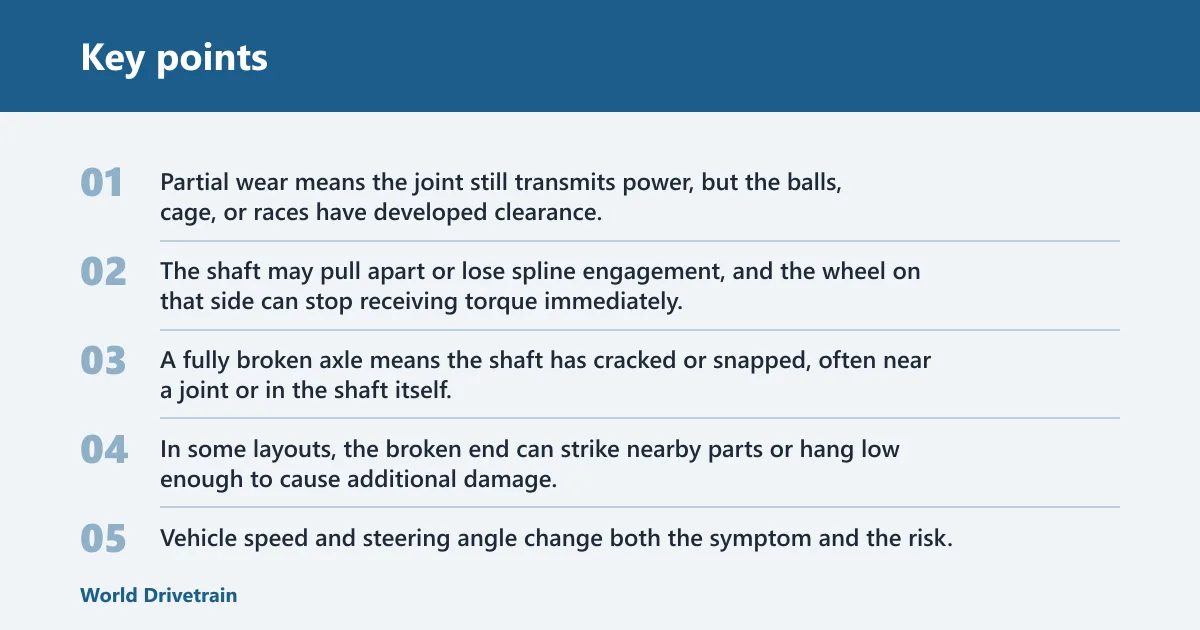
Partial wear means the joint still transmits power, but the balls, cage, or races have developed clearance. That creates clicking, especially while turning under throttle. Joint separation is more severe. The shaft may pull apart or lose spline engagement, and the wheel on that side can stop receiving torque immediately.
Complete axle breakage
A fully broken axle means the shaft has cracked or snapped, often near a joint or in the shaft itself. The vehicle may still roll because the wheel bearings and tires still support it, but the driven wheel on that side no longer gets power. In some layouts, the broken end can strike nearby parts or hang low enough to cause additional damage.
How speed and steering load change the result
Vehicle speed and steering angle change both the symptom and the risk. A worn outer joint often shows itself first in a tight turn at city speed. Under hard acceleration at highway speed, an inner joint may shudder or hop before it fails. A separated axle at speed can feel violent because the load drops off suddenly.
Say your front-wheel-drive car clicks only when you pull away from a parking spot and turn left. That often points to an outer CV joint that is worn but still attached. Say the same car gives one loud pop at 55 mph, then the engine revs rise but the car barely moves. That points much more toward axle separation or a shaft that has broken.
What you may feel and hear
You usually feel the failure before you see it. Clicking on turns points to joint wear. A pop or clunk followed by loss of drive suggests a sudden break or separation. Vibration, shudder, or a wheel wobble can mean the joint or hub connection is loose enough that the axle no longer runs true.
Clicking on turns
Rhythmic clicking that speeds up with wheel speed, especially on full steering lock, is the classic outer joint symptom. It often starts under light throttle and gets louder under load. If the noise only appears while turning one direction, that side’s outer joint is a likely suspect.
Pop, clunk, or sudden loss of drive
A sharp pop can be the sound of a joint letting go or a shaft slipping out of the hub. After that, the engine may rev but the car will not accelerate normally. In a front-driven layout, one side can stop driving while the vehicle still rolls and steers. That is not a safe condition to keep using.
Vibration, shudder, or wheel wobble
Inner joint wear often shows up as a shudder under acceleration, especially at moderate to high speed. A wobble at the wheel can also point to hub play, a loose axle nut, or spline damage. If the wheel appears to move sideways or the steering wheel trembles under load, stop and inspect before continuing.
Drivetrain layout changes the outcome
The same failed axle does not act the same in every vehicle. Front-wheel-drive cars usually lose drive on the affected corner first. AWD vehicles can still move, but torque distribution and traction control may change how the fault feels. Independent rear suspension can also use CV joints in rear drive shafts, so a rear failure may affect propulsion without changing steering.
Front-wheel-drive vehicles
In FWD, the CV axle is a primary drive link from the transaxle to the front wheel hub. If the outer joint fails, you may hear clicking before anything breaks. If the shaft separates, the car may still steer and roll, but that front wheel no longer receives drive power. A damaged axle stub can also stress the hub and bearing.
AWD vehicles
In AWD, a failed axle may cause one wheel to lose drive while the rest of the system still tries to move the car. Some vehicles will shift torque to the other axle, while others will set warnings or limit power. If an axle stub is damaged or removed improperly, fluid can leak from the front differential or transaxle.
Independent rear suspension layouts
Some independent rear setups use CV half-shafts at the rear. A rear failure may not affect steering, which can make the car feel normal until acceleration or hill climbing reveals the problem. The car may still roll and steer, but it can lose rear drive power, make noise, and load the rear hub assembly abnormally.
Axle failure decision table
This table maps the symptom pattern to the most likely failed part and the safest next action. When the symptom includes wobble, binding, or loss of drive, the safest choice is usually to stop and arrange a tow rather than test the car further.
| Symptom pattern | Likely component | Safe to continue? | Immediate action |
|---|---|---|---|
| Clicking only on turns | Outer CV joint wear | No, if the noise is repeatable and getting louder | Inspect soon and replace the axle assembly or joint immediately if the noise is severe |
| Loud pop, then loss of drive | Axle separation or complete shaft break | No | Stop in a safe spot and tow the vehicle |
| Vibration under acceleration | Inner CV joint wear, axle imbalance, or loose axle nut | Not recommended | Stop and inspect for play, torn boot, and hub movement before driving again |
| Wheel wobble or visible play | Axle splines, hub, wheel bearing, or loose axle nut | No | Tow or flatbed the vehicle and inspect the hub and bearing immediately |
| Grease loss only, no noise yet | Split CV boot or leaking clamp | Only for a short, low-risk move to a repair site | Replace the boot or axle soon and inspect for contamination |
Can you keep driving after the failure?
Sometimes the car will still move, roll, or even steer after a CV axle failure, but that does not make it safe to keep driving. If the axle is clicking only, the risk is future breakage. If there is shudder, clunking, or visible wobble, the fault has likely moved beyond early wear. The safer choice is to stop and choose tow, inspect, or replace right away based on the symptom pattern.
-
Pull to a safe shoulder. Use the nearest safe spot, straighten the wheels, and avoid sharp throttle inputs. If the car is still moving, reduce speed smoothly so a damaged axle or hub does not bind or separate further.
-
Check for obvious damage. Look for a torn boot, grease sling around the inside of the wheel, a hanging shaft, or a wheel that sits at an odd angle. A wet, greasy inner wheel well often points to a failed boot that has already started joint wear.
-
Test for play only at rest. With the car safely parked, look for wheel movement, clunks, or looseness at the hub area. If the wheel wobbles by hand or the axle nut looks loose, do not drive it farther.
-
Choose tow or repair. Loss of drive, wobble, or binding calls for a tow or flatbed. Clicking without separation usually means the axle should be replaced soon, but it is still a repair item, not a long-term driving condition.
What if the car “still drives”? It may only be moving because one axle side is no longer carrying load, while the other side or the remaining drivetrain keeps the vehicle moving. That can hide the real fault until the broken side damages the hub, splines, or brake hardware. Do not use continued motion as proof that the axle is fine.
What gets damaged besides the axle?
A failed axle can damage more than the shaft itself. The hub, wheel bearing, axle splines, and nearby brake parts can all take load when the joint wobbles or separates. In some FWD and AWD setups, fluid can also escape from the transaxle or front differential if the axle stub is pulled out or broken badly enough.
Wheel hub and wheel bearing
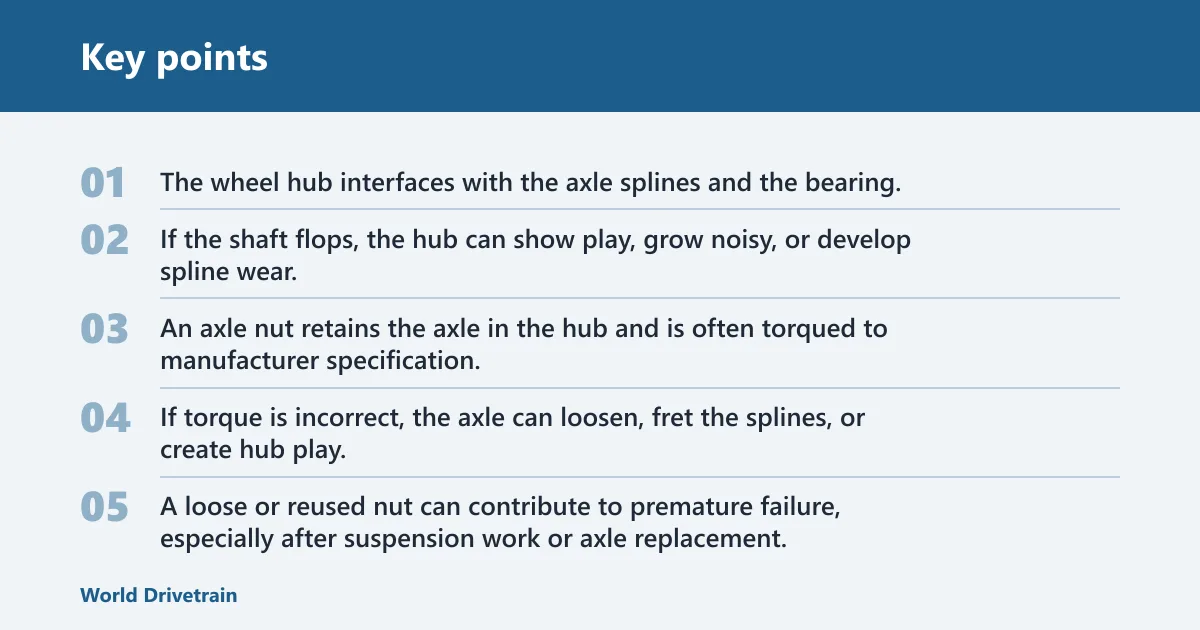
The wheel hub interfaces with the axle splines and the bearing. If the shaft flops, the hub can show play, grow noisy, or develop spline wear. A failed axle that is allowed to wobble may also overload the wheel bearing, which adds noise and can turn a simple axle job into a larger repair.
Axle splines and axle nut torque
An axle nut retains the axle in the hub and is often torqued to manufacturer specification. If torque is incorrect, the axle can loosen, fret the splines, or create hub play. A loose or reused nut can contribute to premature failure, especially after suspension work or axle replacement.
Fluid loss from the front differential or transaxle
In FWD and many AWD systems, the inner axle end seals the transaxle or front differential opening. If the axle stub is removed the wrong way, or if a break damages the seal area, fluid may leak out. That can add transmission or differential damage to the original axle failure.
Nearby brake parts
When a shaft separates or flails, it can strike the splash shield, rotor shield, or sensor wiring nearby. A wheel-speed sensor fault can show up after the mechanical failure, which can confuse diagnosis if the original axle damage is not found first. Inspect the entire corner, not only the shaft.
What happens when a CV joint fails while driving?
When a CV joint fails while driving, the first effect is usually noise or vibration, then loss of smooth torque transfer if the wear gets worse. An outer joint often announces itself on turns with clicking. An inner joint more often shudders under acceleration. If the joint separates, the axle can stop driving that wheel at once.
What happens when a CV axle breaks while driving?
When a CV axle breaks while driving, the broken side usually loses drive immediately. The car may still roll and, in front-wheel-drive layouts, still steer, but the engine power no longer reaches that wheel. A broken shaft can also damage the hub, bearing, or nearby components if it flails or drops out of position.
What happens if you drive with a bad CV axle?
Driving with a bad CV axle usually turns a repairable wear problem into a larger failure. Noise often gets louder, the joint can bind, and the shaft can separate or snap. Continued driving also increases the chance of hub wear, spline damage, fluid loss, and a roadside stop that should have been avoidable.
Frequently asked questions
What happens if a front axle breaks while driving?
In a front-wheel-drive or front-axle-driven vehicle, a broken front axle can leave one front wheel without power while steering remains possible. The car may lurch, shudder, or simply stop accelerating. If the shaft is separated or the hub is loose, continuing to drive can damage the bearing and brake area.
What happens if a CV axle breaks while you are driving?
If a CV axle breaks while you are driving, the most common result is sudden loss of drive on that corner and a sharp change in how the car feels under throttle. The vehicle may still roll, but a broken or hanging shaft can damage nearby parts. Stop safely and arrange a tow or flatbed.